“…denying its existence isn’t helping anybody.” A review of “What Made Maddy Run: The Secret Struggles and Tragic Death of an All-American Teen”

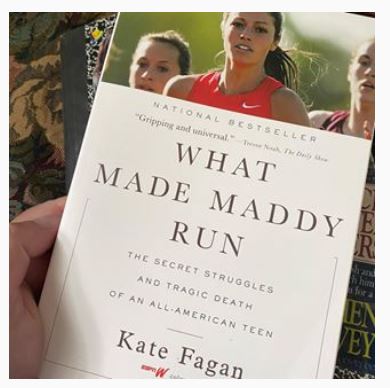
One of the best things I did for myself this year was sign up for the Book Love Summer Book Club to benefit the Book Love Foundation. I enjoyed each of the texts selected for us this year, but the one I just finished – Kate Fagan’s What Made Maddy Run: The Secret Stuggles and Tragic Death of an All-American Teen – is perhaps the one that I enjoyed the most.

But how can one enjoy a book about the suicide of a young person? Well, no… it is not the subject matter that was enjoyable. Not at all. The subject itself is heartbreaking.

It’s Fagan’s manner in telling Maddy’s story that was most profound to me.

In the book’s Foreword, ESPN The Magazine Editor in Chief Alison Overholt wrote, “Great narrative journalism has long been about helping us to understand universal truths of the world by grounding big ideas in the stories of real people.”

The depression that had a stranglehold on college Freshman Maddy Holleran, the stranglehold that eventually led her tragic death, is a subject of universal truth that clearly needs to be addressed quite a bit more.

I reveal no spoilers when I tell you that Maddy Holleran ended her life in 2014 by taking a running leap from the top of a parking structure in downtown Philadelphia.

This event is not the focal point of the story. Instead, Fagan endeavored to examine what could have caused Maddy to make this choice. This final, irreversible choice.

I am not a mental health professional, but I know enough about suicide to understand that it doesn’t exist in a vacuum. The problem is that nobody wants to talk about suicide, and nobody wants to talk about suicide in the presence of kids. It’s almost as if mentioning the word or bringing up the topic in class dissolves some invisible protective barrier surrounding young adults that keeps them safe from suicidal ideations.

So in not discussing suicide, we often too ignore what leads to it: unrelenting personal pressure, anxiety, depression. While all of us battle these demons to one extent or another, there are so many people out there, kids out there, that succumb to the demons.

I must acknowledge my own discomfort in speaking frankly about suicide with students, and I would be hesitant to make What Made Maddy Run available to students without some kind of trigger warning or disclaimer, despite the fact that I loathe the idea of both, because I cannot guarantee that a particular student wouldn’t read a book about suicide and romanticize it.

That was not Fagan’s intention, and she says to herself. I think her approach was meant to give thoughtful readers a wide berth into examination of our own thoughts on anxiety, depression, happiness, and hopelessness. We get a window into Fagan’s thoughts through occasional deviations from Maddy’s story to present first-person narrative from her own experience. These are relevant inclusions and written from a place of empathy given Fagan’s background as a college athlete who also suffered bouts of anxiety and depression.

In fact, the complete story is an interweaving of Fagan’s access to primary source documents from the Holleran family, her own personal narrative, and various third-party interviews. Fagan interviewed those who knew and loved Maddy as well as others who, from their own experience, could offer either anecdotal or expert insight to illuminate Maddy’s mindset. This approach gives the reader a panoramic view of the tragedy through multiple perspectives. We are able to read Maddy’s text conversations with friends, narratives for school assignments, and personal letters to her track coach. We are able to get perspectives on Maddy from her parents, her friends, her friends’ parents, and her coaches. We get Fagan’s perspective, and we get perspectives from Fagan’s carefully-selected interviewees.

The phrase posted in the title of this entry comes later in the book, in a chapter titled, “The Rules of Suicide.” Here Fagan interviews Dese’Rae Stage, suicide survivor-turned-activist whose work aims to humanize survivors and bring light to the need for thoughtful and frank conversation on the topic of suicide. It was she that said, “…denying its existence isn’t helping anybody,” pointing out that we need to be able to talk about suicide in a safe way.

Stage adds, “I would like to imagine that the silence, or the inability to talk about it in healthy ways, directly relates to more suicides. “

One of the more interesting discussions in our Book Club chats centers with bringing Maddy’s story to the classroom. Can we do it? Should we do it? That’s tricky.

I recall a school psychologist I worked with, since retired, who had no problem projecting her frustration upon me when topics such as date rape, assault and suicide came up in English class. She said that such discussions drove fragile students into a state of panic, overflowing her office with urgency.

“You need to stop teaching Speak,” She would often say, adding that I had no idea how traumatizing the story was to kids who were themselves victims of sexual assault.

I see the point. I see it clearly. As a caring educator, the last thing in the world I would ever want to do is bring pain to a student.

But a teaching colleague also made a good point; “Isn’t that what discussion of these texts is supposed to do? Help us find the kids who need help so we can get them that help?”

So what do we do in the best interest of kids? I don’t have an answer, but I know this: Reading and discussing Speak in class is not going to bring an end to sexual assault, but neither is not reading and discussing Speak. Some students, whose own life experience is painful, will be reminded of that fact. Other students may develop an awareness of how sexual assault does long-term harm to a victim. Hopefully this awareness leads to empathy. Hopefully that empathy leads to a lifetime of “doing the right thing.”

How to introduce this text to students is a question I would like to explore with my colleagues: school psychologists, social workers, administrators, teachers, and coaches.

In the meantime, I do think the following people should read What Made Maddy Run:

  1. Secondary educators, especially those who are coaches. In another post, I plan to delve more deeply into the book as read from my own background as a student athlete, a coach, and now an official. Doing that here would have made this post long and unbearable.
  • Parents of teenagers or pre-teens, especially those who are parents of student athletes. I will argue that Maddy’s parents did everything they could to support their daughter and get her the help she needed. Though I’m sure they live with the regret and guilt that naturally comes with losing a child to suicide, they didn’t do anything wrong. The pressure Maddy faced was self-imposed. They recognized that, and they did the best they could to help her.
  • Those who lost someone they love to suicide. I lost a good friend from college, who took her own life at the age of 28. This came as a shock to all who loved her, as she always exuded (what seemed to be) pure happiness and contentment with the world.  I, too, felt a whole ton of guilt after it happened, trying to go backwards and search for any signs I might have missed that she was in trouble, any cries for help. Reading Maddy’s story helped me to understand that sometimes there are no signs, and we need to make peace with that. Before Kate Fagan came along to write this book, Madison Holleran was the author of her own life story. She published it on social media for the world to read. She sent it with her text messages. Everything that was plaguing her so deeply was internal, with only those closest to her knowing that she had some challenges, and with nobody knowing how extensive those challenges really were.

Can a book make you uncomfortable and still be enjoyable at the same time? Yes. It was wholly because of Kate Fagan’s thoughtful, respectful and skillful execution.
A Requiem for August

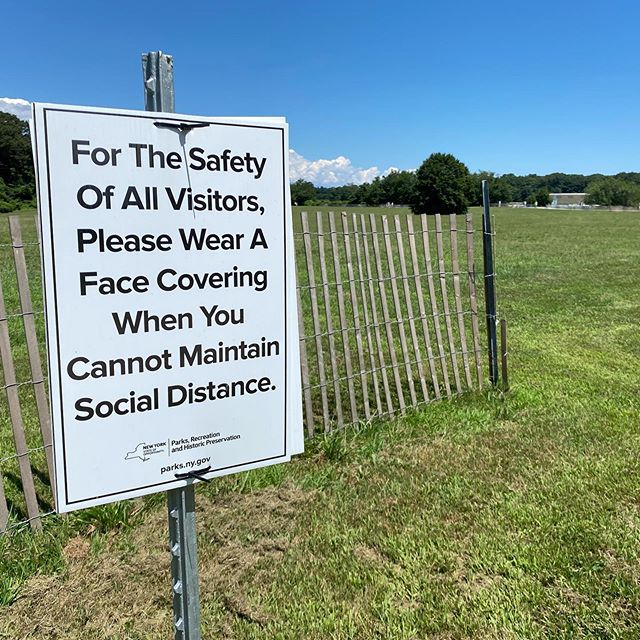
A sign posted in Camusett State Park in Lloyd Harbor, NY
A sign posted at Caumsett State Park in Lloyd Harbor, NY.

August was always a good month.

In my childhood, I’d anxiously await the second Saturday and our three-hour drive to the Pocono Mountains. Families bound together by friendships our parents forged when we kids were young spent a week there together every year. There was something peaceful in the mountain air, the smell of the dirt path walking back to our cabins at night, and the cacophony of crickets by starlight that always, always gave me a sense of peace.

The end of that trip meant it was time to start thinking about going back to school. This never haunted me, neither as a little kid nor as a teenager, and certainly not as a college student. It also never haunted me as an adult. I always looked forward to the first day of school, as a student, as a teacher, and now as an administrator. The new school year, to me, always felt like a fresh start, a new beginning.

As an adult, August was typically the month when I had the most time to spare. My busy Julys had me running around, first with cheerleading camps, and later with summer school and conferences. I would always look forward to August because, despite having to keep an eye on my thinning checking account, I would always try to plan a few weekends away here and there. And the beach…. Oh, the beach! I would go early in the morning to beat the traffic, armed only with my sunscreen and a good book. Later in the day I might enjoy a couchnap in the central air, and maybe, just maybe, I had something else to look forward to that evening…. an outdoor concert, a street festival, dinner and drinks with friends, a date with my boyfriend, now my fiancé. To me, the arrival of August always conjured up feelings of rejuvenation and joy.

Until this year.

The feeling I have now is three parts stress and one part dread. This salty, unsatisfying cocktail has me deeply unsettled, especially in a month when I don’t typically have much else to occupy my brain.

This August there are no concerts, no street festivals, no dinners with friends, and certainly no beach days. I know that at least two of these things can be accomplished with careful social distancing measures in place, but I’m not keen on putting my health and safety in the hands of others. Especially when so many out there refuse to wear masks or still think that all of this is a hoax.

I am looking forward to the new school year with none of the excitement I had in years past, but instead with a fearful kind of hope that we can actually do this and keep everyone safe at the same time. Regardless of what version of “back to school” Governor Cuomo permits, I’m going to put on my big girl shoes and deal. I will do everything in my power to keep myself safe and hope that if I do end up catching COVID-19 at some point that my weakened immune system will be able to handle it. Because, quite frankly, what alternative do I have? What alternative to any of us have?

Yesterday school districts all over Long Island released their three-pronged reopening plans to the public as they were likewise sent to the State for approval. It didn’t take long for the Facebook moms’ groups to light up with critics comparing and contrasting their districts’ plans to others. Though I don’t have school-age children, I watched the posts and comments populate in the three community groups I’m in. In one thread there are groups furious that the “hybrid” plan limits virtual instruction on “off” days to an hour of synchronous videos per week. On another thread there are desperate single parents looking for childcare so they can go back to work. In yet another there are some demanding property tax refunds because schools, “won’t be educating my kids this year after all.” Some are contemplating homeschooling, some are calling for the governor to be drawn and quartered, and others don’t understand what the big fuss is about because, “this is just like the flu.”

In a handful of comments, you have teachers speaking to their own mix of stress and dread as they face going back to school, only to be berated by an oppositionist camp of essential workers who “never stopped working” since the pandemic started. Nobody wins this argument.

My parents now live in central Florida, and I hate the fact that I haven’t seen them since February and that I don’t quite know when I will see them next. Every time I speak to my father on the telephone, our discussion inevitably turns to how we’re both managing this crisis. He said something to me last weekend that struck a nerve. He said, “Your generation doesn’t know what it feels like to be prepared to die, and that’s why you’re all so afraid.”

The statement kind of shocked me at first, but he explained further in a way that made perfect sense (like he always does). The men of my generation volunteered to go to war, they were not forcibly drafted. The women (or men) of my generation who wait on their military and/or first responder spouses to come home safely do so squarely in the reality that their spouse’s career path was a choice. In my father’s case, a football injury and the shattered ankle that followed kept him far away from Vietnam, but he had many friends who were drafted and fought. Not all of them returned. It was a horrible reality, but it was indeed reality – especially for those who didn’t have the money or means to dodge the draft. How many generations before them were sent to war knowing there was a solid chance they would not come back alive? It was true for my grandfather as well, who was fortunate to live long enough to see his honorable discharge and take home his Purple Heart.

Fear is not a stupid emotion. Fear is what keeps people from doing stupid things to put themselves in danger. The fear that I feel – that many of us feel – is valid, but something I can no longer rely on to keep myself safe.

So this August will be spent trying to relax and decompress as much as possible, far away from the beach and with lots of meals at home. And while it will not include many of the fun things of Augusts’ past, I will at least have time and energy to throw myself into the task of figuring out not just how I can keep myself safe in the fall, but how I can be the best and most solid resource for the teachers and kids who I work for. I’m reading a lot… some books for pleasure, but lots of research articles and professional texts, too. Since April I’ve been doing everything I can to learn about best practices in virtual instruction, and this effort will now ramp up in August.

I will continue to sew masks, and I will continue to hope that one of my weekly 7am visits to the grocery store will eventually yield me a tube of Clorox wipes.

I will try to make peace with the reality that I or my fiancé might catch COVID-19. If this happens, I will try to make peace with the fact that either of us could suffer from long term consequences of the illness, or we could even die.

I will make an appointment with my attorney to update my will, just in case.

I don’t mean to be grim. And I apologize deeply to anyone who made it this far and feels worse for it.

But this is August, now.

Stretching Creativity & Professional Growth with Notebooks

I’m one who “learns by doing,” so in order to experiment with designing an asynchronous professional development experience, I created this video series on how educators can enhance their professional practice through keeping a reading & writing notebook. This video series is free for you to use or share with the caveat that I’m a beginner at this! I do share my contact information in the introductory video below and invite you to reach out to me to share your feedback on this work. As well, it’s important to mention that this work was not created in a vacuum! Much of what I’ve done with notebooking is inspired by educational leaders and colleages. I worked to carefully cite my sources, and links to the various resources I mention in these videos are provided for you to explore.

Video 1: Introduction

This video series is designed to show educators how to turn an inexpensive composition notebook and package of color pencils or pens into a powerful learning tool. While some of the work within may be ideally suited for teachers of English, language arts, reading and literature, I argue that it’s not ONLY those teachers who should be readers, writers, thinkers and doers! (Length 2:51)

Video 2: What and Why?

What is the purpose of keeping a Notebook? Why should you do it? An overview of the work that brings us here today (Length 5:02)

Video 3: Setting Up Your Notebook

In this video I share my template for Notebook organization, which I find to be well suited for reading, writing, thinking and doing (Length: 7:01)

You can begin setting up your Notebook as you watch the video, but I would suggest downloading and printing my template pages first.

To learn more about the concept of Ugly First Drafts, check out this article.

Video 4: Quickwrites

In this video, I’ll walk you through an exercise I learned from Linda Rief, who I consider to be an authority on Notebook-keeping! By the time you’re finished you will have 3-4 peices in the Ugly First Drafts section of your notebook (Length: 25:08)

Here are a few additional resources on Quickwrites that you might want to explore in a little more depth:

Introducing a New Feature: Mentor Texts by Katherine Schulten for The New York Times. September 4, 2019

The Quickwrite Handbook: 100 Mentor Texts to Jumpstart Your Students’ Thinking and Writing (2018) by Linda Rief

Listen to a Podcast about Quickwrites. This podcast, hosted by Heinemann and recorded in 2018, features a conversation on Quickwrites with Linda Rief and Penny Kittle.

Video 5: Beautiful Words

This is another Notebook activity inspired by the work of Penny Kittle, author of the bestselling professional text, Book Love. For this activity you will need your color pencils and/or gel pens and a book you’re currently reading for pleasure (Length 3:56)

You can purchase your own copy of Book Love here, and I encourage you to check out Penny’s website or follow her on Twitter, where she shares many of her materials on this kind of Notebook work.

In case you’re interested, the sample of my own work comes from my reading of Robert Caro’s The Power Broker.

Video 6: Textual Lineage

This activity was inspired by my recent reading of Gholdy Muhammad’s professional text Cultivating Genius, which presents a four-layered Historically Responsive Literacy Framework that establishes learning goals that are inclusive of the needs of students of color, who she argues have been marginalized by traditional learning standards. This video is not a review of the book, but instead presents an activty that challenges educators to focus on how their personal identity is reflected in their instructional approaches. This could be a useful first step in identifying personal goals that lead to developing antiracist instructional practice (Length 8:51)

I reference this article from ASCD in the video: How to be an Antiracist Educator by Dena Simmons (2019).

Another great resource is to read Rudine Sims Bishop’s 1990 essay Mirrors, Windows and Sliding Glass Doors and watch the related video interview here.

Here’s the link to “The danger of a single story”, an excellent TED talk that relates to the work described in the video.

Video 7: What’s Next?

Now that you’re on your way to developing your Notebook, where will you go from here? This video will challenge you to think about how you can use your Notebook to stretch your creativity and professional growth.

Summer Book Club: Cultivating Genius

Reflections from Chapter 1: Drawing from History to Reimagine Literacy Education

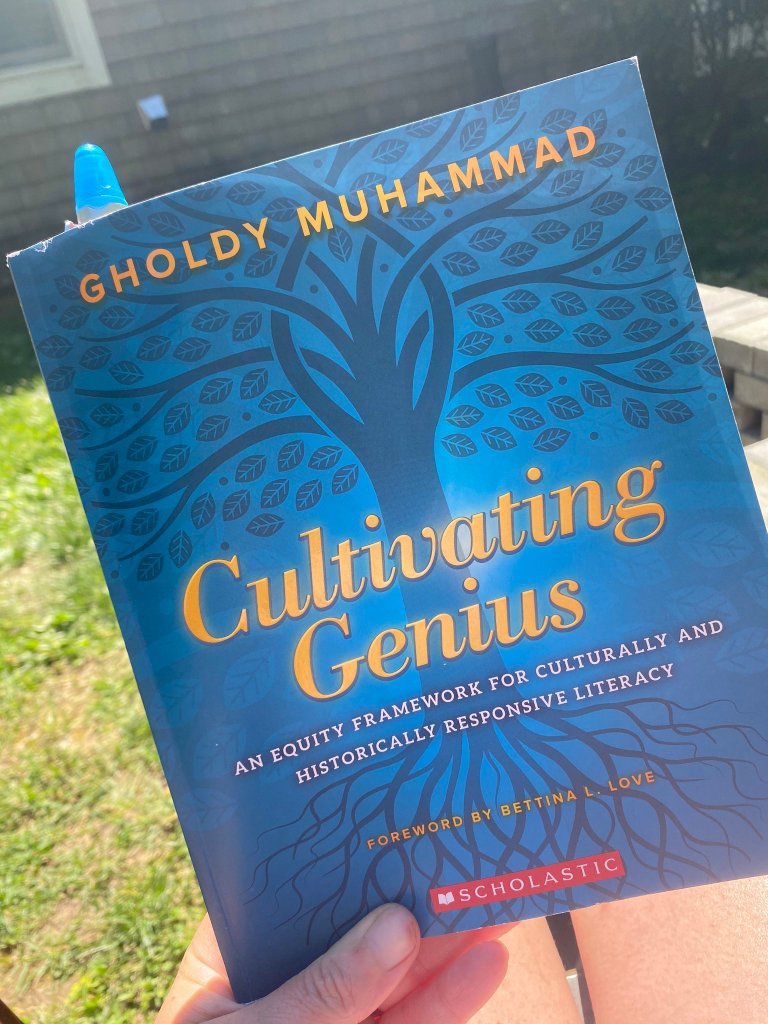
I joined the Book Love Foundation’s Summer Book Club this year. Selections for middle school and high school include this professional text: Cultivating Genius: An equity framework for culturally and historically responsive literacy by Gholdy Muhammad, a Georgia State education professor who founded Atlanta-based Black Girls Write! Perhaps because of its’ soaring popularity among educators after being featured in the Book Club, or perhaps because its subject matter is ever more timely due to current events, the book is presently sold out on Scholastic’s website.

About halfway through the first chapter, I realized how far out of my element I was. Here I am, a white educator who has worked in predominately white settings, reading a chapter in a professional text about Black Excellence. I was ignorant to this phrase prior to reading the book, and I imagine that’s not uncommon among my peers. I imagine that part of Dr. Muhammad’s purpose in writing the text is to educate the educators about what we’re misunderstanding about that buzzworthy phrase – “culturally-responsive pedagogy” – commonly referenced in educhatter and on job interviews.

There’s a tone-deafnessness there that we can’t always help. Case in point… the stay-at-home orders in New York State have given me some more time to go down that Twitter rabbit hole. A few days ago, I noticed that a former colleague had entered into a BLM/education argument by expressing the need to continue teaching To Kill a Mockingbird to 9th graders because the book provides opportunities to discuss the grim realities of racism.

I did not engage in this discussion. Instead, I took a trip back in time to the Tyrolia Literacy Institute that I was super-fortunate to attend last summer. There, as I read, wrote and thought among a truly diverse group of educators, I had that great opportunity to step out of my Long Island upper-middle class and predominantly white “bubble” and discourse with educators from all parts of the country. I helped me to understand things from different perspectives.

One night we had a spirited, but respectful debate about the merits of teaching TKAM over dinner and drinks. I think it was then that I finally began to understand the argument for letting it go.

I won’t go into details, as there are others making the argument much more eloquently than I.

But here’s the thing…

White educators, despite the best of our intentions, will never have a chance to understand a black teenager’s lived experience because we cannot, as Atticus Finch said, “climb into his skin and walk around in it.” But if we can break down the barriers of what we think we know and have known for years, we can begin to imagine what it must be like for a black student to continually read texts in English class where black children and adults are called words that we don’t utter in civilized company. Those characters are slaves, or freed slaves, or bound by the restrictions of Jim Crow. They are criminal or they are poor. They are disrespected and set up for a lifetime of poverty and heartache. We see it in To Kill a Mockingbird and Huck Finn and Of Mice and Men and The Help and Native Son. I can go on… By continually holding onto these texts because we think they teach important lessons about racism, we neglect the reality that there are kids in this world who already know lots about racism because they live within it every single day of their lives.

I met Chad Everett at Tyrolia. I’ve come to respect him and his work tremendously. I felt challenged by him, in a good way. It was he who pointed out that it’s time for me to “get uncomfortable” and “do the work.” A few months later I had an opportunity to meet and chat with Brendan Kiely at the NYSEC Annual Conference in Albany. He explained what it meant for a white educator to be actively antiracist. I am beginning to understand what that means now, and it is through the lens of the best kind of discomfort that I will read and attempt to learn from Dr. Muhammad’s book this summer. Hopefully this is a small piece of the “work” that needs to be done.

Because I think that’s what white upper-middle class educators like me need to do. We need to accept the fact that what we think we know and have known for years is not good enough anymore.

I’m going to keep much of my reflections on this book in a writers’ notebook – as there are some passages that I want to write beside and not necessarily for an audience. But I need to say that, even before getting through the first quarter of the book, I think it’s a worthwhile read for educators. English teachers? Yes. School leaders? Yes. Those who think they know what “culturally-relevant pedagogy” is?

YES.

Welcome to my Master Class on “Surviving 2020.” Now Here’s Your List of Required Reading, Watching & Writing (Part 1)

INTRODUCTION AND COURSE SYLLABUS

Oh. My. Goodness.

What a year we’re having, amiright? Forget the fact that we’re in the midst of an unprecedented three-month social and economic lockdown caused by a global pandemic… we’re told to anticipate an active hurricane season and something called murder hornets, the simmering unrest fueled by decades of racial tensions is back up to a boiling point, and what promises to be yet another volatile presidential election is banging at the door.

All joking and metaphors aside (as if any of these are cause for humor), now is the time for Americans to be smarter. About, well… everything.

How do we educate ourselves? We read. We watch. We write. Such activities lead to THINKING… and we need that more than ever in order to survive 2020.

What follows below is not by any means an exhaustive list, nor is it meant to be in the first part of this “course.” [Aside – I don’t have all day to write this post, so I’ll come back and add to it later]. What I would REALLY love to do; however, is create a space for individuals to discourse about these topics through the context of our learning. Hmmm…

Before we get there, here’s what you need to know to be successful in this course.

LIST OF REQUIRED MATERIALS

In order to come to class prepared and ready to work each day, you need the following materials:

  1. A library card
  2. A Netflix subscription
  3. A black composition notebook (old school) or a blog (new school)
  4. An open mind and a willingness to learn

TOPIC 1: A REVIEW OF EVERYTHING YOU WERE PROBABLY SUPPOSED TO LEARN IN HIGH SCHOOL

Watch The Monsters are Due on Maple Street

The Twilight Zone series is presently available on Netflix, but you can probably catch this uncut episode on YouTube

If your recollection of the term irony stems from the Alanis Morisette CD you listened to on repeat as a teenager, we need to do some work.

As you watch, ask yourself these questions and journal about them in your notebook or blog: 1) What is the driving force behind the characters’ actions? 2) Who is to be blamed for the story’s outcome?

Read The Lord of the Flies by William Golding

Get it at your local library or purchase a copy of your own.

The Quirks of English: The Lord of the Flies : the beast within ...

What happens when a gaggle fine upstanding white boys are left stranded on a deserted island with no adult supervision? Sounds like an adventure, huh?

And – NO. You’re not allowed to read the Cliff’s Notes for any of this. Our soundbyte-loving society is in dire need of complete and thorough (unfiltered) information to process and analyze on our own terms, not through the lens of someone else’s agenda or expertise. What does that mean?

(Hint: If you participate in this master class, you’ll be able to answer that for yourself.)

After you finish the book, use space in your notebook/blog to write (or sketch) about your views on the inherent nature of man. Are we predisposed to do good? Or are we predisposed to do evil?

For extra credit (or perhaps just to get some assistance to answer the questions above), you may want to look into these philosophers to see what they have to say about the nature of man: Jean Jacques Rousseau, Thomas Hobbes, and Maximilien Robespierre.

Read 1984 by George Orwell.

Get it at your local library or purchase a copy here.

The best George Orwell quotes

If you’re familiar with the book and know it well, I think you will agree that this is one of the most scary-poignant novels in the high school canon. Unfortunately the deeper implications of the text are often missed on high schoolers whose parents may have deliberately shielded them from the ways of the world. Even if you feel like you know it fairly well, it’s worth another read through the lens of your life experience.

I suggest you do some work in your notebook at various intervals during and after your reading. You’re probably going to have some, uh, stuff to journal about…

Watch History 101 Episode 3: “The Rise of China.”

U.S. to Expel Chinese Graduate Students With Ties to China's ...

Learn more about this new docuseries in this blog post. You can find it on Netflix.

If the last time you read or watched anything about China was in your 10th grade Global History class, it’s time for a refresher. This one will take less than 25 minutes.

After you watch – spend some time in your notebook answering this question: What’s the big deal about China?

PREVIEWING TOPIC 2:

Once you’ve established a baseline through reading, watching and writing about the selected works above, we’ll be ready to delve deeper into some analysis of modern topics. I’ll give you some time to get started before I release all of that on you just yet.

The CDC Released Guidelines for Opening Schools, and I Have So Many Questions…

Educators and parents have been wondering for weeks what is going to happen with schools in September.

Two days ago, NPR reported that the CDC released guidelines on how to manage this, stating that schools should not reopen “unless they are able to implement coronavirus screening protocols, evaluating employees and children daily for symptoms and potential past exposures to COVID-19.”

I downloaded the document pertaining to schools and read through it carefully. Not only am I concerned about September, but I’m thinking about what needs to be done in order to run a safe summer school program for students who need additional support moving from one grade to the next.

For starters…

Compliance with state and local mandates aside, in order to reopen, schools must be able to guarantee that protective measures will be in place to protect vulnerable populations. This includes (but is not limited to) students and staff members who have compromised immune systems for a variety of reasons, students and staff members who are asthmatic, and staff members over the age of 65.

I clicked through several of the hyperlinks in the hopes that something would portal me into a world of more complete information. Unfortunately what I’m finding is vague, at best.

Take this, for instance, which I found on one of the pages explaining the needs of those who are considered vulnerable for whatever reason:

Without a “specific treatment for or vaccine to prevent COVID-19.  The best way [for vulnerable populations] to prevent illness is to avoid being exposed to this virus.” So what steps must a school put in place to “protect” them? What are some examples?

I have so many questions.

Before I go deeper down the rabbit hole, let me say first that I’m also looking at this through the lens of someone who works in secondary schools. There are a number of challenges for all grade levels, but systems and structures for secondary schools involve their own set of logistical complexities.

For example, in schools that utilize an 8 or 9 period day, students switch classes up to nine times. That’s nine different groups of students and adults that they come into contact with on any given day, and up to nine different seats that students occupy, and up to nine different surfaces that they touch.

Movement in and out of classrooms is one challenge. But what happens upon arrival, which is where schools must be prepared to “screen students and employees upon arrival for symptoms and history of exposure”?

Let’s say a typical middle school on Long Island houses approximately one thousand students. Even if schools are able to put social distancing measures in place and reduce that number by half on any given day, that’s still five hundred students in addition to scores of staff coming into the building at around the same time.

One or two school nurses are going to screen all individuals? How?

And should not these screening measures be put in place before students step onto a school bus? Would then every bus need to include a matron who is qualified to conduct these screenings?

Wherever it is to be conducted, how effective is the screening itself?

I’ve seen news reports about how some employers and even airlines are using temperature checks as one measure for symptom-screening. But it’s a questionable strategy insofar as accuracy and effectiveness, especially when anywhere from an estimated 1 – 17% of individuals testing positive for COVID-19 do not have a fever.

In the last week, Governor Cuomo and both county supervisors on Long Island have been cautioning the public about a frightening new development in our understanding of how COVID-19 affects children. Can these symptoms be checked at the door?

What if we were to go so far as to administer actual COVID-19 tests to all once or twice a week (let’s put aside questions about logistics and consent for a moment)? Are the tests even accurate enough to provide responsible indicators?

How many individuals will walk into a building with no symptoms whatsoever and contribute to a spread the virus under the radar?

So what do we do “out of an abundance of caution” (remember that phrase from March)? Do we create a classroom environment where individuals can maintain 6 feet distance from one another at all times? Ok – maybe we can do that in the classrooms with placement of furniture and by limiting the number of students in the room at one time. But what about entering and leaving the building? The queue for symptom checks? Hallways? Lockers? Lunch rooms?

Limitations in word choice

As I unpack the second and third columns of the flowchart, my eyes gravitate to these words:

Promote healthy hygiene practices…

Encourage social distancing… Encourage anyone who is sick to stay home.

Intensify cleaning, disinfecting, and ventilation…

Forgive me, but the English teacher in me understands the inherent limitations in these words. To “promote” means to support or to actively encourage. It does not mean “to ensure compliance.” The word “encourage” is also a little fluffy. I can “encourage” lots of things all day long. It does not mean “to ensure compliance.”

“Intensify” simply means to do more, but to do more than what has been done before? And is simply doing more doing best?

In sum…

As far as I can tell, there are thirteen total performance indicators that schools must meet to reopen. As noted above, the performance indicators and the language within them do not offer a complete picture of what the “performance” should actually entail.

Perhaps I’m failing to acknowledge the inherent need to keep this all a little vague because schools across the nation are diverse and have divergent needs. Perhaps a clear one-size-fits-all set of specific guidelines will not work.

If that is the case, who then is to interpret these performance indicators and make them applicable to the needs of local schools and school districts?

And what if our knowledge of this virus, on how it spreads and on how it affects children differently, changes before September?

Like I said, I have so many questions…

Things I Learned in School Just By Being There

My parents sent me to a K-12 parochial school. Class sizes were small. In fact, I traversed through each grade with a cohort of about twenty-two. Our school was so small that we had the same English teacher from sixth to eighth grade. Let’s call him Mr. Dooley.

My class loved Mr. Dooley, a jolly Irish man with pale skin and red hair. He was a Coast Guard veteran who left us briefly during the Gulf War because he was called to active duty. He was our collective favorite teacher and an all-around good person,

But that didn’t stop us from torturing the poor guy. He had a bit of temper. When he got angry, Mr. Dooley’s face would slowly redden from the neck up. Sometimes he would yell. Then, like the flip of a switch, steam would come out of his ears and he would lose it.

We knew how to push his buttons.

Someone in class would get it started by doing some knucklehead middle school thing, and then others would jump on the bandwagon.

The red-faced yelling was a source of amusement on its own, but what Mr. Dooley typically did that was truly memorable was, in the height of his anger, kick the aluminium trashcan text to his desk. This always made a loud crashing sound and sent wads of paper flying across the room.

By the time my cohort was set to leave the eighth grade, Mr. Dooley’s trashcan had more dents than a car in a crash-up derby.

(Exhale, readers. It was the early 90’s.)

Good, bad, or otherwise… my classmates and I learned much through these interactions. For one, we learned that actions in general have consequences. We learned which of our behaviors would lead to the trashcan-kicking response. We learned who among us emerged as leaders in executing these behaviors, and who among us were content in acting as bystanders. We also learned how to read, to the degree of redness in Mr. Dooley’s face and the size of the trashcan dent to follow, when we went too far with our shenanigans.

And maybe we learned a little English and language arts, too.

There’s been some talk lately, typically in the form in the posing of rhetorical questions, about whether or not brick-and-mortar schooling is functionally obsolete.

The topic has been explored in news reports, op-ed pieces, and educator blogs. Even New York State Governor Andrew Cuomo has weighed-in on the matter.

“The old model of everybody goes and sits in the classroom, and the teacher is in front of that classroom and teaches that class, and you do that all across the city, all across the state, all these buildings, all these physical classrooms — why, with all the technology you have?” Cuomo said in one of his recent daily news briefings on the COVID-19 pandemic.

This news sent many into somewhat of a tailspin and for a lot of different reasons. On one side, there’s an equity problem. On another side, there’s a question about child care. On yet another side, there are many of us wondering what school would look like for generations of kids who never had an opportunity to enjoy physical face-to-face interaction with their teachers and peers and navigate the social complexities of a classroom.

Or watch their eighth grade English teacher wind up and kick a garbage can in a fit of rage.

And that interaction is not just for the sake of enjoyment, it’s for the sake of learning as well.

I am an only child. Perhaps my parents were not the kind of parents who were up on “best practices on parenting” young children in the early 80s. While I had plenty of childrens’ books and toys to keep me busy, our sources of family entertainment weren’t exactly kid-friendly. I went to my pre-Kindergarten psychological evaluation discussing what was happening this week on Dallas. True story.

My mother laughs when she recounts the details of that meeting. She says that the psychologist, with equal parts amusement and concern, informed her that I was four going on thirty-four.

“You really need to socialize her immediately,” my parents were told.

So off to day care I went – even though my parents were not in need of child care between my mother’s part-time work schedule and the willingness of my grandparents to take me off their hands when needed.

It wasn’t because I needed to develop my vocabulary. On the contrary – that was quite good for a child my age. Maybe too good.

What was lacking was the learning I missed from interacting with my peers. That is, lessons related to reading and responding to social feedback, learning to share and make compromises, problem solving, reading body language, and cooperating with others in real time.

I also learned how to be a kid. I learned which sugary cereals were tasty, what the Fraggles were and why I should care, and why She-Ra was a badass lady. I moved beyond my limited childhood experience of Grape Nuts, prime-time soaps, and Nana.

Now I ask, can any of these lessons be learned in a virtual teaching environment? Maybe – but not likely in the same way.

With all due respect to parents who decided, for whatever reason, to homeschool their children – there are lessons about socialization likely to be missed in the absence of regular peer interaction inside of a classroom.

I get that children who are predominately educated in the home still have opportunities to socialize through various play groups and organized activities such as dance classes, scouting groups, and team sports. But what will happen to those if brick and mortar schools were to close, buildings were to be razed, and land to be repurposed into strip malls, Amazon Prime warehouses or cookie-cutter housing developments? Where would that dance recital be held? Where would the girl scouts meet? On whose field would pee wee football play?

Further- homeschooling is a choice made by parents who weigh the pros and cons of their decision and take steps to ensure that their children are not educated in isolation. When what was once a choice becomes the norm for all, we have the potential to run into problems.

I try to imagine how I would behave as a student living in these times if remote learning was my only option. Would I have the chance to experience the humiliation of committing a social faux pas and the opportunity to learn from it? Would I be able to read my teacher’s body language in a Zoom meeting and know when my behavior is moving from borderline to risky? Would I miss out on learning about great music, fashion trends and fun sports if I didn’t have friends or those influential peers to respect or wish to emulate?

I’m not sure… but I do know that I would not be the same person that I am today if I hadn’t experienced Mr. Dooley’s occasional red-faced trashcan-kicking.

And that can’t be replicated in a Zoom meeting.

A Metaphor for Leadership in Times of Crisis

I am one of approximately 3 million people in America living with Crohn’s Disease.

After years of skating by with mostly good health, my system started to flare up again in early 2011.

At the time, my gastroenterologist had tried several rounds of tests and medications only to find that nothing was working to combat the inflammation.

The news came in a follow-up appointment after I was sent to the emergency room because a routine colonoscopy went sideways. “I will continue to treat you locally,” he said to me, “but I need guidance from someone who has experience working with more complex cases like yours.”

He then referred me to a colleague affiliated with Mount Sinai hospital in New York.

To make a long story short, I saw his colleague in the city. I needed surgery. I was told after the fact that the inflammation in a large section of my small intestine was so bad that I was perhaps months away from a far more scary health situation.

Flash forward to the present day… I am much better now. Since my surgery in 2012, the medications that had originally done nothing seem to be working. I am still being treated by my local gastroenterologist who frequently consults with my doctor in the city any time he has a question regarding my care.

I will never leave him.

The truth is that I have a tremendous amount of respect for what he did. He knew his limitations, and in his focus on doing what was best for me, his patient, he referred me to a colleague who he knew could do better.

Had he led with his pride rather than what was best for me overall, it’s quite possible that my story would have a different outcome.

I often tell this story when speaking of those qualities of leadership that I think are most important. One is our ability to recognize our shortcomings and ask for help.

How many leaders have I worked with… how many leaders have YOU worked with… would just assume sweep their shortcomings under the rug and move forward pretending that they didn’t exist?

But I think the real point of this metaphor is to illustrate the power of collaboration.

We are now moving into week nine of remote instruction here in New York State. As time passes, I’m learning that school districts all over Long Island have had vastly different approaches in navigating the shift from brick-and-mortar instruction to working in an online environment. Suffice it to say, some are doing as well as can be expected, some are doing more, and some are doing less.

What is needed, more than ever, is collaboration. At all levels. Especially in the glaring absence of straightforward guidance from central powers such as the State Education Department.

I often hear Governor Cuomo referencing that many decisions about remote instruction are to be left with the local school districts. Ironically, this is the same governor who pointed out shortcomings in leadership coming from the federal government and worked to form a coalition of northeast governors to make somewhat of a shared decision-making team for our states.

There is an opportunity, at every level, to do better through collaboration. And I think that there is a huge missed opportunity on the part of the State Education Department and even, to an extent, our local BOCES, to make opportunities for collaboration much easier through the power of leadership and organization. Perhaps that’s a topic for another blog post.

In this moment, wherever we all are in the pecking order of the educational system, we need to find that important quality of leadership within ourselves. We all need to acknowledge our shortcomings and identify those people who we know can do better, and we need to reach out to those people and ask for help.

Teachers should not be working in isolation trying to figure out how to use a technological tool they’ve never seen before. Curriculum leaders should not miss out on opportunities to reach out to colleagues in other areas for frank discussion about successes and shortcomings of our practice. A central administrator shouldn’t exist as an island, but instead consult with a wide range of stakeholders to establish a three hundred and sixty degree view of what is, what should be, and what could be.

Now more than ever, it’s important for all of us to look for and to acknowledge our shortcomings and ask for help.

Today, May 11th, we should all be acutely aware that there is a very real chance that school will not be able to open “business as usual” in September. This realization should serve as a call to action for all of us working in brick-and-mortar schools: What are we doing TODAY that will prepare ourselves for whatever happens then? With whom will we collaborate to make the best decisions?

Teacher leaders – What will you do today to improve your craft should you need to teach online in September? Who will you ask for help?

Department leaders – What will you do today to ensure that the teachers with whom you work have the professional development and resources that they need to do this effectively? Who will you ask for help?

Building and District leaders – What will you do today to improve equity among the families in your district to ensure all have the ability to connect and engage in a virtual classroom environment? Who will you ask for help?

Parent leaders – What will you do today to prepare your children for success in this model moving forward? Who will you ask for help?

My hometown gastroenterolgist is a great guy. He’s treated me well for ten years and counting. I will stay with him until he decides to retire.

Why? Not because he’s the best at everything on his own, but because he is better through collaboration with others in his field.

“Inconsistent Effort and/or Performance”

The title of this blog is a canned progress report/report card comment that I’ve used more frequently than I’d like to admit.

I doubt any educator needs an explanation, as I’m sure most school districts have some iteration that captures the same idea. The truth is that some of our most capable students can be guilty of doing lackluster work at times.

Take, for instance, the fact that I haven’t updated this blog since April.

I feel guilty about this… what kind of self-proclaimed “writer” ignores a recently-started blog project for almost three months? 

But I guess I should give myself a break. These last few months have been incredibly busy, not just in my graduate studies, but in work and home life as well. We all know what the last days of school bring, so I won’t bore you with the details there… While I did have about a week and a half to myself between the last days of school and starting summer school, there’s was still plenty to be done. I’m in the process of trying to get a significant construction project off the ground at home. While “that old house charm” is certainly a perk of living in a house built in the early 1900s, a huge drawback is that the original garage (which was built in 1928), is, as they say, “past its useful life.” While trying to construct a bigger and better garage on the other side of my property, I’m running into those typical fill-in-the-blank roadblocks homeowners face when doing construction.

Ok, enough with the excuses!

The summer semester has come and (almost) gone. This one was particularly rough because it involved a STATISTICS course. I should point out that I couldn’t pass Syracuse University’s watered-down version of Probability and Statistics for Dummies (not actual course title, but it might as well have been) as an undergrad back in 1998, so this class was especially challenging.

Today was our final exam. I think I rocked it. I guess I’ll find out soon enough…

The mental anguish that came from four hours of Stats each Saturday morning left me weaker than usual for my afternoon class, which is a bummer because it involved deeply creative and philosophical discussions and projects. My kind of jam. Unfortunately I came into class like a marathon runner who hit a wall way too early. I probably exhibited much too much “inconsistent performance.”

But here’s the great part: I’m FREE for the rest of the summer!!!

Well, sorta… I still have some projects to finish for that second class and three more weeks of summer school. But I can at least sleep in on Saturdays for the rest of the season!

Are you still reading? If so, everything thus far is a preface to my very simple point:

I will be returning my energy to this blog in the coming weeks. 

Thanks again for joining me on this journey!

IMG_0909
Check out Portia (and the other formerly-homeless pets that live in my house) on Instagram: @lifewithportia


Preparing Students to be “College and Career Ready” : Where are we lacking?

It was more than twenty years ago, but remember my first year of college like it was yesterday. In August of 1997, my parents drove our navy blue Chevy Tahoe five hours north on I-81 to Syracuse University and dropped me and countless boxes of my belongings into an “open double” in Day Hall.

Three weeks later, I was already “in the thick” of my first semester, which was primarily filled with prerequisite courses needed for my liberal arts core: Biology, Psychology, Probability & Statistics among them. Each of these classes met in large lecture halls about the size of my high school auditorium.

Dr. Druger was my biology professor. I remember him as a great guy… passionate. He required each of his freshmen to meet him in pairs or groups of three for lunch at a dining hall of our choice. This was his way of connecting with each one of us personally, and he was the only professor I had who did this. Most other 100 and 200-level courses were taught by professors who probably couldn’t pick me out in a lineup, and I don’t recall their names.

Probability and Statistics. Ugh. Let’s just say that I ended up dropping this course, but the truth was that, past midterms, I could barely maintain a D plus. Math was ALWAYS my struggle in high school, but at least in high school I had the benefit of caring teachers who were looking out for me. My Stats lecture probably had 80 kids in it, and while I remember going to weekly recitation (led by graduate assistant in the math department), I don’t remember a thing about it. The sad part was that I knew I was lost, and I also felt helpless as to what to do about it. Luckily my faculty advisor found me a data analysis class that satisfied my math requirement, otherwise I would have been in real trouble.

College and Career Readiness for Success (CCRS)

This phrase was a mere sentiment in the mid-90s, and to credit my parents, they did what they could to adequately prepare me for college, but not all families can (or do). In fact, many of my high school friends did not complete their four-year degrees as planned. Some even dropped out after their freshman year.

What happened? We all went to the same high school and took the same classes. Why were some of us able to function in college while others did not?

I’ll come back to that…

Somewhere in the mid 2010s, the U.S. Department of Education published this document that articulated a growing problem: too many of this generation of college students are forced to take remedial classes because they haven’t mastered the academic skills needed for college coursework. At the same time, employers across the nation began to grouse about ill-prepared candidate pools, which can be used in defense of outsourcing. The CCRS “movement” gained momentum along with the Common Core State Standards, which were fashioned as academic learning standards that would ensure that all students would be equally prepared to face the rigors of college and beyond.

I’m going to temporarily ignore the “career” part of this phrase and instead focus solely on college readiness. As secondary educators, we can ensure that our grade level curricula teaches the necessary prerequisite skills so that students do not need to waste their first semesters of post-secondary education taking non-credit remedial courses. We can work with our students to teach them the academic norms related to critical reading, annotating a text, submitting a properly-formatted research paper. We can predict their academic success based on their performance on standardized exams, and if they perform poorly, we can implement interventions.

But what are we doing to help students attain the non-academic soft skills they need for college?

One of the better explanations of what it means to be “college and career ready”, in my opinion, comes from Dr. David T Conley, a professor of the University of Oregon who led the Educational Policy Improvement Center (EPIC), which is now called Inflexion. In a presentation created for Edweek, Conley advocated for a more whole-student approach to CCRS. This includes the notion that students must “take ownership of their learning and become proficient with a range of learning strategies.”

In my own experience as an undergraduate, graduate, and now a post-graduate student, I can attest that college professors do not always take attendance (if at all). They do not march up and down classroom rows to check if students have done the previous night’s homework. They do not call home to tell mom and dad that a struggling student should seek extra help. Rarely in experience have I had a professor give me timely (and useful) feedback on my writing assignments. College students really do NEED to “take ownership of their learning,” as Conley says.

Through the lens of my own experience, I came up with three nouns that can either be innate personality characters or acquired behaviors: Gumption, Prioritization and Focus.

Gumption. I could have used some of this is Probability and Statistics. I was hopelessly lost and too intimidated to raise my hand to ask for clarification in such a large class. My attendance started to wane, and I feel even further behind.  I simply gave up.

What can we do, as educators, to teach students how to advocate for themselves when they feel lost? What can we do to ensure that they WANT to advocate for themselves rather than to simply give up, as I did?

Prioritization. I fell into the rabbit hole of my freshman year. I made a ton of new friends, I joined the marching band, and I participated in Greek life. It was “very difficult to find the time to study” when there was so much else going on. Band practices were from 6-8pm 3x a week, and more often than not my friends and I followed with some sort of social activity such as dinner on M Street, or simply “hanging out” at someone’s off-campus apartment. When was I going to study or do homework? Sadly, many of my class assignments were done in the late-night hours, and my sleep suffered. I’m certain I handed in many assignments that didn’t represent anything close to my best work. Though I “effortlessly” excelled in English classes, I got by in college with a lot of “fake reading.”

What can we do to help students value their education enough to put schoolwork ahead of social distractions? How do we help students develop time management skills for out-of-class work in an era where the value of homework is being questioned in elementary and secondary settings? 

Focus. Let’s be honest, we administors cringe when we observe teacher-focused, teacher-directed lessons that involve little or no student-to-student interaction. We WANT to see the teacher stepping aside to allow students to direct their learning. The old “chalk-and-talk” model of class lecture is outdated; instead, students should be working primarily in groups, right? Many of our classrooms have been re-worked to eliminate the front-facing rows in favor of desks arranged in collaborative-clusters of four. Many of us who are financially capable of doing so have adopted a flexible-seating policy where students can opt to enjoy class from a comfy bean-bag chair or a stool behind a high-top table. Many of us work hard to discourage districations by having students drop their cell phones into a numbered cubby upon entering a classroom. I myself used to take my students’ phones away when I caught them texting in class and wrap them with paper and masking tape, a practice that never got me into trouble (but certainly could have).

I wish there was a way that high school administrators and teachers could relive college as a freshman, just for one week. How many classes are held in large lecture halls with 100+ students listening to a sage-on-the-stage talking through PowerPoint presentation? How many professors may be brilliant minds in their fields but poor teachers? How many freshman classes follow the accepted structural pattern of a lesson with a clearly definable Anticipatory Set, Direct Instruction, Guided Practice, Independent Practice, and Summary/Closure? How many professors use classroom management techniques to ensure that students are attentive and participatory? How many professors ask students to check their cell phone use in class?

I don’t think I need to ask any more rhetorical questions on this one. The subtext should speak for itself.

Please don’t misunderstand me; my intention is not to be critical of our practices as secondary educators. My criticism, instead, is in the concept of College and Career Readiness and its buzzworthy omnipresence that focuses so much on academic learning standards and assessments.

The beauty of public education in New York State (and throughout most of the nation) is that educators value good teaching practices and professional development. While many college professors may be brilliant minds in their  respective fields (as evidenced by terminal degrees, accolades, research grants and publications), how many are able to teach in the manner that today’s students are accustomed to learning?

To circle back to a question I posed earlier: If we examine a pool of students who have similar family backgrounds, similar socio-economic prowess and the same educational experiences, how can we predict who will compete four year degree and who will not?

Obviously there is no simple answer to this question, and as my St. John’s professor Dr. Rich Bernato would say, “There’s a dissertation in that.”

But I honestly think it has to do with those personal characteristics and associated behaviors. Perhaps this is why Carol Dweck’s Mindset became such a popular read around the same time that CCRS and CCSS shifted into gear.

Still, while CCRS is a well-intentioned initiative, there may be an imbalance between the focus academic skills over the development of soft skills for universal success. Educators (and parents) may need to do more to help students become persistent go-getters who can thrive in any academic setting.