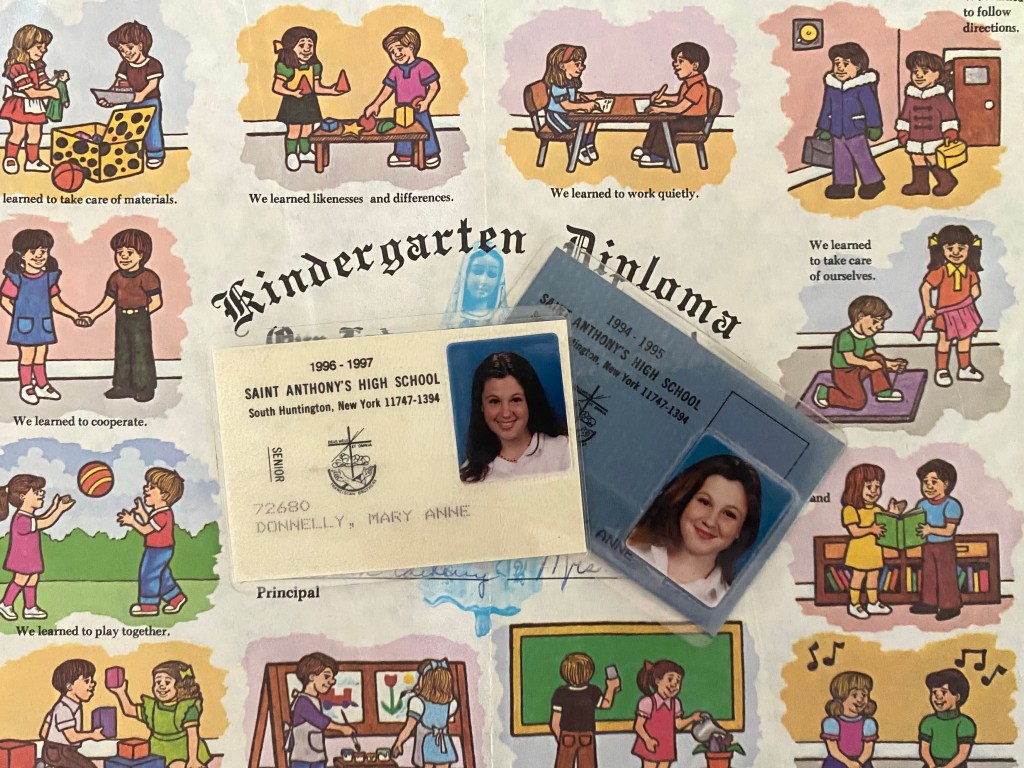
My parents sent me to a K-12 parochial school. Class sizes were small. In fact, I traversed through each grade with a cohort of about twenty-two. Our school was so small that we had the same English teacher from sixth to eighth grade. Let’s call him Mr. Dooley.
My class loved Mr. Dooley, a jolly Irish man with pale skin and red hair. He was a Coast Guard veteran who left us briefly during the Gulf War because he was called to active duty. He was our collective favorite teacher and an all-around good person,
But that didn’t stop us from torturing the poor guy. He had a bit of temper. When he got angry, Mr. Dooley’s face would slowly redden from the neck up. Sometimes he would yell. Then, like the flip of a switch, steam would come out of his ears and he would lose it.
We knew how to push his buttons.
Someone in class would get it started by doing some knucklehead middle school thing, and then others would jump on the bandwagon.
The red-faced yelling was a source of amusement on its own, but what Mr. Dooley typically did that was truly memorable was, in the height of his anger, kick the aluminium trashcan text to his desk. This always made a loud crashing sound and sent wads of paper flying across the room.
By the time my cohort was set to leave the eighth grade, Mr. Dooley’s trashcan had more dents than a car in a crash-up derby.
(Exhale, readers. It was the early 90’s.)
Good, bad, or otherwise… my classmates and I learned much through these interactions. For one, we learned that actions in general have consequences. We learned which of our behaviors would lead to the trashcan-kicking response. We learned who among us emerged as leaders in executing these behaviors, and who among us were content in acting as bystanders. We also learned how to read, to the degree of redness in Mr. Dooley’s face and the size of the trashcan dent to follow, when we went too far with our shenanigans.
And maybe we learned a little English and language arts, too.
There’s been some talk lately, typically in the form in the posing of rhetorical questions, about whether or not brick-and-mortar schooling is functionally obsolete.
The topic has been explored in news reports, op-ed pieces, and educator blogs. Even New York State Governor Andrew Cuomo has weighed-in on the matter.
“The old model of everybody goes and sits in the classroom, and the teacher is in front of that classroom and teaches that class, and you do that all across the city, all across the state, all these buildings, all these physical classrooms — why, with all the technology you have?” Cuomo said in one of his recent daily news briefings on the COVID-19 pandemic.
This news sent many into somewhat of a tailspin and for a lot of different reasons. On one side, there’s an equity problem. On another side, there’s a question about child care. On yet another side, there are many of us wondering what school would look like for generations of kids who never had an opportunity to enjoy physical face-to-face interaction with their teachers and peers and navigate the social complexities of a classroom.
Or watch their eighth grade English teacher wind up and kick a garbage can in a fit of rage.
And that interaction is not just for the sake of enjoyment, it’s for the sake of learning as well.
I am an only child. Perhaps my parents were not the kind of parents who were up on “best practices on parenting” young children in the early 80s. While I had plenty of childrens’ books and toys to keep me busy, our sources of family entertainment weren’t exactly kid-friendly. I went to my pre-Kindergarten psychological evaluation discussing what was happening this week on Dallas. True story.
My mother laughs when she recounts the details of that meeting. She says that the psychologist, with equal parts amusement and concern, informed her that I was four going on thirty-four.
“You really need to socialize her immediately,” my parents were told.
So off to day care I went – even though my parents were not in need of child care between my mother’s part-time work schedule and the willingness of my grandparents to take me off their hands when needed.
It wasn’t because I needed to develop my vocabulary. On the contrary – that was quite good for a child my age. Maybe too good.
What was lacking was the learning I missed from interacting with my peers. That is, lessons related to reading and responding to social feedback, learning to share and make compromises, problem solving, reading body language, and cooperating with others in real time.
I also learned how to be a kid. I learned which sugary cereals were tasty, what the Fraggles were and why I should care, and why She-Ra was a badass lady. I moved beyond my limited childhood experience of Grape Nuts, prime-time soaps, and Nana.
Now I ask, can any of these lessons be learned in a virtual teaching environment? Maybe – but not likely in the same way.
With all due respect to parents who decided, for whatever reason, to homeschool their children – there are lessons about socialization likely to be missed in the absence of regular peer interaction inside of a classroom.
I get that children who are predominately educated in the home still have opportunities to socialize through various play groups and organized activities such as dance classes, scouting groups, and team sports. But what will happen to those if brick and mortar schools were to close, buildings were to be razed, and land to be repurposed into strip malls, Amazon Prime warehouses or cookie-cutter housing developments? Where would that dance recital be held? Where would the girl scouts meet? On whose field would pee wee football play?
Further- homeschooling is a choice made by parents who weigh the pros and cons of their decision and take steps to ensure that their children are not educated in isolation. When what was once a choice becomes the norm for all, we have the potential to run into problems.
I try to imagine how I would behave as a student living in these times if remote learning was my only option. Would I have the chance to experience the humiliation of committing a social faux pas and the opportunity to learn from it? Would I be able to read my teacher’s body language in a Zoom meeting and know when my behavior is moving from borderline to risky? Would I miss out on learning about great music, fashion trends and fun sports if I didn’t have friends or those influential peers to respect or wish to emulate?
I’m not sure… but I do know that I would not be the same person that I am today if I hadn’t experienced Mr. Dooley’s occasional red-faced trashcan-kicking.
And that can’t be replicated in a Zoom meeting.
 Inside the Launch Window