Reflections from Chapter 1: Drawing from History to Reimagine Literacy Education
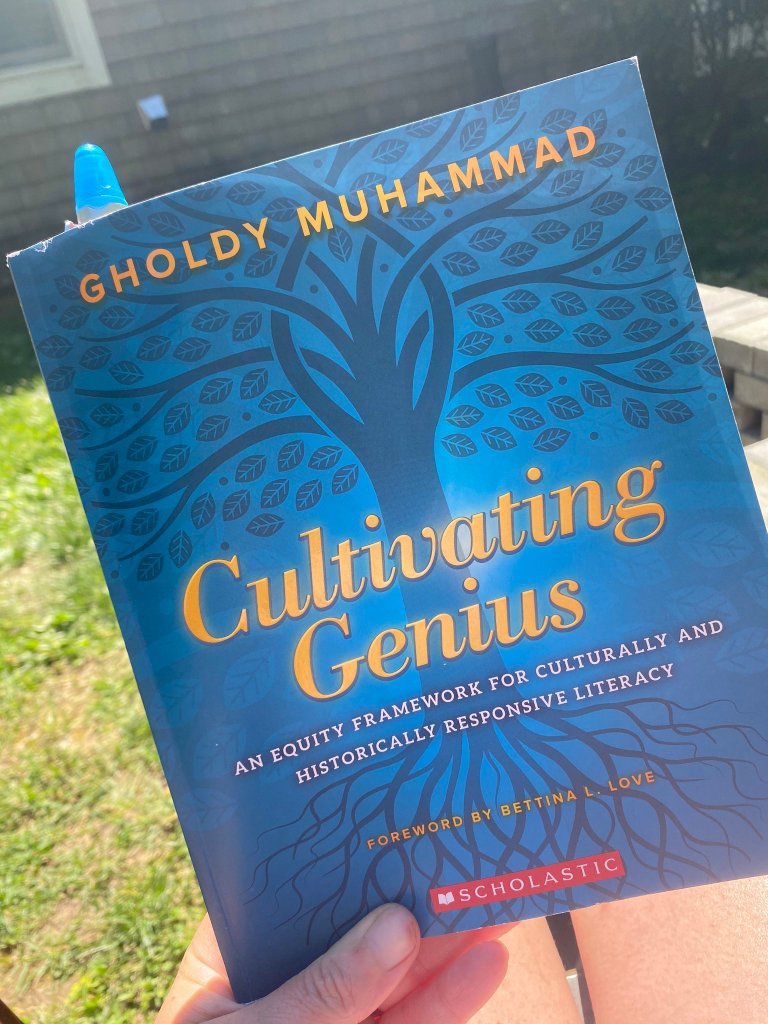
I joined the Book Love Foundation’s Summer Book Club this year. Selections for middle school and high school include this professional text: Cultivating Genius: An equity framework for culturally and historically responsive literacy by Gholdy Muhammad, a Georgia State education professor who founded Atlanta-based Black Girls Write! Perhaps because of its’ soaring popularity among educators after being featured in the Book Club, or perhaps because its subject matter is ever more timely due to current events, the book is presently sold out on Scholastic’s website.
About halfway through the first chapter, I realized how far out of my element I was. Here I am, a white educator who has worked in predominately white settings, reading a chapter in a professional text about Black Excellence. I was ignorant to this phrase prior to reading the book, and I imagine that’s not uncommon among my peers. I imagine that part of Dr. Muhammad’s purpose in writing the text is to educate the educators about what we’re misunderstanding about that buzzworthy phrase – “culturally-responsive pedagogy” – commonly referenced in educhatter and on job interviews.
There’s a tone-deafnessness there that we can’t always help. Case in point… the stay-at-home orders in New York State have given me some more time to go down that Twitter rabbit hole. A few days ago, I noticed that a former colleague had entered into a BLM/education argument by expressing the need to continue teaching To Kill a Mockingbird to 9th graders because the book provides opportunities to discuss the grim realities of racism.
I did not engage in this discussion. Instead, I took a trip back in time to the Tyrolia Literacy Institute that I was super-fortunate to attend last summer. There, as I read, wrote and thought among a truly diverse group of educators, I had that great opportunity to step out of my Long Island upper-middle class and predominantly white “bubble” and discourse with educators from all parts of the country. I helped me to understand things from different perspectives.
One night we had a spirited, but respectful debate about the merits of teaching TKAM over dinner and drinks. I think it was then that I finally began to understand the argument for letting it go.
I won’t go into details, as there are others making the argument much more eloquently than I.
But here’s the thing…
White educators, despite the best of our intentions, will never have a chance to understand a black teenager’s lived experience because we cannot, as Atticus Finch said, “climb into his skin and walk around in it.” But if we can break down the barriers of what we think we know and have known for years, we can begin to imagine what it must be like for a black student to continually read texts in English class where black children and adults are called words that we don’t utter in civilized company. Those characters are slaves, or freed slaves, or bound by the restrictions of Jim Crow. They are criminal or they are poor. They are disrespected and set up for a lifetime of poverty and heartache. We see it in To Kill a Mockingbird and Huck Finn and Of Mice and Men and The Help and Native Son. I can go on… By continually holding onto these texts because we think they teach important lessons about racism, we neglect the reality that there are kids in this world who already know lots about racism because they live within it every single day of their lives.
I met Chad Everett at Tyrolia. I’ve come to respect him and his work tremendously. I felt challenged by him, in a good way. It was he who pointed out that it’s time for me to “get uncomfortable” and “do the work.” A few months later I had an opportunity to meet and chat with Brendan Kiely at the NYSEC Annual Conference in Albany. He explained what it meant for a white educator to be actively antiracist. I am beginning to understand what that means now, and it is through the lens of the best kind of discomfort that I will read and attempt to learn from Dr. Muhammad’s book this summer. Hopefully this is a small piece of the “work” that needs to be done.
Because I think that’s what white upper-middle class educators like me need to do. We need to accept the fact that what we think we know and have known for years is not good enough anymore.
I’m going to keep much of my reflections on this book in a writers’ notebook – as there are some passages that I want to write beside and not necessarily for an audience. But I need to say that, even before getting through the first quarter of the book, I think it’s a worthwhile read for educators. English teachers? Yes. School leaders? Yes. Those who think they know what “culturally-relevant pedagogy” is?
YES.
 Inside the Launch Window