I’m not one for New Year’s Resolutions because, quite frankly, I am definitely someone who begins with the best of intentions and then fails almost immediately. There are obviously those things I want to do (and NEED to do) when January rolls around again each year: lose the weight I put on through the holidays, clean and organize my home, get back into a steady exercise routine, spend less time doom-scrolling through social feeds, etc. etc. You know the drill…
I will say with certainty that I will not set grandiose life-changing goals for 2022; however, I do want to spend more time doing things that make me feel more positive and whole.
How much happier would we be if we made, and kept, that one promise to ourselves?
Like many others, I was a giant stress magnet at the end of 2021. While I’m grateful that it was a personally good year and that I and my family made it through relatively healthy and unscathed, the last twelve (or – more accurately – the last 22) months doled out a fair amount of tough love. In reflection, I’m grateful that the pandemic gave me the introspection needed to reflect on those things that make me happy and those things that hold me down. To make a long story short, I went a little “Marie Kondo” on my psyche in December. I’m learning to let go of those things that used to make me happy, but for whatever reason, are stressful in the here and now. I am also learning that closing one door does not mean that I have to immediately open another. I will try not to fill gaps with other “stuff” (ie: trying to pick up a new hobby) and will instead try to focus on my day-to-day well being.
Regular Goodreads nerds like me might know that users can set a personal Reading Challenge for themselves at the beginning of each year, and there’s a nice social aspect in tracking your progress along with the progress of your reader-friends as you finish and rate titles. Last year I set a goal for 50 books and exceeded it by one. I’m not going to raise that number this year; actually, I’m backing off a bit. Though I read many incredible books last year, reading for pleasure took up a fair amount of my free time, which is always in short supply. That’s not a bad thing, but spending so much more time reading created an imbalance that left little space for writing. I’d like to fix that.
If you’re surprised that you’re seeing two blog posts from me this week, don’t be. One thing I’ve done successfully since beginning this blog was neglect it. This isn’t because I don’t have ideas. I do. It takes me a long time to get them on the page. As the words appear, I perseverate on revision. Instead of moving from one stage of the writing process to the next, I attempt to write and revise at once. I want to be careful about what I say, as to not say the “wrong” thing. I worry about how I might be perceived if I share my opinion on a debatable topic. I worry about whether or not my voice atrophied from lack of practice. I worry about using too many semicolons. I worry about still having the chops for this. Is it worth it? Or would I be better off writing in my notebook for an audience of one. Who is even reading this anyway?
Despite the negative self-talk above, I really enjoy writing. I’m convinced that making space for writing in 2022 will help me move in the direction of being that more positive and whole person I want to be.
So if I’m making a “resolution” for 2022, that’s it. There will not be a “new” me this year; I want to get back to the old me. To do that, I will create more space for writing. Maybe some of it will appear here, or maybe it will go into that notebook on my nightstand. Maybe I will finally take something from my dissertation and submit a journal article for publication. Maybe I will write a poem that doesn’t stink.
Or maybe it doesn’t matter if I do or don’t do any of these things, as long as I’m leveraging my free time to do something that makes me happy.
Happy News Years Eve to all of my teacher-pals near and far!
I don’t know who needs to hear this, but it’s time to toss those cloth masks you were wearing in 2021. Those cheap-y disposable masks are probably no good, either.
I know… this hurts! While cloth masks were useful in a time when there was limited supply of surgical masks and N95 respirators, their usefulness is questionable amid the rapidly-spreading Omicron variant.
I’m not sure where you are in the nation, but here in New York, K-12 students and staff are required to mask up indoors regardless of vaccination status. I know that this is not the case everywhere. For this reason (and for reasons noted here and here and here), I recommend that you ditch any remaining cloth masks and upgrade to higher-quality face coverings NOW.
Why bold and all caps? Remember back in 2020 when it was hard to get paper products and cleaning supplies unless you knew a guy who knew a guy? We now know it’s because everyone realized how much they needed them all at once, and we panic-bought as many supplies as we could. You can probably recall how disruptive and borderline traumatizing this was.
Here’s the kicker, though. At that point the US did not have the same supply chain issues that exist now. In fact, the supply chain was working just fine back then. The lack of availability of these products was all about supply-and-demand. Today’s supply chain issues are mostly blamed on critical workforce issues due, in part, to the so-called “Great Resignation.”
I’m not clairvoyant, but it seems as if the urgency of this latest surge is starting to sink in. Those of us who are vaccinated and boosted are vulnerable. Those who recovered from previous infection are vulnerable. We’re all vulnerable. Given this, I sense a possibility that high-quality masks may once again be hard to find, despite the fact that they are in good supply now. Yes, I can log into Home Depot’s website and pre-order an 80 pack of 3M’s N95 masks to pick up later today if I want to. Two weeks ago we were all able to get at-home Covid test kits from CVS. Today? Good luck with that.
See where I’m going with this?
I hope I’m wrong, but I’m also not willing to take that risk. While my husband and I appear to have dodged the Omicron this holiday season, we don’t know for sure because we don’t have tests on hand to know for sure. We understand that those testing positive with this latest variant run the gamut of having mild to moderate cold or flu-like symptoms, but others have no symptoms. It’s not beyond the scope of reason that there will be lots of COVID-positive folks walking around without knowing it.
And let’s not forget that there’s still a fair number of folks who refuse to wear masks at all, with inconsistent (if not inadequate) consequences for those who challenge and defy mask mandates.
I’ve read enough dystopian novels to know that those who emerge victorious at the end had the resources and common sense to keep themselves safe along the way. So, for those who intent to emerge victorious in 2022, here are some tips on how to arm yourselves with better-quality masks. I am not an authority on this matter. What I present here comes from actual research, not social media ding dongs.
TIP 1: Educate Yourself on Mask Ratings and Quality
Apparently the N95 is well-regarded as the “gold standard” for mask quality in the United States, but actual NIOSH-rated N95 masks do not come with the ear loop option. That’s because ear loops make it harder for a wearer to achieve a tight seal around the nose and chin, which is necessary in order for a mask to be effective. I didn’t know that until recently when a friend who is a nurse supervisor explained it to me, and it makes perfect sense. From my own experience of wearing masks with ear loops and masks with headbands, the masks with the headbands even feel more secure.
That being said, if you purchased an N95 mask from Amazon, and it has ear loops instead of a headband, it is not NIOSH rated. That does not mean that the mask is ineffective, it means that you need to make extra-sure that it fits you well. Also, it’s important to be careful when purchasing masks from Amazon unless you are 100% sure that the vendor is selling you authentic products. Read this for more information.
KN95 masks are also said to be very effective. The KN95 rating is issued for masks made in China. Given that, may the buyer beware. While KN95 masks may be sold by US suppliers, they are created in China and “regulated” by the Chinese government.
You may have heard of KF94 masks as another option. These are from South Korea, and they are similar in quality to N95 and KN95 masks (this is explained in more detail here).
Any of these three options, assuming the masks are legitimate and authentic, will give the user more solid protection than a disposable surgical-style mask or a cloth mask.
TIP 2: Use Trusted Vendors
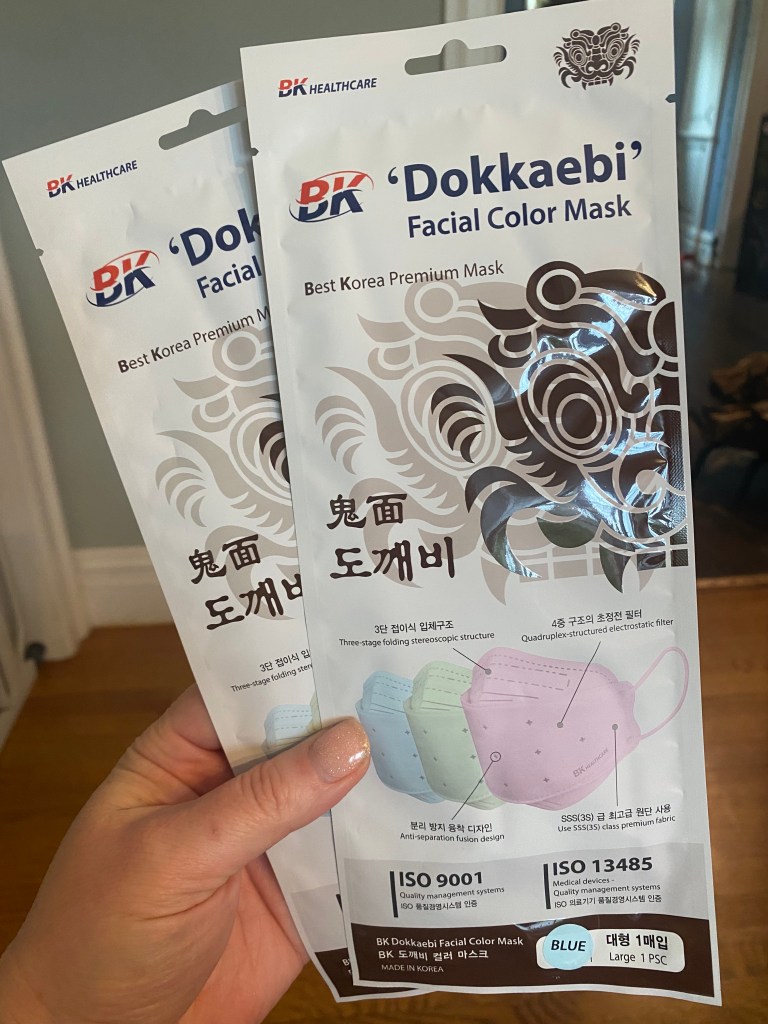
These were purchased from a “trusted” vendor. Be sure to read the fine print no matter who you buy from!
Up until recently, I used VIDA to shop for KN95 masks. Though the company has been positively featured in news stories and appears to be legitimate, I was not happy when I received an order of M95i masks from a brand called Lutema instead of the KN95 masks I actually ordered. Though the masks were made by a US company, the “M95i” rating is not recognized nationally and is instead a Lutema marketing trick. Lutema’s website will tell you all about how their “independent tests” show these masks to be effective, but a few paragraphs down in small print, you’ll see the disclaimer. I don’t want to take any chances with that, so I don’t wear these masks in higher-risk situations. On a second VITA order, I received BK Dokkaebi masks from Korea that may or may not be KF94 masks. I have not been able to find any reputable news articles or studies about the legitimacy of these masks. I’m done with VIDA.
I’ve used WellBefore in the past, but I was a bit sketched out when I received 3M N95 masks in what seemed to be a plastic ziplock bag and not authentic 3M packaging. According to what I found here, this is a red flag. WellBefore’s customer service response was that they purchase masks in bulk and have no choice but to send the masks out in different packaging. I’d love to take their word for it, but I will no longer buy 3M products from vendors who are not listed as “authorized resellers.” This is not to say that WellBefore is no good. Use caution.
I recently learned about Project N95. Check them out!
TIP 3: When Possible, Buy Directly From The Source
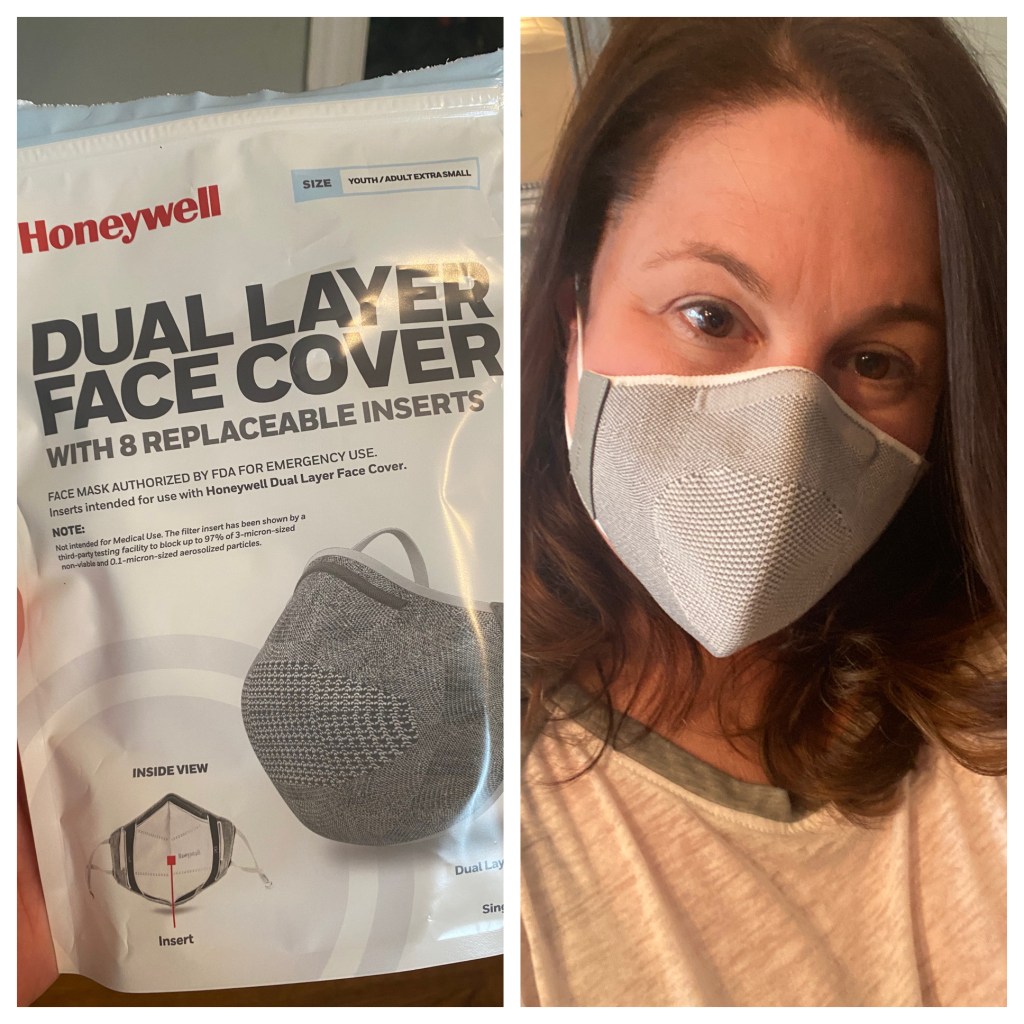
Honeywell sells face coverings directly from their website, but make sure you read the fine print before you make a purchase.
I know that the CDC has been the butt of some unfortunate jokes lately due to this 10-day-5-day isolation thing, but they do have a helpful resource on their website that can serve as a guide for purchasing PPE to keep you safe.
A few months back, I started buying masks directly from Honeywell. Yes, they sell NIOSH-approved N95 masks, and I have them and like them, but wearing masks with headbands is neither necessary nor convenient for me on a day-to-day basis. If you’re in an environment like I am when the mask comes on and off pretty frequently (ie: on when I’m outside of my office or have a guest, off when I’m alone in my office), a wearing a NIOSH-approved mask well can be annoying. Again, you can’t purchase a NIOSH-approved N95 mask with more convenient ear loops. However, Honeywell does sell a product that I like, and I’m willing to accept the risk that comes with it because I trust the brand. Honeywell makes and sells a washable poly-blend face cover with adjustable ear loops that comes with single-use filter inserts. With this comes with a wordy disclaimer that the mask is intended for “source control.” So let’s say that a member of your household tests positive for COVID-19 and isolating that individual is difficult. This is a mask that they can comfortably wear around the house to avoid infecting others. This is a mask that I will wear in situations where social distancing is possible and when others around me are wearing masks.
This product runs a bit large. I initially purchased the face cover for adults. It was huge, and I couldn’t get a secure fit without the top of the mask digging into my under-eye area. I found that the light gray youth/extra small size is much better for me. I also like that the mask comes with replaceable inserts that cover far more ground than the PM2.5 filters I had been inserting into my homemade cloth masks.
TIP 4: Assess Your Risk, and Adjust Accordingly
I know there are a ton of people out there that like to make fun of people driving around in their vehicles alone while wearing masks. True, I don’t really get it myself, but I can mind my own business.
That being said: don’t waste expensive high-quality masks on situations where you don’t really need them. If you are in crowded spaces where social distancing is difficult, wear a good mask. If you’re in an office most of the day with limited interaction with others, a surgical-style disposable mask with a cloth cover on top is probably more than enough. Until this Omicron surge passes, I’ll probably rock my Honeywell face covering on most days.
Good quality masks are not inexpensive, and I won’t know whether or not all of the masks I purchased in 2021 can be written off on my income taxes for at least another month. Whether they are or are not, I do intend to use these masks in higher-risk situations. If there comes a point when my supply becomes low, or if there is a “run” in masks that leads to price-gouging of any kind, I will re-use them if I need to.
Last year I used paper sandwich bags to “quarantine” and then re-use my good masks as long as I didn’t have to wear them for a prolonged period of time (ie: a 10-hour cheerleading competition) and they didn’t become soiled. I actually learned this trick from friends & family who work in hospitals. It’s a contingency plan for when supply is low, so you still need to consider the risks associated with this and decide if it is worth it for you. I have seen articles about how masks can be “disinfected” with an Instant Pot, but that’s far too complicated of a process for me to attempt. I know that there’s something science-y about the material of high quality masks that can break down over time, so I never re-use a mask after three wears. Remember, these are intended to be disposable.
I Swear I’m Not an Alarmist!
Friends sometimes joke that the pandemic has turned me into a “doomsday prepper” of sorts. While I appreciate the humor in the idea, I’m of the mindset that its better to proactively prepare for trouble than struggle to react. If you take nothing else away from this post, leave with this: regardless of what mask you wear, it’s better than NOT wearing one. It should fit well, and it should cover your nose and your mouth. You can be a mask-wearing all star. Let’s do this!
PS: If disaster strikes, don’t come to my house. Contrary to the lore among friends, my husband and I did NOT build a bunker in our 110-year-old haunted basement.
Despite the setbacks of Omicron, I am optimistic that we are past the worst of this pandemic and willsomeday soon be able to “get back to normal.” For some, the gut instinct may be to retreat into the hidey-holes we created for ourselves in the spring of 2020; however, we can’t hide forever. I am so happy to be back in school this year doing what I love, which is being present to offer in-person support to students and teachers. We have the tools to do this safely, so let’s use them! Be well in 2022, friends!Happy New Year!
The pandemic has brought out the best of the worst on Facebook.
Love it or hate it, social media in general is now woven into the fabric of human discourse. It’s an omnibus forum for debate and discussion of all kinds. Sometimes this is healthy and maybe even useful. Where can I get the best Chinese take-out these days? Who has an affordable landscaper looking for work? What color should I paint this wall?
It’s also a place where one can get answers to questions that nobody asked: What does Mindy from high school think about mask mandates? Why does Allison never get a flu shot? Who did Patrick vote for in the election? (Who does Patrick think I should vote for in the election?)
As we’re creeping up to the holidays, I’m seeing lots of folks offer unsolicited advice on how to celebrate Thanksgiving this year. Some of this advice is quite passionate, especially here in New York where we have an additional talking point on the matter: The governor’s 10-person limit on group gatherings.
“If you look at where the cases are coming from, if you do the contact tracing, you’ll see they’re coming from three main areas: establishments where alcohol is served, gyms, and indoor gatherings at private homes. The reason we have been successful in reducing the spread in New York is we have been a step ahead of COVID. You know where it’s going; stop it before it gets there….
He then added that, “local governments are in charge of enforcement… I need the local governments to enforce this.”
I don’t always align with the governor’s ideologies, but he has earned more of my respect based on (some) of what he’s done (and has been doing) to manage COVID statewide. With that, I’ll give him the benefit of the doubt here. This measure, as drastic and over-reaching as it seems, is being taken to save New Yorkers from themselves.
Not everyone sees it that way, according to Facebook.
“I refuse to live my life in fear.”
“Who is this dictator to tell me who I can and cannot have in my home? It’s my business.”
“I’m just going to call Thanksgiving with my family a protest and then it will be fine.”
“Don’t you dare rat on your neighbors unless you want long-term trouble.”
“This may be the last Thanksgiving I will be able to have with [insert name of older relative]. I’m not going to let this pass.”
I may not agree with everything I’m seeing, but folks are not wrong to be upset. I, too, am uncomfortable with the dystopian-novel nature of all of this, but I’m even more uncomfortable with the idea that I’m not sure if all who are planning to have their big Thanksgiving celebrations in spite of what the governor says are fully aware of the potential consequences of their actions.
Or worse… maybe they are aware and just don’t care?
Sure, my husband and I could hop on an airplane and spend Thanksgiving in restriction-free Florida with our families. That would assume that we’re making the governor’s action a jugular issue.
We’re not.
There’s an issue with the travel restrictions and the fact that I would probably lose quite a few days of work. Though the restrictions may appear to be more-relaxed, they are certainly quite a bit more confusing. Further, the personal risk that I would assume in forcing the “Happy Thanksgiving” tradition… as a person with a compromised immune system, as a child of elderly parents with various comorbidities, as an educator working in a public school… it just isn’t worth the risk.
Not for one heavily-symbolic meal.
But I’m also hopeful that this overwhelming feeling of “ick” will only be for one Thanksgiving. One Christmas. One New Year’s. Hopefully by next Easter we can be together again without breaking any state mandates or putting loved ones at risk for the sake of tradition.
So I went to the market early yesterday morning to pick up, with my regular grocery haul, an overpriced bone-in turkey breast for two. We will make the best of a safe and low-key holiday, and we hope that our restriction-free Florida family will do the same.
Because, well… we’d really like to see them next Thanksgiving.
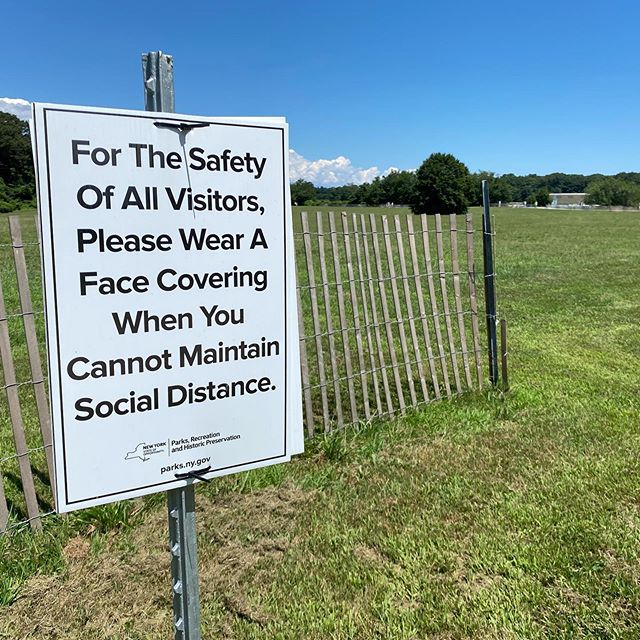
A sign posted at Caumsett State Park in Lloyd Harbor, NY.
August was always a good month.
In my childhood, I’d anxiously await the second Saturday and our three-hour drive to the Pocono Mountains. Families bound together by friendships our parents forged when we kids were young spent a week there together every year. There was something peaceful in the mountain air, the smell of the dirt path walking back to our cabins at night, and the cacophony of crickets by starlight that always, always gave me a sense of peace.
The end of that trip meant it was time to start thinking about going back to school. This never haunted me, neither as a little kid nor as a teenager, and certainly not as a college student. It also never haunted me as an adult. I always looked forward to the first day of school, as a student, as a teacher, and now as an administrator. The new school year, to me, always felt like a fresh start, a new beginning.
As an adult, August was typically the month when I had the most time to spare. My busy Julys had me running around, first with cheerleading camps, and later with summer school and conferences. I would always look forward to August because, despite having to keep an eye on my thinning checking account, I would always try to plan a few weekends away here and there. And the beach…. Oh, the beach! I would go early in the morning to beat the traffic, armed only with my sunscreen and a good book. Later in the day I might enjoy a couchnap in the central air, and maybe, just maybe, I had something else to look forward to that evening…. an outdoor concert, a street festival, dinner and drinks with friends, a date with my boyfriend, now my fiancé. To me, the arrival of August always conjured up feelings of rejuvenation and joy.
Until this year.
The feeling I have now is three parts stress and one part dread. This salty, unsatisfying cocktail has me deeply unsettled, especially in a month when I don’t typically have much else to occupy my brain.
This August there are no concerts, no street festivals, no dinners with friends, and certainly no beach days. I know that at least two of these things can be accomplished with careful social distancing measures in place, but I’m not keen on putting my health and safety in the hands of others. Especially when so many out there refuse to wear masks or still think that all of this is a hoax.
I am looking forward to the new school year with none of the excitement I had in years past, but instead with a fearful kind of hope that we can actually do this and keep everyone safe at the same time. Regardless of what version of “back to school” Governor Cuomo permits, I’m going to put on my big girl shoes and deal. I will do everything in my power to keep myself safe and hope that if I do end up catching COVID-19 at some point that my weakened immune system will be able to handle it. Because, quite frankly, what alternative do I have? What alternative to any of us have?
Yesterday school districts all over Long Island released their three-pronged reopening plans to the public as they were likewise sent to the State for approval. It didn’t take long for the Facebook moms’ groups to light up with critics comparing and contrasting their districts’ plans to others. Though I don’t have school-age children, I watched the posts and comments populate in the three community groups I’m in. In one thread there are groups furious that the “hybrid” plan limits virtual instruction on “off” days to an hour of synchronous videos per week. On another thread there are desperate single parents looking for childcare so they can go back to work. In yet another there are some demanding property tax refunds because schools, “won’t be educating my kids this year after all.” Some are contemplating homeschooling, some are calling for the governor to be drawn and quartered, and others don’t understand what the big fuss is about because, “this is just like the flu.”
In a handful of comments, you have teachers speaking to their own mix of stress and dread as they face going back to school, only to be berated by an oppositionist camp of essential workers who “never stopped working” since the pandemic started. Nobody wins this argument.
My parents now live in central Florida, and I hate the fact that I haven’t seen them since February and that I don’t quite know when I will see them next. Every time I speak to my father on the telephone, our discussion inevitably turns to how we’re both managing this crisis. He said something to me last weekend that struck a nerve. He said, “Your generation doesn’t know what it feels like to be prepared to die, and that’s why you’re all so afraid.”
The statement kind of shocked me at first, but he explained further in a way that made perfect sense (like he always does). The men of my generation volunteered to go to war, they were not forcibly drafted. The women (or men) of my generation who wait on their military and/or first responder spouses to come home safely do so squarely in the reality that their spouse’s career path was a choice. In my father’s case, a football injury and the shattered ankle that followed kept him far away from Vietnam, but he had many friends who were drafted and fought. Not all of them returned. It was a horrible reality, but it was indeed reality – especially for those who didn’t have the money or means to dodge the draft. How many generations before them were sent to war knowing there was a solid chance they would not come back alive? It was true for my grandfather as well, who was fortunate to live long enough to see his honorable discharge and take home his Purple Heart.
Fear is not a stupid emotion. Fear is what keeps people from doing stupid things to put themselves in danger. The fear that I feel – that many of us feel – is valid, but something I can no longer rely on to keep myself safe.
So this August will be spent trying to relax and decompress as much as possible, far away from the beach and with lots of meals at home. And while it will not include many of the fun things of Augusts’ past, I will at least have time and energy to throw myself into the task of figuring out not just how I can keep myself safe in the fall, but how I can be the best and most solid resource for the teachers and kids who I work for. I’m reading a lot… some books for pleasure, but lots of research articles and professional texts, too. Since April I’ve been doing everything I can to learn about best practices in virtual instruction, and this effort will now ramp up in August.
I will continue to sew masks, and I will continue to hope that one of my weekly 7am visits to the grocery store will eventually yield me a tube of Clorox wipes.
I will try to make peace with the reality that I or my fiancé might catch COVID-19. If this happens, I will try to make peace with the fact that either of us could suffer from long term consequences of the illness, or we could even die.
I will make an appointment with my attorney to update my will, just in case.
I don’t mean to be grim. And I apologize deeply to anyone who made it this far and feels worse for it.
What a year we’re having, amiright? Forget the fact that we’re in the midst of an unprecedented three-month social and economic lockdown caused by a global pandemic… we’re told to anticipate an active hurricane season and something called murder hornets, the simmering unrest fueled by decades of racial tensions is back up to a boiling point, and what promises to be yet another volatile presidential election is banging at the door.
All joking and metaphors aside (as if any of these are cause for humor), now is the time for Americans to be smarter. About, well… everything.
How do we educate ourselves? We read. We watch. We write. Such activities lead to THINKING… and we need that more than ever in order to survive 2020.
What follows below is not by any means an exhaustive list, nor is it meant to be in the first part of this “course.” [Aside – I don’t have all day to write this post, so I’ll come back and add to it later]. What I would REALLY love to do; however, is create a space for individuals to discourse about these topics through the context of our learning. Hmmm…
Before we get there, here’s what you need to know to be successful in this course.
LIST OF REQUIRED MATERIALS
In order to come to class prepared and ready to work each day, you need the following materials:
A library card
A Netflix subscription
A black composition notebook (old school) or a blog (new school)
An open mind and a willingness to learn
TOPIC 1: A REVIEW OF EVERYTHING YOU WERE PROBABLY SUPPOSED TO LEARN IN HIGH SCHOOL
Watch The Monsters are Due on Maple Street
The Twilight Zone series is presently available on Netflix, but you can probably catch this uncut episode on YouTube
If your recollection of the term irony stems from the Alanis Morisette CD you listened to on repeat as a teenager, we need to do some work.
As you watch, ask yourself these questions and journal about them in your notebook or blog: 1) What is the driving force behind the characters’ actions? 2) Who is to be blamed for the story’s outcome?
What happens when a gaggle fine upstanding white boys are left stranded on a deserted island with no adult supervision? Sounds like an adventure, huh?
And – NO. You’re not allowed to read the Cliff’s Notes for any of this. Our soundbyte-loving society is in dire need of complete and thorough (unfiltered) information to process and analyze on our own terms, not through the lens of someone else’s agenda or expertise. What does that mean?
(Hint: If you participate in this master class, you’ll be able to answer that for yourself.)
After you finish the book, use space in your notebook/blog to write (or sketch) about your views on the inherent nature of man. Are we predisposed to do good? Or are we predisposed to do evil?
For extra credit (or perhaps just to get some assistance to answer the questions above), you may want to look into these philosophers to see what they have to say about the nature of man: Jean Jacques Rousseau, Thomas Hobbes, and Maximilien Robespierre.
If you’re familiar with the book and know it well, I think you will agree that this is one of the most scary-poignant novels in the high school canon. Unfortunately the deeper implications of the text are often missed on high schoolers whose parents may have deliberately shielded them from the ways of the world. Even if you feel like you know it fairly well, it’s worth another read through the lens of your life experience.
I suggest you do some work in your notebook at various intervals during and after your reading. You’re probably going to have some, uh, stuff to journal about…
Watch History 101 Episode 3: “The Rise of China.”
Learn more about this new docuseries in this blog post. You can find it on Netflix.
If the last time you read or watched anything about China was in your 10th grade Global History class, it’s time for a refresher. This one will take less than 25 minutes.
After you watch – spend some time in your notebook answering this question: What’s the big deal about China?
PREVIEWING TOPIC 2:
Once you’ve established a baseline through reading, watching and writing about the selected works above, we’ll be ready to delve deeper into some analysis of modern topics. I’ll give you some time to get started before I release all of that on you just yet.
Educators and parents have been wondering for weeks what is going to happen with schools in September.
Two days ago, NPR reported that the CDC released guidelines on how to manage this, stating that schools should not reopen “unless they are able to implement coronavirus screening protocols, evaluating employees and children daily for symptoms and potential past exposures to COVID-19.”
I downloaded the document pertaining to schools and read through it carefully. Not only am I concerned about September, but I’m thinking about what needs to be done in order to run a safe summer school program for students who need additional support moving from one grade to the next.
For starters…
Compliance with state and local mandates aside, in order to reopen, schools must be able to guarantee that protective measures will be in place to protect vulnerable populations. This includes (but is not limited to) students and staff members who have compromised immune systems for a variety of reasons, students and staff members who are asthmatic, and staff members over the age of 65.
I clicked through several of the hyperlinks in the hopes that something would portal me into a world of more complete information. Unfortunately what I’m finding is vague, at best.
Take this, for instance, which I found on one of the pages explaining the needs of those who are considered vulnerable for whatever reason:
Without a “specific treatment for or vaccine to prevent COVID-19. The best way [for vulnerable populations] to prevent illness is to avoid being exposed to this virus.” So what steps must a school put in place to “protect” them? What are some examples?
I have so many questions.
Before I go deeper down the rabbit hole, let me say first that I’m also looking at this through the lens of someone who works in secondary schools. There are a number of challenges for all grade levels, but systems and structures for secondary schools involve their own set of logistical complexities.
For example, in schools that utilize an 8 or 9 period day, students switch classes up to nine times. That’s nine different groups of students and adults that they come into contact with on any given day, and up to nine different seats that students occupy, and up to nine different surfaces that they touch.
Movement in and out of classrooms is one challenge. But what happens upon arrival, which is where schools must be prepared to “screen students and employees upon arrival for symptoms and history of exposure”?
Let’s say a typical middle school on Long Island houses approximately one thousand students. Even if schools are able to put social distancing measures in place and reduce that number by half on any given day, that’s still five hundred students in addition to scores of staff coming into the building at around the same time.
One or two school nurses are going to screen all individuals? How?
And should not these screening measures be put in place before students step onto a school bus? Would then every bus need to include a matron who is qualified to conduct these screenings?
Wherever it is to be conducted, how effective is the screening itself?
I’ve seen news reports about how some employers and even airlines are using temperature checks as one measure for symptom-screening. But it’s a questionable strategy insofar as accuracy and effectiveness, especially when anywhere from an estimated 1 – 17% of individuals testing positive for COVID-19 do not have a fever.
In the last week, Governor Cuomo and both county supervisors on Long Island have been cautioning the public about a frightening new development in our understanding of how COVID-19 affects children. Can these symptoms be checked at the door?
What if we were to go so far as to administer actual COVID-19 tests to all once or twice a week (let’s put aside questions about logistics and consent for a moment)? Are the tests even accurate enough to provide responsible indicators?
How many individuals will walk into a building with no symptoms whatsoever and contribute to a spread the virus under the radar?
So what do we do “out of an abundance of caution” (remember that phrase from March)? Do we create a classroom environment where individuals can maintain 6 feet distance from one another at all times? Ok – maybe we can do that in the classrooms with placement of furniture and by limiting the number of students in the room at one time. But what about entering and leaving the building? The queue for symptom checks? Hallways? Lockers? Lunch rooms?
Limitations in word choice
As I unpack the second and third columns of the flowchart, my eyes gravitate to these words:
Promote healthy hygiene practices…
Encourage social distancing… Encourage anyone who is sick to stay home.
Intensify cleaning, disinfecting, and ventilation…
Forgive me, but the English teacher in me understands the inherent limitations in these words. To “promote” means to support or to actively encourage. It does not mean “to ensure compliance.” The word “encourage” is also a little fluffy. I can “encourage” lots of things all day long. It does not mean “to ensure compliance.”
“Intensify” simply means to do more, but to do more than what has been done before? And is simply doing more doing best?
In sum…
As far as I can tell, there are thirteen total performance indicators that schools must meet to reopen. As noted above, the performance indicators and the language within them do not offer a complete picture of what the “performance” should actually entail.
Perhaps I’m failing to acknowledge the inherent need to keep this all a little vague because schools across the nation are diverse and have divergent needs. Perhaps a clear one-size-fits-all set of specific guidelines will not work.
If that is the case, who then is to interpret these performance indicators and make them applicable to the needs of local schools and school districts?
And what if our knowledge of this virus, on how it spreads and on how it affects children differently, changes before September?
My parents sent me to a K-12 parochial school. Class sizes were small. In fact, I traversed through each grade with a cohort of about twenty-two. Our school was so small that we had the same English teacher from sixth to eighth grade. Let’s call him Mr. Dooley.
My class loved Mr. Dooley, a jolly Irish man with pale skin and red hair. He was a Coast Guard veteran who left us briefly during the Gulf War because he was called to active duty. He was our collective favorite teacher and an all-around good person,
But that didn’t stop us from torturing the poor guy. He had a bit of temper. When he got angry, Mr. Dooley’s face would slowly redden from the neck up. Sometimes he would yell. Then, like the flip of a switch, steam would come out of his ears and he would lose it.
We knew how to push his buttons.
Someone in class would get it started by doing some knucklehead middle school thing, and then others would jump on the bandwagon.
The red-faced yelling was a source of amusement on its own, but what Mr. Dooley typically did that was truly memorable was, in the height of his anger, kick the aluminium trashcan text to his desk. This always made a loud crashing sound and sent wads of paper flying across the room.
By the time my cohort was set to leave the eighth grade, Mr. Dooley’s trashcan had more dents than a car in a crash-up derby.
(Exhale, readers. It was the early 90’s.)
Good, bad, or otherwise… my classmates and I learned much through these interactions. For one, we learned that actions in general have consequences. We learned which of our behaviors would lead to the trashcan-kicking response. We learned who among us emerged as leaders in executing these behaviors, and who among us were content in acting as bystanders. We also learned how to read, to the degree of redness in Mr. Dooley’s face and the size of the trashcan dent to follow, when we went too far with our shenanigans.
And maybe we learned a little English and language arts, too.
There’s been some talk lately, typically in the form in the posing of rhetorical questions, about whether or not brick-and-mortar schooling is functionally obsolete.
The topic has been explored in news reports, op-ed pieces, and educator blogs. Even New York State Governor Andrew Cuomo has weighed-in on the matter.
“The old model of everybody goes and sits in the classroom, and the teacher is in front of that classroom and teaches that class, and you do that all across the city, all across the state, all these buildings, all these physical classrooms — why, with all the technology you have?” Cuomo said in one of his recent daily news briefings on the COVID-19 pandemic.
This news sent many into somewhat of a tailspin and for a lot of different reasons. On one side, there’s an equity problem. On another side, there’s a question about child care. On yet another side, there are many of us wondering what school would look like for generations of kids who never had an opportunity to enjoy physical face-to-face interaction with their teachers and peers and navigate the social complexities of a classroom.
Or watch their eighth grade English teacher wind up and kick a garbage can in a fit of rage.
And that interaction is not just for the sake of enjoyment, it’s for the sake of learning as well.
I am an only child. Perhaps my parents were not the kind of parents who were up on “best practices on parenting” young children in the early 80s. While I had plenty of childrens’ books and toys to keep me busy, our sources of family entertainment weren’t exactly kid-friendly. I went to my pre-Kindergarten psychological evaluation discussing what was happening this week on Dallas. True story.
My mother laughs when she recounts the details of that meeting. She says that the psychologist, with equal parts amusement and concern, informed her that I was four going on thirty-four.
“You really need to socialize her immediately,” my parents were told.
So off to day care I went – even though my parents were not in need of child care between my mother’s part-time work schedule and the willingness of my grandparents to take me off their hands when needed.
It wasn’t because I needed to develop my vocabulary. On the contrary – that was quite good for a child my age. Maybe too good.
What was lacking was the learning I missed from interacting with my peers. That is, lessons related to reading and responding to social feedback, learning to share and make compromises, problem solving, reading body language, and cooperating with others in real time.
I also learned how to be a kid. I learned which sugary cereals were tasty, what the Fraggles were and why I should care, and why She-Ra was a badass lady. I moved beyond my limited childhood experience of Grape Nuts, prime-time soaps, and Nana.
Now I ask, can any of these lessons be learned in a virtual teaching environment? Maybe – but not likely in the same way.
With all due respect to parents who decided, for whatever reason, to homeschool their children – there are lessons about socialization likely to be missed in the absence of regular peer interaction inside of a classroom.
I get that children who are predominately educated in the home still have opportunities to socialize through various play groups and organized activities such as dance classes, scouting groups, and team sports. But what will happen to those if brick and mortar schools were to close, buildings were to be razed, and land to be repurposed into strip malls, Amazon Prime warehouses or cookie-cutter housing developments? Where would that dance recital be held? Where would the girl scouts meet? On whose field would pee wee football play?
Further- homeschooling is a choice made by parents who weigh the pros and cons of their decision and take steps to ensure that their children are not educated in isolation. When what was once a choice becomes the norm for all, we have the potential to run into problems.
I try to imagine how I would behave as a student living in these times if remote learning was my only option. Would I have the chance to experience the humiliation of committing a social faux pas and the opportunity to learn from it? Would I be able to read my teacher’s body language in a Zoom meeting and know when my behavior is moving from borderline to risky? Would I miss out on learning about great music, fashion trends and fun sports if I didn’t have friends or those influential peers to respect or wish to emulate?
I’m not sure… but I do know that I would not be the same person that I am today if I hadn’t experienced Mr. Dooley’s occasional red-faced trashcan-kicking.
I am one of approximately 3 million people in America living with Crohn’s Disease.
After years of skating by with mostly good health, my system started to flare up again in early 2011.
At the time, my gastroenterologist had tried several rounds of tests and medications only to find that nothing was working to combat the inflammation.
The news came in a follow-up appointment after I was sent to the emergency room because a routine colonoscopy went sideways. “I will continue to treat you locally,” he said to me, “but I need guidance from someone who has experience working with more complex cases like yours.”
He then referred me to a colleague affiliated with Mount Sinai hospital in New York.
To make a long story short, I saw his colleague in the city. I needed surgery. I was told after the fact that the inflammation in a large section of my small intestine was so bad that I was perhaps months away from a far more scary health situation.
Flash forward to the present day… I am much better now. Since my surgery in 2012, the medications that had originally done nothing seem to be working. I am still being treated by my local gastroenterologist who frequently consults with my doctor in the city any time he has a question regarding my care.
I will never leave him.
The truth is that I have a tremendous amount of respect for what he did. He knew his limitations, and in his focus on doing what was best for me, his patient, he referred me to a colleague who he knew could do better.
Had he led with his pride rather than what was best for me overall, it’s quite possible that my story would have a different outcome.
I often tell this story when speaking of those qualities of leadership that I think are most important. One is our ability to recognize our shortcomings and ask for help.
How many leaders have I worked with… how many leaders have YOU worked with… would just assume sweep their shortcomings under the rug and move forward pretending that they didn’t exist?
But I think the real point of this metaphor is to illustrate the power of collaboration.
We are now moving into week nine of remote instruction here in New York State. As time passes, I’m learning that school districts all over Long Island have had vastly different approaches in navigating the shift from brick-and-mortar instruction to working in an online environment. Suffice it to say, some are doing as well as can be expected, some are doing more, and some are doing less.
What is needed, more than ever, is collaboration. At all levels. Especially in the glaring absence of straightforward guidance from central powers such as the State Education Department.
I often hear Governor Cuomo referencing that many decisions about remote instruction are to be left with the local school districts. Ironically, this is the same governor who pointed out shortcomings in leadership coming from the federal government and worked to form a coalition of northeast governors to make somewhat of a shared decision-making team for our states.
There is an opportunity, at every level, to do better through collaboration. And I think that there is a huge missed opportunity on the part of the State Education Department and even, to an extent, our local BOCES, to make opportunities for collaboration much easier through the power of leadership and organization. Perhaps that’s a topic for another blog post.
In this moment, wherever we all are in the pecking order of the educational system, we need to find that important quality of leadership within ourselves. We all need to acknowledge our shortcomings and identify those people who we know can do better, and we need to reach out to those people and ask for help.
Teachers should not be working in isolation trying to figure out how to use a technological tool they’ve never seen before. Curriculum leaders should not miss out on opportunities to reach out to colleagues in other areas for frank discussion about successes and shortcomings of our practice. A central administrator shouldn’t exist as an island, but instead consult with a wide range of stakeholders to establish a three hundred and sixty degree view of what is, what should be, and what could be.
Now more than ever, it’s important for all of us to look for and to acknowledge our shortcomings and ask for help.
Today, May 11th, we should all be acutely aware that there is a very real chance that school will not be able to open “business as usual” in September. This realization should serve as a call to action for all of us working in brick-and-mortar schools: What are we doing TODAY that will prepare ourselves for whatever happens then? With whom will we collaborate to make the best decisions?
Teacher leaders – What will you do today to improve your craft should you need to teach online in September? Who will you ask for help?
Department leaders – What will you do today to ensure that the teachers with whom you work have the professional development and resources that they need to do this effectively? Who will you ask for help?
Building and District leaders – What will you do today to improve equity among the families in your district to ensure all have the ability to connect and engage in a virtual classroom environment? Who will you ask for help?
Parent leaders – What will you do today to prepare your children for success in this model moving forward? Who will you ask for help?
My hometown gastroenterolgist is a great guy. He’s treated me well for ten years and counting. I will stay with him until he decides to retire.
Why? Not because he’s the best at everything on his own, but because he is better through collaboration with others in his field.





 Inside the Launch Window