Supervisors: focus on growth, not perfection.

From Focus on excellence, not perfection by Naphtali Hoff. The full text of this article is here.

Before I dive in here, let me explain what writing “from” something means.

What you see here was inspired, in some way, by the article I linked above.

This is a concept I’ve come to understand from reading and learning from educators such as Kelly Gallagher, Penny Kittle, and Linda Rief. One thing I’d like to do this year (that is, as I chase my non-resolution to create more) is to use texts as sources of inspiration for my own writing.

I’m mentoring an aspiring administrator this year, which is a first for me. As I brainstorm a list of things I’d like for her to take into her first administrative role, my mind goes to some conversations I’ve had with colleagues about lesson observations. That is not what Hoff’s article is about; however, reading that first and coming back to this might offer some additional context for the brain dump that follows. It’s a response, but it’s not a response. Perhaps its better to explain it as an idea that leapt from the platform of the one that came before.

Mr. Jones teachers another perfect lesson. Photo by mentatdgt on Pexels.com

I’ve been a school administrator for nearly seven years. In the context of my role, I conduct one formal observation for each veteran (tenured) teacher that I supervise, and at least two formal observations for probationary teachers. Most of the teachers I work with are around my age, give or take a few years. We have at least 10 – 15 years of classroom experience, with much of that from the same school district. Sometimes that experience is tipped, if not exclusive, to one or two grade levels.

Mr. Jones* has been teaching 9th grade English for about twelve years. He’s an excellent teacher, often one of students’ favorites in their high school days. His lessons are thoughtful and creative, at least as far as I can tell… In the seven years that I’ve worked with Mr. Jones so far, he has consistently arranged for me to observe him teaching one of his tried-and-true, already exemplary lessons. Each year it seems that I see a lesson that Mr. Jones has had plenty of time to develop, self-assess and perfect. Our pre-observation meetings are typical: Mr. Jones shares a summary of the lesson I will see, and he explains the context of where it falls in the unit. Sometimes this idea is accompanied with an already-written lesson plan, sometimes it is not. Either way, Mr. Jones speaks through his plan expertly, confidently, justifying each procedure and explaining with explicit detail how long each activity will take. His matter-of-fact demeanor suggests that he is neither looking for nor wants questions or suggestions. If I’m being honest, I don’t often have any questions or suggestions because everything is plausible and clear. Mr. Jones already knows that this lesson has been field tested and perfected. While he can’t always control for what will happen in class that day, more often than not, everything goes as just as expected…just as he planned.

Ms. Davis* is also a veteran teacher. Though I suspect she’s been in the classroom for the better part of twenty years, she’s bounced between different grade levels and between the middle school and high school. For the last eight years, Ms. Davis has been teaching 8th grade exclusively. Ms. Davis rarely comes to our pre-observation meetings with a solid lesson plan. More often than not, she has an idea, a seed. Our conversations fascinate me because she walks me through her metacognitive processes, and I watch that idea become a plan. While Ms. Davis doesn’t usually ask for feedback or suggestions, she’s open to both. She welcomes my questions, and she does not feel challenged by them. It might be fair to say that Ms. Davis has no clue what’s going to happen when I see her class for our observation. She will often say, “This sounds good in theory, but I’m not sure how it will go in practice.” Sometimes her lessons are executed beautifully. Sometimes they tank.

I am the direct supervisor for both teachers, and I’m the only administrator who has seen them every year for the last seven years. In that time, Mr. Jones has not demonstrated, at least to me, any growth in the design or execution of his lessons. Nada. Zip. Zilch. Now I am smart enough to know that Mr. Jones, because he is such a great teacher, is often experimenting with new lessons and ideas. For whatever reason, he chooses not to show them to me. Ms. Davis, while not particularly proud of those lessons that fail while I’m in the room, is at least OK with it.

I actually love the bad Ms. Davis lessons, and others like them. They make me feel useful, at least, as there is an opportunity for the two of us to roll up our sleeves. We can consider what went wrong from both perspectives, and we can work together to fix it. I learn so much about good teaching from these exchanges.

I don’t so much love the Mr. Jones lessons. While I got to see a nice show, I’m not being utilized well for the observation. I can give nothing but praise and validation. There’s nothing to fix, nor is there anything to suggest. Gold star.

I’ve spent a lot of time reflecting on why far more folks share the same mindset as Mr. Jones, “My supervisor needs to see a perfect lesson.” I don’t have an answer, but I have this… In my own classroom days, I’ve had excellent supervisors, and I’ve had terrible supervisors. I’ve had supervisors who were compassionate and real, and from whom I’ve learned a great deal. I’ve had others who did things like use the chromebook I offered to follow along with an activity to check e-mail and do some shoe shopping, or forget to swap English for math in the paragraphs they clearly copied and pasted from another teachers’ observation to mine.

This is not hyperbole. These things actually happened to me.

But perhaps those not-so-good experiences that I’ve had with certain supervisors taught me, more than anything else, that this role needs to be taken seriously. We will never earn respect if we don’t give the task the respect it deserves. We will never earn trust if we dole out “developing” scores punitively.

I’ve also learned from my good experiences. Our relationships with our colleagues need not over-emphasize hierarchy. School administrators like myself are neither experts or gurus. We can’t let our egos lead us, no matter how many gold stars we ourselves received on our Danielsen rubrics. While I’ve learned so much about good teaching from the context of this role, and while I’m confident that I could be a better teacher tomorrow than I was on my “best” days from 2000 – 2015, I know there is no way I’d be able to pull off executing mistake-free lesson plans for the rest of my days. Absolutely not.

But I can promise this… I will not fear those mistakes in front of a supervisor who works hard to earn my trust, who takes the process seriously, and is going to do what she can, however much or however little, to help me be the best teacher I can be.

I wish all of my teaching colleagues were more like Ms. Davis and less like Mr. Jones. I wish all of my teaching colleagues knew that its ok to be vulnerable. It’s OK to take risks. It’s OK to step away from their comfort zones when I’m in the room.

I celebrate those moments in pre-observation meetings when teachers indicates that they are trying something new and are not sure how it will go. If I’ve earned their trust, if I’ve walked my talk, they will never see any feedback from me as “judgey,” and the narrative I will eventually write to accompany a not-so-great lesson will certainly never, ever be punitive. I know that there are performance indicators on that rubric that run the gamut from awesome to awful, but I make no apologies in saying that, in my opinion, an effective or a highly-effective teacher is not made so by the language of a rubric. In my eyes, the truly highly-effective teachers are the ones that leave room for growth, no matter how long they have been teaching.

This is a plea to all of my fellow administrative colleagues: please do not create an environment where the teachers you supervise feel like they’ve done something wrong if their lessons aren’t perfect all the time. Let teachers know that it is safe to take risks in lessons that will be observed. How else can they get authentic feedback from a colleague? Please behave in a manner that celebrates the occasional failure as a teachable moment. If something goes wrong, or if something can be improved, don’t check the “bad box” write about it in the narrative… roll up your sleeves and offer to help. Allow a do-over. Show your colleagues that it is OK to be vulnerable by acknowledging that we all make mistakes. None of us are perfect. The best we can hope for, in all circumstances, is growth.

If you want to do any of the things I mentioned above, but you are fearful that your supervisor simply won’t have that, feel free to print this blog post and share it with them. As a matter of fact, give them my phone number, too. I might be small, but I’m mighty.

That being said, even after seven years, I have so much more growth to accomplish. I need to find a way to make Mr. Jones and teachers like him feel more comfortable showing me a lesson that needs peer feedback. I need to find a way to create a circumstance where he can accept that feedback without losing confidence. I’m working on it.

The good news is that I have a number of exemplary role models and leadership mentors less than a phone call or a five minute drive away. I am blessed to have learned what I have from their leadership. If I, if we, ever figure this out, I’ll let you know!

*Mr. Jones and Ms. Davis are fictionalized characters, created as amalgamations of real people and real situations I’ve encountered both as a teacher and as an administrator.

New Year, (Re)New Me?

I’m not one for New Year’s Resolutions because, quite frankly, I am definitely someone who begins with the best of intentions and then fails almost immediately. There are obviously those things I want to do (and NEED to do) when January rolls around again each year: lose the weight I put on through the holidays, clean and organize my home, get back into a steady exercise routine, spend less time doom-scrolling through social feeds, etc. etc. You know the drill…

I will say with certainty that I will not set grandiose life-changing goals for 2022; however, I do want to spend more time doing things that make me feel more positive and whole.

How much happier would we be if we made, and kept, that one promise to ourselves?

Like many others, I was a giant stress magnet at the end of 2021. While I’m grateful that it was a personally good year and that I and my family made it through relatively healthy and unscathed, the last twelve (or – more accurately – the last 22) months doled out a fair amount of tough love. In reflection, I’m grateful that the pandemic gave me the introspection needed to reflect on those things that make me happy and those things that hold me down. To make a long story short, I went a little “Marie Kondo” on my psyche in December. I’m learning to let go of those things that used to make me happy, but for whatever reason, are stressful in the here and now. I am also learning that closing one door does not mean that I have to immediately open another. I will try not to fill gaps with other “stuff” (ie: trying to pick up a new hobby) and will instead try to focus on my day-to-day well being.

Regular Goodreads nerds like me might know that users can set a personal Reading Challenge for themselves at the beginning of each year, and there’s a nice social aspect in tracking your progress along with the progress of your reader-friends as you finish and rate titles. Last year I set a goal for 50 books and exceeded it by one. I’m not going to raise that number this year; actually, I’m backing off a bit. Though I read many incredible books last year, reading for pleasure took up a fair amount of my free time, which is always in short supply. That’s not a bad thing, but spending so much more time reading created an imbalance that left little space for writing. I’d like to fix that.

If you’re surprised that you’re seeing two blog posts from me this week, don’t be. One thing I’ve done successfully since beginning this blog was neglect it. This isn’t because I don’t have ideas. I do. It takes me a long time to get them on the page. As the words appear, I perseverate on revision. Instead of moving from one stage of the writing process to the next, I attempt to write and revise at once. I want to be careful about what I say, as to not say the “wrong” thing. I worry about how I might be perceived if I share my opinion on a debatable topic. I worry about whether or not my voice atrophied from lack of practice. I worry about using too many semicolons. I worry about still having the chops for this. Is it worth it? Or would I be better off writing in my notebook for an audience of one. Who is even reading this anyway?

Despite the negative self-talk above, I really enjoy writing. I’m convinced that making space for writing in 2022 will help me move in the direction of being that more positive and whole person I want to be.

So if I’m making a “resolution” for 2022, that’s it. There will not be a “new” me this year; I want to get back to the old me. To do that, I will create more space for writing. Maybe some of it will appear here, or maybe it will go into that notebook on my nightstand. Maybe I will finally take something from my dissertation and submit a journal article for publication. Maybe I will write a poem that doesn’t stink.

Or maybe it doesn’t matter if I do or don’t do any of these things, as long as I’m leveraging my free time to do something that makes me happy.

Photo by Startup Stock Photos on Pexels.com

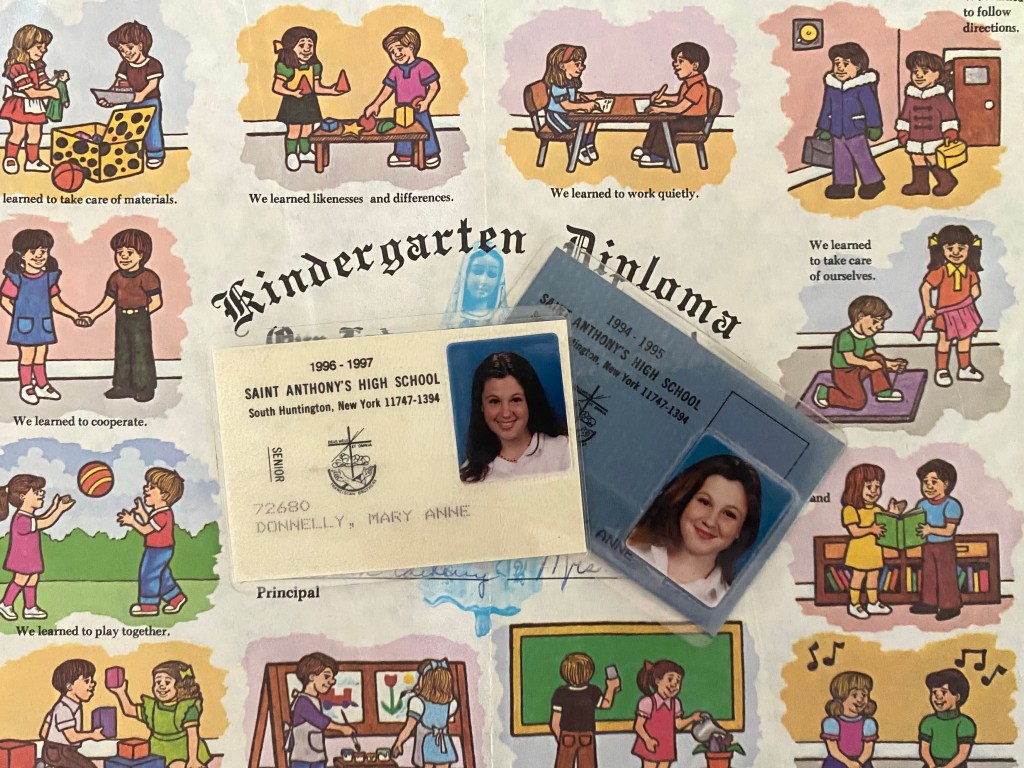
Things I Learned in School Just By Being There

My parents sent me to a K-12 parochial school. Class sizes were small. In fact, I traversed through each grade with a cohort of about twenty-two. Our school was so small that we had the same English teacher from sixth to eighth grade. Let’s call him Mr. Dooley.

My class loved Mr. Dooley, a jolly Irish man with pale skin and red hair. He was a Coast Guard veteran who left us briefly during the Gulf War because he was called to active duty. He was our collective favorite teacher and an all-around good person,

But that didn’t stop us from torturing the poor guy. He had a bit of temper. When he got angry, Mr. Dooley’s face would slowly redden from the neck up. Sometimes he would yell. Then, like the flip of a switch, steam would come out of his ears and he would lose it.

We knew how to push his buttons.

Someone in class would get it started by doing some knucklehead middle school thing, and then others would jump on the bandwagon.

The red-faced yelling was a source of amusement on its own, but what Mr. Dooley typically did that was truly memorable was, in the height of his anger, kick the aluminium trashcan text to his desk. This always made a loud crashing sound and sent wads of paper flying across the room.

By the time my cohort was set to leave the eighth grade, Mr. Dooley’s trashcan had more dents than a car in a crash-up derby.

(Exhale, readers. It was the early 90’s.)

Good, bad, or otherwise… my classmates and I learned much through these interactions. For one, we learned that actions in general have consequences. We learned which of our behaviors would lead to the trashcan-kicking response. We learned who among us emerged as leaders in executing these behaviors, and who among us were content in acting as bystanders. We also learned how to read, to the degree of redness in Mr. Dooley’s face and the size of the trashcan dent to follow, when we went too far with our shenanigans.

And maybe we learned a little English and language arts, too.

There’s been some talk lately, typically in the form in the posing of rhetorical questions, about whether or not brick-and-mortar schooling is functionally obsolete.

The topic has been explored in news reports, op-ed pieces, and educator blogs. Even New York State Governor Andrew Cuomo has weighed-in on the matter.

“The old model of everybody goes and sits in the classroom, and the teacher is in front of that classroom and teaches that class, and you do that all across the city, all across the state, all these buildings, all these physical classrooms — why, with all the technology you have?” Cuomo said in one of his recent daily news briefings on the COVID-19 pandemic.

This news sent many into somewhat of a tailspin and for a lot of different reasons. On one side, there’s an equity problem. On another side, there’s a question about child care. On yet another side, there are many of us wondering what school would look like for generations of kids who never had an opportunity to enjoy physical face-to-face interaction with their teachers and peers and navigate the social complexities of a classroom.

Or watch their eighth grade English teacher wind up and kick a garbage can in a fit of rage.

And that interaction is not just for the sake of enjoyment, it’s for the sake of learning as well.

I am an only child. Perhaps my parents were not the kind of parents who were up on “best practices on parenting” young children in the early 80s. While I had plenty of childrens’ books and toys to keep me busy, our sources of family entertainment weren’t exactly kid-friendly. I went to my pre-Kindergarten psychological evaluation discussing what was happening this week on Dallas. True story.

My mother laughs when she recounts the details of that meeting. She says that the psychologist, with equal parts amusement and concern, informed her that I was four going on thirty-four.

“You really need to socialize her immediately,” my parents were told.

So off to day care I went – even though my parents were not in need of child care between my mother’s part-time work schedule and the willingness of my grandparents to take me off their hands when needed.

It wasn’t because I needed to develop my vocabulary. On the contrary – that was quite good for a child my age. Maybe too good.

What was lacking was the learning I missed from interacting with my peers. That is, lessons related to reading and responding to social feedback, learning to share and make compromises, problem solving, reading body language, and cooperating with others in real time.

I also learned how to be a kid. I learned which sugary cereals were tasty, what the Fraggles were and why I should care, and why She-Ra was a badass lady. I moved beyond my limited childhood experience of Grape Nuts, prime-time soaps, and Nana.

Now I ask, can any of these lessons be learned in a virtual teaching environment? Maybe – but not likely in the same way.

With all due respect to parents who decided, for whatever reason, to homeschool their children – there are lessons about socialization likely to be missed in the absence of regular peer interaction inside of a classroom.

I get that children who are predominately educated in the home still have opportunities to socialize through various play groups and organized activities such as dance classes, scouting groups, and team sports. But what will happen to those if brick and mortar schools were to close, buildings were to be razed, and land to be repurposed into strip malls, Amazon Prime warehouses or cookie-cutter housing developments? Where would that dance recital be held? Where would the girl scouts meet? On whose field would pee wee football play?

Further- homeschooling is a choice made by parents who weigh the pros and cons of their decision and take steps to ensure that their children are not educated in isolation. When what was once a choice becomes the norm for all, we have the potential to run into problems.

I try to imagine how I would behave as a student living in these times if remote learning was my only option. Would I have the chance to experience the humiliation of committing a social faux pas and the opportunity to learn from it? Would I be able to read my teacher’s body language in a Zoom meeting and know when my behavior is moving from borderline to risky? Would I miss out on learning about great music, fashion trends and fun sports if I didn’t have friends or those influential peers to respect or wish to emulate?

I’m not sure… but I do know that I would not be the same person that I am today if I hadn’t experienced Mr. Dooley’s occasional red-faced trashcan-kicking.

And that can’t be replicated in a Zoom meeting.

In Retrospect, Cheerleading Taught Me Quite a Bit About Leadership Theories

I came home from school one day in fifth grade and begged my mother to sign me up for our town’s youth league cheerleading program. At this point, I had participated in a number of extracurriculars: softball, ballet, and baton twirling, each for no more than a year. I imagine my mother assumed that cheerleading would be short-lived as well. In fairness to her, the primary reason I wanted to join cheerleading was not because I had any clue what a cheerleader was or did, but because my best friend Brooke was on the team, and Brooke’s 3x weekly cheer practices conflicted with our frequent playdates. In all honesty, I just wanted to do what Brooke was doing (which was what explained my interest in softball, which I wasn’t very good at anyway…)

So at 11 years old, I became a cheerleader for the blue and white. The difference this time, however, was that something about cheerleading ignited me. Not only did I stay with the town team through the end of middle school, I went on to cheer in high school, and I eventually enjoyed a long coaching career in all levels of cheer: youth, JV and Varsity.

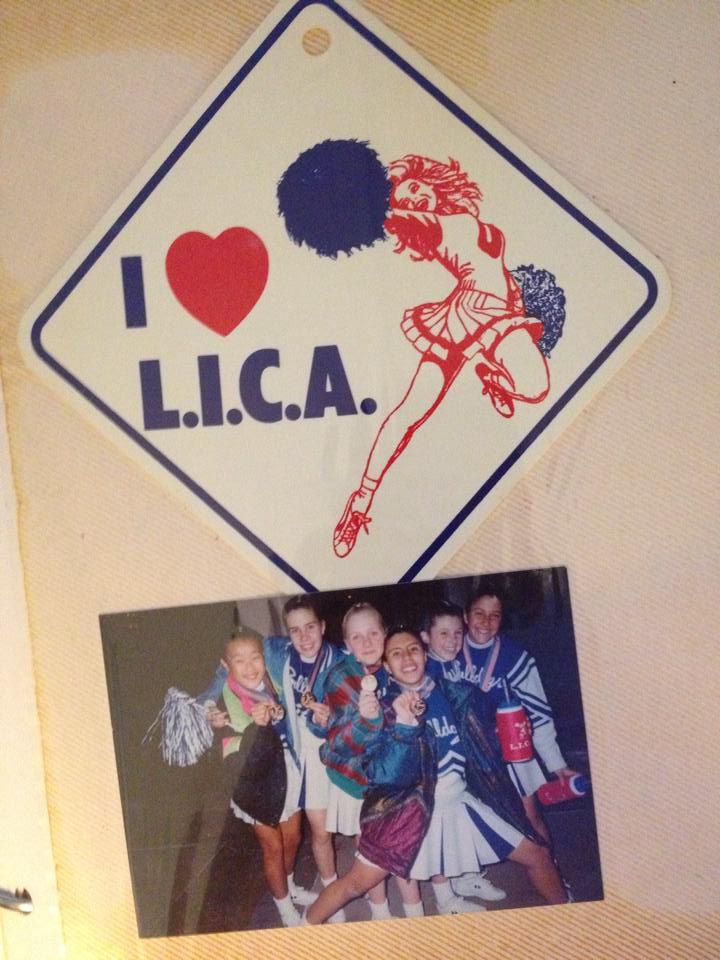
lica1993
A page from my 8th grade scrapbook – enjoying our team’s victorious performance at LICA Champs in 1993. 

To build context for this post, I want to go back and examine the leadership style of a woman who was deeply influential to me in this process. I first met the commissioner of our community’s youth cheerleading program at 10 years old. I remember her as a strict, all-business woman who took a tremendous amount of pride in the award-winning program she had helped to build. We were good… we were REALLY good! In my “senior” year on the 13-year-old team, the Bulldogs took first place in every competition we attended, including the SUPER awesome LICA (Long Island Cheerleading Association) competition that was held annually at Nassau Community College.

Her daughter, a year older than I, attended my high school. When it was time for me to try out for the varsity team, her mom had stepped in to serve as assistant coach.

To say that Coach helped to take our cheer program to the proverbial “next level” was an understatement. She coached with the same all-business discipline that set the standard at North Babylon. Though cheer was typically a fall/winter activity, we practiced year-round. Oftentimes practice included grueling conditioning exercises intended to build strength and endurance. We spent our “off season” attending stunt clinics and camps, and our Varsity team, in 1995, was the first from our high school granted permission to attend a national competition in Nashville, TN.

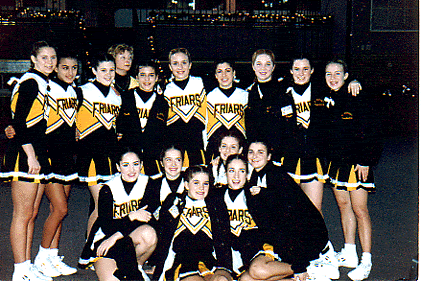
friarettes
The 1995-1996 St. Anthony’s Friarettes at Nationals at the Opryland Hotel in Nashville. I’m pictured 3rd from left in the back, and Coach is behind me.

Though I grew up with Coach, to an extent, she was not my “buddy” at practice. She was not warm, nor did she ever entertain any excuses as to why my individual (or collective team’s) performance was not to her expectation. I went to every single practice ready to work, even as I was battling a significant Crohn’s Disease flare and sometimes had to excuse myself to the locker room to throw up. The minute I came back into the gym, I went right back to my stunt group and kept working.

If at any time we stepped out of line, either as youth cheerleaders or as high school cheerleaders, Coach’s shouting would send icicles through our veins and snap us back to attention. Sometimes we were disciplined with extra conditioning: additional push ups, crunches, or jumps drills… one or two laps around the track. Late practices. Additional practices. And if we dared “fight back” (not that it was even a conceivable option), Coach had no problem benching us. Nobody on that team was irreplaceable, in her eyes. Knowing that kept us working our hardest.

I loved and respected her, but I probably also feared her. Regardless, I always thought she was an effective coach because I always knew that my teams were good. I felt lucky and honored to be a part of two very successful programs. I credited both to her.

Flash forward to 2002:

I begin my first year teaching English at a public high school, and I immediately expressed interest in working with the cheerleading program. I had been coaching a youth team since my senior year in high school, and I was ready for something more. As chance would have it, the existing varsity coach at Smithtown High School was expecting her first child. She welcomed my attendance at practice as a “helper,” and I imagined that someday I would be her official assistant coach, or maybe even head coach myself.

But I received an unexpected phone call on a cold December morning. The varsity coach had gone into early labor, and the team had a competition that day. Could I meet them on the bus and take them to the competition in her place?

That’s the day I became head coach of Smithtown Varsity Cheerleading.

I finished out the year with the team, who were sad to have lost their beloved coach to motherhood, but were also optimistic about a future with me. While I ran the remaining practices, I had nothing to do with existing choreography or stunt groups. I didn’t make too many changes. This was her team still, not mine…

My colleague never came back to school, so not only was I set to coach moving forward, I could operate on a clean slate without “ghosts” from the past (or so I thought). I was beyond elated at the idea and immediately got to work, spending lots of time thinking about the most effective ways to run practice, about stunts and choreography, about new uniforms.  Basically everything I had learned about running a competitive cheer program came from my own experiences with a coach, Robyn Woisin. I knew her approach worked, so I planned to do what I believed she would have done.

What I didn’t do was stop to think about the kids.

The members of the 2003-2004 varsity team were talented and capable, but they were not used to the level of hard work that I wanted from them. For me, cheer was life, and everything else was secondary. For them, cheerleading was something fun they did after school and on weekends, but it was not going to conflict with other important things they had going on.

Perhaps I was too immature at the time or simply couldn’t fathom “cheerleading” in any other way, but my approach with that team was tremendously unsuccessful. I butt heads with the kids, the parents, and even the athletic director… over what I thought were non-negotiable keys to success for a winning program. I came in there with my own mental model (as Peter Senge, author of The Fifth Discipline would say) or my own preconceived notion of what “should be” based on my own experience as a cheerleader with a demanding coach. My implicit bias stymied communication within the organization I was attempting to lead, and I failed.

Actually, I think most of the kids on that team ended up hating me. And I don’t blame them.

I was demoted to JV the following year, replaced by someone from another program who had far more coaching experience than I did, and she had come with a completely different style and approach. While I was upset at the time, I later came to understand why the demotion was the best thing for me. While my pride took a hit, I was able to take a hard look at what I had done wrong: I completely ignored the culture.  I had come in with an ego-driven agenda, and I assumed that everyone was going to be on board. I assumed that MY vision was also THEIR vision.  Not once did I ask if they were “all in” with me. Not once did I seek to understand before I could be understood. I didn’t “listen” to them (or interpret their thinking through action, or inaction). I thought, on my own, I could take an already-talented team and make them superstars. I thought that’s what they wanted.

I realized that I tried to break into an already-established culture and make sweeping changes with my wrecking-ball. It was incredibly naive of me to think like this because I never had buy-in. Not from them.

But luckily that next year coaching the Smithtown “JV Blue” team was different. In fact, it was undoubtedly my most successful year as a coach. Without knowing it then, I, with my team and their parents, had engaged in a form of presencing that Otto Scharmer describes as connecting deeply to our identity and our purpose to  “allow the future to emerge from the whole rather than from a smaller part…” That smaller part would have been my own ego that tripped me up the previous year.

I opened up to this group of 9th and 10th graders about my vision for the team, but I also endeavored to lean more about them and what THEY wanted from me, their coach. I began to see the “team” as a whole made up of parts: me the coach, the kids, their parents, our athletic director, the school. In the fall season, the team began to crystallize by committing ourselves to learning, growing, and working as hard as we could. The goals we set for ourselves were incredibly energizing and motivating. Unlike my varsity team the year before, this group of kids was accepting of my “tough love” approach. At the same time, I was learning and growing myself, and I quickly learned how far “tough love” would get me with different individuals, as some kids responded to softer, more patient approaches. We continued to work with my established cadre of cheer-industry professionals for tumbling instruction and choreography, who were also energized by this team’s confidence and grit. Similarly to my own experience in 1993, the JV Blue team ended up having an undefeated competition season, and they easily won Long Island JV Finals. I was even able to take them to Nationals. To date, no other Smithtown JV team has been permitted to attend a national competition. We were very lucky.

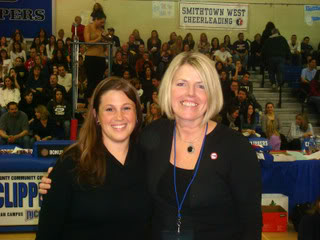
SmallVarsityFinals08036
Shortly after being honored at my last competition in 2009 with my “5 year” coaching pin, pictured with current NYSCJA Vice President Nancy VanHouten 

After that one year with JV Blue, Smithtown High School split into East and West campuses. I was appointed Varsity coach at West, which is where I coached until I eventually “retired” in 2009 to focus on finishing my administrative degree. In that remaining time, I worked with first-place teams and last-place teams, good kids and troublesome kids. Some of the girls I’ve coached have grown up to become colleagues and lifelong friends. But  – as many teams as I coached throughout the years, none was quite like the JV Blue team from 2004-2005. In my opinion, that was the year I finally learned how to coach.

Cheerleading is still a big part of my life today.  My involvement with the Section VIII and Section XI officials associations, CHSAA and the New York State Cheerleading Judges Association connects with that love of cheer that I developed at 11 years old. It wasn’t until reading Chapter 1 of Futures-Based Change Leadership by Dr. Richard Bernato, one of my professors at St. John’s University, that I made a connection to the leadership theories of Peter Senge and Otto Scharmer to coaching cheerleading. In the middle of writing this blog post, I connected to one of the earliest texts I read on leadership (and one of my favorites), Principle-Centered Leadership by Stephen Covey. To an extent, I think a lot of these theories are intuitive. Today, with the benefit of continual learning, I can articulate how the mistakes I made and the changes that followed connect to leadership theories. It’s an “a-ha” moment that arrived a little late…but at least it arrived.

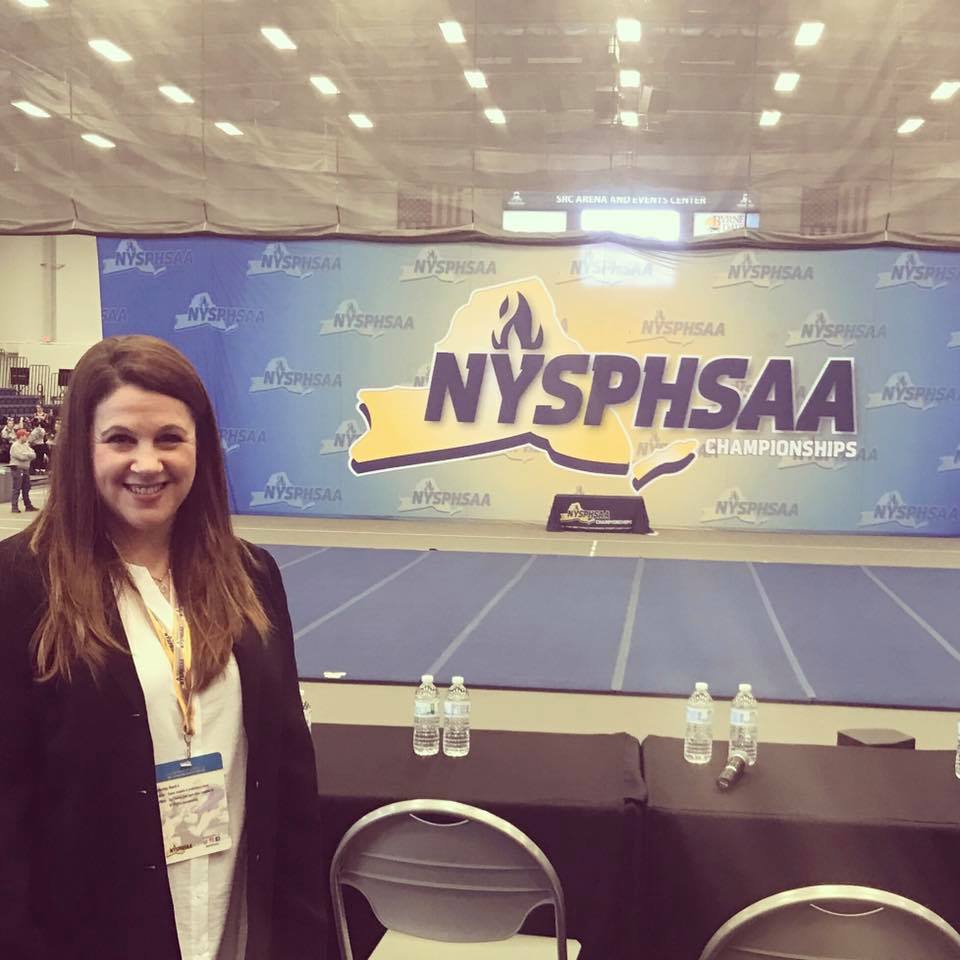
headjudge
Here I am in March 2017 before serving as “head judge” at the NYSPHSAA Cheerleading State Championships in Syracuse – approximately 20 years after I started coaching.

“Hybrid” Reading Strategies (because Johnny 5 Needs Input & There’s Never Enough Time)

Do you remember this movie from the 1980s? I loved it!

https://youtu.be/Pj-qBUWOYfE

This scene, actually, sums up how I feel in my dual role as an English chairperson and a graduate student. There’s so much “input” that I want and need; if only I could process everything as quickly as Johnny 5! Instead, my own reading is a slow process. Sometimes the only time I have to sit down and read is when I’m winding down for bedtime, and there’s a small window of “input” opportunity before my eyes begin closing, my vision blurs, and I’m snoozing before I get to the end of a page.

I have so many goals for reading this year. In no particular order, they are to:

  1. discover high quality young teen books that might be popular with the middle school students I work with
  2. catch up on the contemporary YA reads that the high school kids are buzzing about
  3. read some of the canonical classics that I missed in high school in college (I guess to continue flexing the part of my brain that formerly taught AP Literature and Composition)
  4. read the assigned texts for both of my cohort classes
  5. read the buzzworthy professional texts related to best practice in English and literacy education
  6. read the buzzworthy texts on leadership that are useful for the professional growth of any school administrator
  7. read the books I want to read!

All of this is a pretty tall order, and there’s simply not enough time in the day to read as much as I want to… which reminds me of another pop culture reference:

So – I can’t be Johnny 5, and there will never be “time enough at last” to get all of this reading done, so I came up with what I think is a pretty good solution which I’m calling hybrid reading.

I was tasked with reading Thank You for Being Late: An Optimist’s Guide to Thriving in the Age of Accelerations by New York Times columnist Thomas L. Friedman for one of my classes. While the premise of the book was intriguing to me, the length (500+ pages) was downright intimidating. As well, I’m not well-versed enough in concepts of globalization to fully “get it,” so it took a while to “get into it.”

There was no way I was getting through 500+ pages of dense text in 5 minute-before-sleep increments, but I did find a way to increase my available reading time… during my commute to work.

That’s right – it takes me approximately 35 minutes to drive to work each way (sometimes a little shorter if I manage to avoid rush-hour traffic home), but I typically spend that time listening to the radio in the car. Why not put that 1 hour a day to better use?

I downloaded the Overdrive app to my iPhone, and using my public library account, I was able to download an audio version of the book. On long drives, I would pick up a section of the book where I left off in my reading. When I got home and could use the physical book, I was able to skip ahead several pages to pick up where the audiobook left me.

Now this wasn’t always a perfect idea. As happens to many of us as we’re driving, my mind tends to wander. My drive in to work is particularly a difficult time to focus, as my mind is running the mental “to-do” list for the day ahead. When I found that I was too distracted, I would turn the audio off, turn on some music on, and let myself go.

This system works for me, though. It allows me to maximize the time I typically use during my commute to gain some time for “input.” Furthermore, having access to audiobooks allows me to “read” when I’m doing other things that don’t demand a whole lot of mental energy… enjoying a walk, folding laundry, cleaning the kitchen.

Sometimes I’ll come across a particularly engaging portion of a book on audio that I want to go back and examine more deeply in the text. It’s easy enough for me to “bookmark” the location by taking a screenshot of the chapter and location, then go back into the physical text and find the passage I’m looking for to highlight or annotate.

I definitely recommend this strategy for anyone who has an awful lot of reading to ingest and not a lot of time to do it. It’s amazing to me how much more I learn on long car rides and how many more books I can get through in less time!