Writing from an OpEd on the Need for News Literacy in Schools

Dear Reader: This blog post is something that I began drafting last year, but had evidently abandoned for a reason that I don’t quite recall. As I looked through my “unpublished drafts” folder today for a bit of housekeeping, I was triggered by the title. This need still exists; there has not been nearly enough movement in this direction in the last three years. The emergence of AI only complicates this matter more. 2024 will bring us another Presidential election, one that promises to be just a tumultuous as the 2020 and 2016 elections. I am troubled by two questions: How can we ensure that our students know how to access credible, reliable and nonpartisan news sources? Do we know how to equip students with the tools they need to identify disinformation, misinformation and malinformation?

I had intended this post as a response to an opinion peice by Liz Ramos that was published to EdSurge.com in 2020. I encourage you to check it out before you continue reading this post: The U.S. Election Underscores the Need for Teaching News Literacy in Our Schools.
Photo by Produtora Midtrack on Pexels.com

When I taught 10th grade, I frequently incorporated Jerome Lawrence and Robert E. Lee’s screenplay for Inherit the Wind in my curriculum. I recall students having a hard time wrapping their heads around the Scopes Monkey Trial, flabbergasted that there were so many intelligent American adults that refused to accept Darwin’s Theory of Evolution, or science in general, because it worked in opposition to the Judeo-Christian mythology anthologized the Christian Bible.

True story: I once got in a little bit of trouble for referring to the Holy Bible as “an anthology of Judeo-Christian mythology” in class. Apparently one of my students went home and repeated what I said to a parent, and the concerned parent called my supervisor to inquire about “the heathen in the English Department…” (insert rolling-on-the-floor-laughing emoji here).

I would have loved to speak to the parent myself and explain my choice of phrases, but many of these calls never came my way. My supervisor addressed it and moved on. The parent was placated. My job was safe.

But gone are the days when a mere phone call to someone’s supervisor could clear up a misconception. Now folks take their grievances to social media, where an echo chamber of talking heads are ready and willing to like, comment or share what they see. Even if it’s not accurate. Even if it’s made up of only “alternative facts.” Even if it’s so illogical that there’s no way it COULD be true.

Any efforts to repudiate that information with actual truth is rationalized with the dangerous idea that mainstream media is controlled by an abstract evil-Left who will stop at nothing to suppress the truth.


In September, a Facebook friend shared a photo that she took of a sign she noticed on the lawn of her child’s middle school. It read, “We believe Black Lives Matter, Love is Love, Feminism is for Everyone, No Human Being is Illegal, Science is Real. Be kind to all.” She posted without any further comment.

I clicked “Like” and went to leave a comment about how nice this was to see, but I was stopped dead in my tracks by some comments already there:

“This liberal indoctrination is absolute garbage. Call the principal and demand it be taken down.”

“Time to send the kids to Catholic school, where ALL Lives Matter.”

“It figures. Overpaid school administrators spewing their [expletive] as usual.”

The comments go on in a similar tone, some with more heated and colorful language.

I’d like to say I was surprised, but I wasn’t. In the last few years, it has become apparent that more and more people are willing to share their uncensored opinions about almost everything, regardless of how prejudiced, illogical or devoid of facts these opinions appear to be. I’m watching folks that I’ve known for 20 or more years use their social media pages to share the most alarmingly untrue information and then get upset when people argue the point. They do not believe that fact-checking is real. They believe that efforts to censor misinformation are efforts to censor the truth. They tout their belief that “mainstream media” lies and that the real truth comes from TikTok, YouTube, and extreme Left or Right blog posts.

You can’t argue with these folks, no matter how much you want to. They will often get angry and upset. They will call you blind and stupid. They will try to get you to doubt everything you’ve ever learned about how to read, watch, listen and think critically. They may delete you or block you from their social media pages. They may avoid you at social gatherings.

It’s 1984. It’s The Wave. It’s The Monsters are Due on Maple Street. It’s all of the dystopian literature I loved never thinking that someday it would be our reality.  

I agree that, perhaps now more than ever, teaching news literacy is essential in schools.

I agree that the spread of “false, fabricated and misleading content” further divides us.

I agree that this spread is dangerous -not only because it is easy enough for foreign influences to manage- but also because it shows how easily the American public can be manipulated.

I fear that, because so many people have built up walls against the so-called “lamestream media,” efforts to teach media literacy in schools can be further curtailed by at-home ideologies rooted in fear or misconception.

To that end, I fear that efforts to teach students the informational literacy skills that they need could be dismissed at home as “liberal indoctrination.”

I believe that digital literacy, media literacy, news literacy – whatever you want to call it – is literacy. This is important work, and it’s not something that can be left for English or social studies teachers to do in isolation. If State Education Departments will not lead the charge on affecting change through policy, than it’s up to school district leaders to consider what can be done locally to ensure successful outcomes for students in their communities.


To Share Slides or Not To Share Slides… That Is The Question

Is it unfair to ask education consultants who are paid to present to share their slides with the audience?

Photo by Pavel Danilyuk on Pexels.com

Some of my colleagues and I had the opportunity to facilitate a workshop at the Long Island Language Arts Council/Nassau Reading Council 2022 Spring Conference held yesterday at the Melville Marriott. Our session was about the work we’ve done in our district to make a shift to workshop-based instruction using the work of Penny Kittle & Kelly Gallagher’s 2018 professional text 180 Days: Two Teachers and the Quest to Engage and Empower Adolescents as our “field guide” for implementation.

After most professional organizations were forced to either cancel or shift their conferences online in the head of the pandemic, I was thrilled to have learned that LILAC/NRC was planning an in-person conference this year. While I’m still a tiny bit apprehensive about being in the company of large crowds, I didn’t hesitate to submit an enthusiastic response to their call for proposals. Thankfully four of my colleagues who have successfully shifted their practice (either in conjunction with or as a result of my initial research study) agreed to co-present with me. I felt that their presence and input was essential, as they are the teachers whose daily work with kids gives this idea breath and legs.

Our workshop was very well attended, and we truly enjoyed having the opportunity to share our work with colleagues from around the region. At the end of our session, several of us were approached by one or more members of the audience to receive feedback or answer questions. That, itself, was validating.

I don’t expect that our 60 minute presentation will have moved mountains or changed decades of instructional methodology, but if it inspires just one English teacher to experiment with workshop-based instruction in their middle school or high school classroom, than we were successful.

There are some things I think I need to make clear before I back into the point of this post. First, we submitted a proposal for this workshop; we were not “approached” or asked to present by any entity involved in the leadership of this association. Second, we understood that we would not be compensated for facilitating this workshop. In fact, we were still required to pay admission fees to attend. We neither expected nor received any kind of tangible “reward” for facilitating this workshop.

Though our team had been preparing for this conference for months, we didn’t meet in person as a full group until earlier this week. In the few hours we had together, we assembled our Google Slides presentation and discussed which one of us would take the lead for each subtopic within our session. As we assembled our slides, we included hyperlinks to various resources: teacher-created organizing documents, handouts and materials, ready-to-use assessments, samples of students’ work, links to the professional texts we found useful, etc. Most of the hyperlinks go right back to materials that “live” in teachers’ Google Drive accounts.

As we entered our assigned space and began setting up for our workshop, a few of my colleagues placed a 5×7 flyer with a QR code linked to a copy of our presentation. We told participants that they were welcome to download the presentation, access the resources, and use any or all parts of it to turnkey this work in their own school districts. We expect nothing in return.

Why did we do this? Because we believe in the value of this work. We want for it to be shared, to be modified, to be made even more useful for specific purposes. While I suppose it would be nice to receive some kind of attribution, that is, quite literally, the furthest thing from our minds. To be honest, I’m not even sure to what extent “attribution” is warranted… very few of these materials were developed completely in isolation, and with the exception of my published dissertation, nothing is copyrighted to any of us. Make no mistake – we did not pass off others’ work as our own. We did not link to other party’s handouts or materials that weren’t already in the public domain or that we didn’t have a right to share. Any work we might have created that was modified from an original source offered due credit to that original source.

That’s what teachers do, right? We don’t re-invent wheels… we modify them and make them our own.

And, quite honestly, this fits in with the “big idea” that we wanted folks who attended our workshop to understand: there is not a singular “correct” way to incorporate workshop-based instruction into a classroom. Though models may be provided, such as we have with Gallagher & Kittle’s text, it’s not practical to follow those models in lock-step and expect them to work beautifully within different settings.

Before I stray too far away from the point of this post, I’ll go ahead and get back to it.

I happened to be scrolling through my Twitter feed yesterday to see what kind of discussion was brewing from our conference. I was soon distracted by a series of tweets from an influential teacher-turned-author/consultant lamenting about being repeatedly asked to share her presentation slides after speaking engagements. She continued to explain how being asked to share her work is an example of how “the education system continues to exploit its people…”

This is where I need to pause and take a breath… because I have some strong feelings about this, but I also need to acknowledge that I am not walking in this person’s shoes, and there are some things from her perspective that I might not understand, including the context of her experience that motivated these posts. There’s not much information you can provide in a tweet or two.

I’m working with some assumptions here, but let’s assume that this particular author/consultant was paid to give a presentation at an educator conference of some kind (as, in this case, I doubt this particular individual would work for “free”). I find it somewhat odd for an author/consultant to accept an honorarium to give a presentation and refuse to share materials with the audience. Is the honorarium not inclusive of access these materials? Or should the materials themselves cost extra? Are the attendees expected to purchase a book? Pay a subscription fee for a “product?” Pay for that author/consultant to come to their school district and host the presentation again?

Consultants, especially those who are published and have made a name for themselves, are costly for many valid reasons. Yes, they deserve to be compensated for their work, but is it not somewhat “exploitive” for a consultant (or their publisher) to charge a school district or a professional organization a thousand or more dollars to appear and speak for 45 minutes or so… and that’s it?

I get it. Teachers are busy enough doing the work of “teaching,” and those who have worked beyond the four walls of their classroom to author professional texts and make themselves available for consulting opportunities work even harder. They deserve our respect and, to an extent, our gratitude. But are they not appropriately compensated for this work? If they are not, why do they do it? Because I’m sure that if work was being done for the sake of educational progress, sharing slides after a presentation wouldn’t be a sticky widget.

I can imagine that a great deal of earnings from authors’ text sales go to the publishers, but author/consultants are not “martyrs” to the cause. They made the choice to work with a publisher rather than to self-publish or write in a blog. They need the publisher as much as the publisher needs them. So perhaps the angst should be directed elsewhere, and not upon the teacher probably paid $150 out-of-pocket to attend a conference featuring them as a keynote speaker.

The way I see it, authors/consultants provide a service and/or a “product” that earns proceeds. By effectively marketing themselves as consultants and workshop presenters, they not only earn additional proceeds for their engagements, they continue to build credibility and create pathways for future opportunities to monetize their work. I find it surprising that anyone who is paid to give a presentation would refuse to share the presentation itself. I understand that, to an extent, the content in workshop slides will include some intellectual property… but should that not part of the “package deal” in their speaker fee?

I have never seen this particular consultant speak, nor have I read any of her published materials. I honestly cannot say for sure how much of her work was created in a vacuum and to what extent her ideas are truly unique. To me, a blanket refusal to share slides from a presentation seems a little counter-productive in the grand scheme of things. Does she expect that a member of the audience would use her slides to personally benefit from her intellectual property? It’s far more likely that an attendee would use the slides to somehow enhance the experience of the kids in their classrooms. Why else would a teacher-turned-author/consultant do this work if not, among other things, to benefit kids?

Perhaps I’m in left field here, but this didn’t sit right with me. Or maybe I myself am a part of the problem… maybe each time I share my work with others for free, I allow myself to be “exploited.”

No – that’s wrong. I don’t feel exploited at all.

New Year, (Re)New Me?

I’m not one for New Year’s Resolutions because, quite frankly, I am definitely someone who begins with the best of intentions and then fails almost immediately. There are obviously those things I want to do (and NEED to do) when January rolls around again each year: lose the weight I put on through the holidays, clean and organize my home, get back into a steady exercise routine, spend less time doom-scrolling through social feeds, etc. etc. You know the drill…

I will say with certainty that I will not set grandiose life-changing goals for 2022; however, I do want to spend more time doing things that make me feel more positive and whole.

How much happier would we be if we made, and kept, that one promise to ourselves?

Like many others, I was a giant stress magnet at the end of 2021. While I’m grateful that it was a personally good year and that I and my family made it through relatively healthy and unscathed, the last twelve (or – more accurately – the last 22) months doled out a fair amount of tough love. In reflection, I’m grateful that the pandemic gave me the introspection needed to reflect on those things that make me happy and those things that hold me down. To make a long story short, I went a little “Marie Kondo” on my psyche in December. I’m learning to let go of those things that used to make me happy, but for whatever reason, are stressful in the here and now. I am also learning that closing one door does not mean that I have to immediately open another. I will try not to fill gaps with other “stuff” (ie: trying to pick up a new hobby) and will instead try to focus on my day-to-day well being.

Regular Goodreads nerds like me might know that users can set a personal Reading Challenge for themselves at the beginning of each year, and there’s a nice social aspect in tracking your progress along with the progress of your reader-friends as you finish and rate titles. Last year I set a goal for 50 books and exceeded it by one. I’m not going to raise that number this year; actually, I’m backing off a bit. Though I read many incredible books last year, reading for pleasure took up a fair amount of my free time, which is always in short supply. That’s not a bad thing, but spending so much more time reading created an imbalance that left little space for writing. I’d like to fix that.

If you’re surprised that you’re seeing two blog posts from me this week, don’t be. One thing I’ve done successfully since beginning this blog was neglect it. This isn’t because I don’t have ideas. I do. It takes me a long time to get them on the page. As the words appear, I perseverate on revision. Instead of moving from one stage of the writing process to the next, I attempt to write and revise at once. I want to be careful about what I say, as to not say the “wrong” thing. I worry about how I might be perceived if I share my opinion on a debatable topic. I worry about whether or not my voice atrophied from lack of practice. I worry about using too many semicolons. I worry about still having the chops for this. Is it worth it? Or would I be better off writing in my notebook for an audience of one. Who is even reading this anyway?

Despite the negative self-talk above, I really enjoy writing. I’m convinced that making space for writing in 2022 will help me move in the direction of being that more positive and whole person I want to be.

So if I’m making a “resolution” for 2022, that’s it. There will not be a “new” me this year; I want to get back to the old me. To do that, I will create more space for writing. Maybe some of it will appear here, or maybe it will go into that notebook on my nightstand. Maybe I will finally take something from my dissertation and submit a journal article for publication. Maybe I will write a poem that doesn’t stink.

Or maybe it doesn’t matter if I do or don’t do any of these things, as long as I’m leveraging my free time to do something that makes me happy.

Photo by Startup Stock Photos on Pexels.com

I Just Finished a Memoir Written by a 15-year-old Transgender Teen and I Have So Many Feelings….

I have a confession to make. It’s after 6pm on a Sunday, and I’m still in my pajamas. 

In my defense… we’re more than halfway through a cold and sloppy holiday weekend. I don’t have any plans, and even if I did, I’d be concocting some kind of excuse to break them. So maybe I should extend myself a little bit of grace for my sloth-like behavior today. 

After spending a few hours playing mindless video games, I did attempt to motivate myself to do some cleaning in the bedroom. That didn’t last long… a book I’d started and had yet to finish was sitting at the bottom of a small pile of “reading nows” on my nightstand. Any semblance of motivation to clean quickly fled, so I sat Indian style on my unmade bed and finished Being Jazz, My Life as a (Transgender) Teen.

And here we are. Though I don’t talk about its contents in explicit detail, this book is the impetus of this post, and what you’re reading is the product of many stops and starts… crap paragraphs replaced by lesser-crap paragraphs. What I’m saying here is messy, but it’s important, and I need to get it out of my head in into some kind of public discourse.

Here goes:

For weeks I’ve been doom-scrolling through my Newsday app and social media sites reading stories and first-person perspectives of what’s going on in Smithtown. The school district where I had enjoyed twelve years of teaching High School English has become Long Island’s epicenter of the anti Diversity, Equity and Inclusion movement.

I can and have shared my thoughts on this in private company, but will do no such thing on a blog or through social media. I have seen what happens to some educators who share their opinions on the Internet, and that’s not a tree that I wish to bark up. Further, I’m neither employed by nor a resident of the school district, so there are obvious limits to my understanding of the full story. But from what I’ve observed through print media and social media, it’s pretty ugly right now.

Also, this ugliness is not unique to this one community… it’s happening all over the country. Do a Google News Search using boolean-style terms “Critical Race Theory” and “Education.” You’ll get caught up and quick.

So let’s keep it moving, shall we?

I have a running mental list of texts, TED talks, conversations with others and learning experiences that shape my educator’s philosophy. One of these is an essay called Mirrors, Windows and Sliding Glass Doors written over 30 years ago by Rudine Sims Bishop of The Ohio State University. Despite its age, the text is so very relevant today. Painfully relevant. In fact, if you’re not familiar with this essay, please stop here and go read it now. You’ll understand it even if you’re not an educator, and what it says provides some important context for my argument. 

Here are two of the most powerful paragraphs:

I’ve been on a memoir kick lately. It’s not a purposeful reading goal, but instead something that happened somewhat organically. I love nonfiction, and I love hearing stories about people whose life experiences are different than mine. Hillbilly Elegy was not a “mirror” for me, but it helped me to rationalize why, though we share the same roots, I was raised differently than my first and second cousins who grew up in the podunk coal-mining towns of northeastern Pennsylvania. Between The World and Me was more of a window. I had an opportunity to peer into the mind of Ta-Nehisi Coates and see, maybe not understand, but see… the reason for his anger. Earlier this year I read the memoir of an ex-CIA operative. It helped me, in a small way, learn what it feels like to live in THAT world. It was part window and part sliding glass door.

Being Jazz was also part window and part sliding glass door. I think most children have experienced intense feelings of loneliness or abandonment, especially if they were ever the butt of a bully’s cruel joke. However, reading through the first person perspective of fifteen-year-old Jazz, I experienced the pain of bullying on a whole different level. It was an important read for me, not just as a cisgender woman, but as an educator who has worked with and will continue to work with children who are nonconforming in some manner.

These are kids in crisis. I don’t need to tell you that… I’m sure there are grim statistics that will show how LGBTQ+ kids are far more likely to do harm to themselves.

Yet there are politicians and pundits and parents who argue that these topics should not be addressed in schools. At all. Some laws have been passed that actually hurt nonconforming children. These laws are passed under the guise of “protecting” others from being exposed to this kind of information. As if this “exposure” was to a noxious gas.

So let’s stick to the basics, right? Let’s cram the traditional literary canon into the gullets of teens. Even if they don’t actually read the actual literature, they’ll learn from scanning Sparknotes that Tom Robinson’s outcome was hopeless because he was black. They’ll learn that Lennie had to die because he was mentally retarded.

These classic texts offer examples of what happens when humans are victimized by intolerance. Contemporary and YA texts do that, too. And this omnibus anti-DEI sentiment that’s out there, this rhetoric manifesting through social media posts in Facebook mommies groups or in red state legislature banning any discussions about potentially divisive current events in schools, it’s intolerance.

Diversity, Equity and Inclusion is not a movement to be feared. I suspect that those who fear it do not understand it, or they’re not in a place where they possess the empathy TO understand it, even if they can decode the words and gain the most surface-level comprehension of what it means.

Having discussions about current events in schools NEEDS to happen. Kids need a place where they can engage in discourse outside of the echo chamber of their home. They benefit from learning about what makes us different. They benefit from learning about and discussing history and science, and the evolution of these topics through research and innovation. Any parents who are triggered by these ideas should look deep within themselves and ask themselves why. We cannot send kids away to college bubble-wrapped in the myopia of their own experience.

Books like Being Jazz and its adapted children’s book should be available to kids, not banned. I can see how this book can be a much needed mirror for kids in crisis. They will see in Jazz a reflection of themselves, they will see that they are not alone, that their feelings are valid, no matter how rare or unusual those feelings might be in the eyes of the entire population.

More importantly, books like Being Jazz can help cisgender readers of all ages “window” into the experience of a trans peer. How wonderful would it be if more discussion of these real-world issues could mitigate some of the harm that comes from ignorance and lack of understanding?

Will Being Jazz make a typical boy decide, out of the blue, that he’s actually girl? Nahhh.

While we’re on the topic… books, fiction or nonfiction, that offer windows into the lived experiences of black lives treated unjustly by an inherently racist system should not be dismissed as fabrications of truth. The increased focus and attention on instances of black lives lost at the hands of police officers is not intended as or actually “indoctrination.” If this is the case, reading Mario Puzo’s The Godfather and watching all three films should be considered “anti-Sicilian rhetoric.” That’s just ridiculous.

I argue that the best thing we can do for kids is to help them develop rich literary lives where they learn how to be critical readers and think for themselves. We can do that by embracing Diversity, Equity and Inclusion as a vehicle to bring more diverse texts into classrooms. We can do that by creating opportunities for kids to ask questions, to engage in discourse with others, and to make thoughtful connections between literature and the world at large.

The books need to be interesting and engaging. Kids should want to read them and discuss them. Also, we owe it to our black youth to have them see themselves in literature as someone other than Tom Robinson or Crooks or Bigger Thomas. We owe it to our neurodiverse youth to see themselves in literature as someone other than Boo Radley or Lennie. We owe it to our LGBTQ+ youth to see themselves at all.

So let’s discourse. If DEI is on your mind, or if you’re not sure how it intersects with Critical Race Theory, or if you’re not sure what Critical Race Theory is… please don’t turn to the pundits on the cable news station. Please don’t rely on the posts in the mommies groups.

Read. Learn. Think.

And then decide how you feel.

For New York State Residents, here is the NYS Board of Regents press release and framework on Diversity, Equity and Inclusion. This is a primary source document: http://www.nysed.gov/news/2021/new-york-state-board-regents-launches-initiative-advance-diversity-equity-and-inclusion

Here’s a few chapters from a book on Critical Race theory. I found this by conducting a Google search and I’m not sure if this text is in the public domain or not, but it’s a good starting place.

Of course you can read news reports from left or right-leaning media outlets or news organizations, and there are plenty. However, if this ends up being your only source, you’ve reached the end of this post and missed my whole point.

One last recommendation… this is another of those galvanizing philosophical texts that I recommend to anyone who teaches or feeds/clothes/houses children: https://www.thecoddling.com . If you don’t have time to read or if you don’t consider yourself a reader, do yourself a favor and get the audiobook.

A Cornucopia of Conundra: Celebrating Thanksgiving in the Era of COVID-19

The pandemic has brought out the best of the worst on Facebook.

Love it or hate it, social media in general is now woven into the fabric of human discourse. It’s an omnibus forum for debate and discussion of all kinds. Sometimes this is healthy and maybe even useful. Where can I get the best Chinese take-out these days? Who has an affordable landscaper looking for work? What color should I paint this wall?

It’s also a place where one can get answers to questions that nobody asked: What does Mindy from high school think about mask mandates? Why does Allison never get a flu shot? Who did Patrick vote for in the election? (Who does Patrick think I should vote for in the election?)  

As we’re creeping up to the holidays, I’m seeing lots of folks offer unsolicited advice on how to celebrate Thanksgiving this year. Some of this advice is quite passionate, especially here in New York where we have an additional talking point on the matter: The governor’s 10-person limit on group gatherings.

Here’s what he said according to an official press release:

“If you look at where the cases are coming from, if you do the contact tracing, you’ll see they’re coming from three main areas: establishments where alcohol is served, gyms, and indoor gatherings at private homes. The reason we have been successful in reducing the spread in New York is we have been a step ahead of COVID. You know where it’s going; stop it before it gets there….

He then added that, “local governments are in charge of enforcement… I need the local governments to enforce this.”

I don’t always align with the governor’s ideologies, but he has earned more of my respect based on (some) of what he’s done (and has been doing) to manage COVID statewide. With that, I’ll give him the benefit of the doubt here. This measure, as drastic and over-reaching as it seems, is being taken to save New Yorkers from themselves.

Not everyone sees it that way, according to Facebook.

“I refuse to live my life in fear.”

“Who is this dictator to tell me who I can and cannot have in my home? It’s my business.”

I’m just going to call Thanksgiving with my family a protest and then it will be fine.”

“Don’t you dare rat on your neighbors unless you want long-term trouble.

“This may be the last Thanksgiving I will be able to have with [insert name of older relative]. I’m not going to let this pass.”

I may not agree with everything I’m seeing, but folks are not wrong to be upset. I, too, am uncomfortable with the dystopian-novel nature of all of this, but I’m even more uncomfortable with the idea that I’m not sure if all who are planning to have their big Thanksgiving celebrations in spite of what the governor says are fully aware of the potential consequences of their actions.

Or worse… maybe they are aware and just don’t care?

Sure, my husband and I could hop on an airplane and spend Thanksgiving in restriction-free Florida with our families. That would assume that we’re making the governor’s action a jugular issue.

We’re not.

There’s an issue with the travel restrictions and the fact that I would probably lose quite a few days of work. Though the restrictions may appear to be more-relaxed, they are certainly quite a bit more confusing. Further, the personal risk that I would assume in forcing the “Happy Thanksgiving” tradition… as a person with a compromised immune system, as a child of elderly parents with various comorbidities, as an educator working in a public school… it just isn’t worth the risk.

Not for one heavily-symbolic meal.

But I’m also hopeful that this overwhelming feeling of “ick” will only be for one Thanksgiving. One Christmas. One New Year’s. Hopefully by next Easter we can be together again without breaking any state mandates or putting loved ones at risk for the sake of tradition.

So I went to the market early yesterday morning to pick up, with my regular grocery haul, an overpriced bone-in turkey breast for two. We will make the best of a safe and low-key holiday, and we hope that our restriction-free Florida family will do the same.

Because, well… we’d really like to see them next Thanksgiving.

A Requiem for August

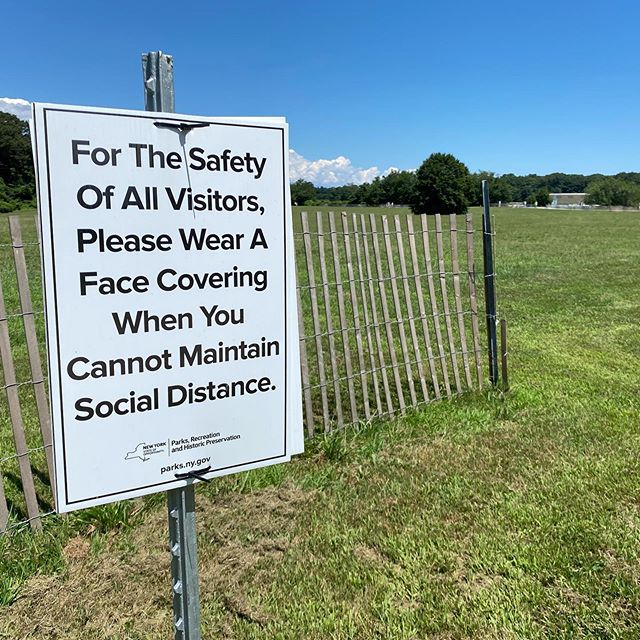
A sign posted in Camusett State Park in Lloyd Harbor, NY
A sign posted at Caumsett State Park in Lloyd Harbor, NY.

August was always a good month.

In my childhood, I’d anxiously await the second Saturday and our three-hour drive to the Pocono Mountains. Families bound together by friendships our parents forged when we kids were young spent a week there together every year. There was something peaceful in the mountain air, the smell of the dirt path walking back to our cabins at night, and the cacophony of crickets by starlight that always, always gave me a sense of peace.

The end of that trip meant it was time to start thinking about going back to school. This never haunted me, neither as a little kid nor as a teenager, and certainly not as a college student. It also never haunted me as an adult. I always looked forward to the first day of school, as a student, as a teacher, and now as an administrator. The new school year, to me, always felt like a fresh start, a new beginning.

As an adult, August was typically the month when I had the most time to spare. My busy Julys had me running around, first with cheerleading camps, and later with summer school and conferences. I would always look forward to August because, despite having to keep an eye on my thinning checking account, I would always try to plan a few weekends away here and there. And the beach…. Oh, the beach! I would go early in the morning to beat the traffic, armed only with my sunscreen and a good book. Later in the day I might enjoy a couchnap in the central air, and maybe, just maybe, I had something else to look forward to that evening…. an outdoor concert, a street festival, dinner and drinks with friends, a date with my boyfriend, now my fiancé. To me, the arrival of August always conjured up feelings of rejuvenation and joy.

Until this year.

The feeling I have now is three parts stress and one part dread. This salty, unsatisfying cocktail has me deeply unsettled, especially in a month when I don’t typically have much else to occupy my brain.

This August there are no concerts, no street festivals, no dinners with friends, and certainly no beach days. I know that at least two of these things can be accomplished with careful social distancing measures in place, but I’m not keen on putting my health and safety in the hands of others. Especially when so many out there refuse to wear masks or still think that all of this is a hoax.

I am looking forward to the new school year with none of the excitement I had in years past, but instead with a fearful kind of hope that we can actually do this and keep everyone safe at the same time. Regardless of what version of “back to school” Governor Cuomo permits, I’m going to put on my big girl shoes and deal. I will do everything in my power to keep myself safe and hope that if I do end up catching COVID-19 at some point that my weakened immune system will be able to handle it. Because, quite frankly, what alternative do I have? What alternative to any of us have?

Yesterday school districts all over Long Island released their three-pronged reopening plans to the public as they were likewise sent to the State for approval. It didn’t take long for the Facebook moms’ groups to light up with critics comparing and contrasting their districts’ plans to others. Though I don’t have school-age children, I watched the posts and comments populate in the three community groups I’m in. In one thread there are groups furious that the “hybrid” plan limits virtual instruction on “off” days to an hour of synchronous videos per week. On another thread there are desperate single parents looking for childcare so they can go back to work. In yet another there are some demanding property tax refunds because schools, “won’t be educating my kids this year after all.” Some are contemplating homeschooling, some are calling for the governor to be drawn and quartered, and others don’t understand what the big fuss is about because, “this is just like the flu.”

In a handful of comments, you have teachers speaking to their own mix of stress and dread as they face going back to school, only to be berated by an oppositionist camp of essential workers who “never stopped working” since the pandemic started. Nobody wins this argument.

My parents now live in central Florida, and I hate the fact that I haven’t seen them since February and that I don’t quite know when I will see them next. Every time I speak to my father on the telephone, our discussion inevitably turns to how we’re both managing this crisis. He said something to me last weekend that struck a nerve. He said, “Your generation doesn’t know what it feels like to be prepared to die, and that’s why you’re all so afraid.”

The statement kind of shocked me at first, but he explained further in a way that made perfect sense (like he always does). The men of my generation volunteered to go to war, they were not forcibly drafted. The women (or men) of my generation who wait on their military and/or first responder spouses to come home safely do so squarely in the reality that their spouse’s career path was a choice. In my father’s case, a football injury and the shattered ankle that followed kept him far away from Vietnam, but he had many friends who were drafted and fought. Not all of them returned. It was a horrible reality, but it was indeed reality – especially for those who didn’t have the money or means to dodge the draft. How many generations before them were sent to war knowing there was a solid chance they would not come back alive? It was true for my grandfather as well, who was fortunate to live long enough to see his honorable discharge and take home his Purple Heart.

Fear is not a stupid emotion. Fear is what keeps people from doing stupid things to put themselves in danger. The fear that I feel – that many of us feel – is valid, but something I can no longer rely on to keep myself safe.

So this August will be spent trying to relax and decompress as much as possible, far away from the beach and with lots of meals at home. And while it will not include many of the fun things of Augusts’ past, I will at least have time and energy to throw myself into the task of figuring out not just how I can keep myself safe in the fall, but how I can be the best and most solid resource for the teachers and kids who I work for. I’m reading a lot… some books for pleasure, but lots of research articles and professional texts, too. Since April I’ve been doing everything I can to learn about best practices in virtual instruction, and this effort will now ramp up in August.

I will continue to sew masks, and I will continue to hope that one of my weekly 7am visits to the grocery store will eventually yield me a tube of Clorox wipes.

I will try to make peace with the reality that I or my fiancé might catch COVID-19. If this happens, I will try to make peace with the fact that either of us could suffer from long term consequences of the illness, or we could even die.

I will make an appointment with my attorney to update my will, just in case.

I don’t mean to be grim. And I apologize deeply to anyone who made it this far and feels worse for it.

But this is August, now.

Welcome to my Master Class on “Surviving 2020.” Now Here’s Your List of Required Reading, Watching & Writing (Part 1)

INTRODUCTION AND COURSE SYLLABUS

Oh. My. Goodness.

What a year we’re having, amiright? Forget the fact that we’re in the midst of an unprecedented three-month social and economic lockdown caused by a global pandemic… we’re told to anticipate an active hurricane season and something called murder hornets, the simmering unrest fueled by decades of racial tensions is back up to a boiling point, and what promises to be yet another volatile presidential election is banging at the door.

All joking and metaphors aside (as if any of these are cause for humor), now is the time for Americans to be smarter. About, well… everything.

How do we educate ourselves? We read. We watch. We write. Such activities lead to THINKING… and we need that more than ever in order to survive 2020.

What follows below is not by any means an exhaustive list, nor is it meant to be in the first part of this “course.” [Aside – I don’t have all day to write this post, so I’ll come back and add to it later]. What I would REALLY love to do; however, is create a space for individuals to discourse about these topics through the context of our learning. Hmmm…

Before we get there, here’s what you need to know to be successful in this course.

LIST OF REQUIRED MATERIALS

In order to come to class prepared and ready to work each day, you need the following materials:

  1. A library card
  2. A Netflix subscription
  3. A black composition notebook (old school) or a blog (new school)
  4. An open mind and a willingness to learn

TOPIC 1: A REVIEW OF EVERYTHING YOU WERE PROBABLY SUPPOSED TO LEARN IN HIGH SCHOOL

Watch The Monsters are Due on Maple Street

The Twilight Zone series is presently available on Netflix, but you can probably catch this uncut episode on YouTube

If your recollection of the term irony stems from the Alanis Morisette CD you listened to on repeat as a teenager, we need to do some work.

As you watch, ask yourself these questions and journal about them in your notebook or blog: 1) What is the driving force behind the characters’ actions? 2) Who is to be blamed for the story’s outcome?

Read The Lord of the Flies by William Golding

Get it at your local library or purchase a copy of your own.

The Quirks of English: The Lord of the Flies : the beast within ...

What happens when a gaggle fine upstanding white boys are left stranded on a deserted island with no adult supervision? Sounds like an adventure, huh?

And – NO. You’re not allowed to read the Cliff’s Notes for any of this. Our soundbyte-loving society is in dire need of complete and thorough (unfiltered) information to process and analyze on our own terms, not through the lens of someone else’s agenda or expertise. What does that mean?

(Hint: If you participate in this master class, you’ll be able to answer that for yourself.)

After you finish the book, use space in your notebook/blog to write (or sketch) about your views on the inherent nature of man. Are we predisposed to do good? Or are we predisposed to do evil?

For extra credit (or perhaps just to get some assistance to answer the questions above), you may want to look into these philosophers to see what they have to say about the nature of man: Jean Jacques Rousseau, Thomas Hobbes, and Maximilien Robespierre.

Read 1984 by George Orwell.

Get it at your local library or purchase a copy here.

The best George Orwell quotes

If you’re familiar with the book and know it well, I think you will agree that this is one of the most scary-poignant novels in the high school canon. Unfortunately the deeper implications of the text are often missed on high schoolers whose parents may have deliberately shielded them from the ways of the world. Even if you feel like you know it fairly well, it’s worth another read through the lens of your life experience.

I suggest you do some work in your notebook at various intervals during and after your reading. You’re probably going to have some, uh, stuff to journal about…

Watch History 101 Episode 3: “The Rise of China.”

U.S. to Expel Chinese Graduate Students With Ties to China's ...

Learn more about this new docuseries in this blog post. You can find it on Netflix.

If the last time you read or watched anything about China was in your 10th grade Global History class, it’s time for a refresher. This one will take less than 25 minutes.

After you watch – spend some time in your notebook answering this question: What’s the big deal about China?

PREVIEWING TOPIC 2:

Once you’ve established a baseline through reading, watching and writing about the selected works above, we’ll be ready to delve deeper into some analysis of modern topics. I’ll give you some time to get started before I release all of that on you just yet.

A Metaphor for Leadership in Times of Crisis

I am one of approximately 3 million people in America living with Crohn’s Disease.

After years of skating by with mostly good health, my system started to flare up again in early 2011.

At the time, my gastroenterologist had tried several rounds of tests and medications only to find that nothing was working to combat the inflammation.

The news came in a follow-up appointment after I was sent to the emergency room because a routine colonoscopy went sideways. “I will continue to treat you locally,” he said to me, “but I need guidance from someone who has experience working with more complex cases like yours.”

He then referred me to a colleague affiliated with Mount Sinai hospital in New York.

To make a long story short, I saw his colleague in the city. I needed surgery. I was told after the fact that the inflammation in a large section of my small intestine was so bad that I was perhaps months away from a far more scary health situation.

Flash forward to the present day… I am much better now. Since my surgery in 2012, the medications that had originally done nothing seem to be working. I am still being treated by my local gastroenterologist who frequently consults with my doctor in the city any time he has a question regarding my care.

I will never leave him.

The truth is that I have a tremendous amount of respect for what he did. He knew his limitations, and in his focus on doing what was best for me, his patient, he referred me to a colleague who he knew could do better.

Had he led with his pride rather than what was best for me overall, it’s quite possible that my story would have a different outcome.

I often tell this story when speaking of those qualities of leadership that I think are most important. One is our ability to recognize our shortcomings and ask for help.

How many leaders have I worked with… how many leaders have YOU worked with… would just assume sweep their shortcomings under the rug and move forward pretending that they didn’t exist?

But I think the real point of this metaphor is to illustrate the power of collaboration.

We are now moving into week nine of remote instruction here in New York State. As time passes, I’m learning that school districts all over Long Island have had vastly different approaches in navigating the shift from brick-and-mortar instruction to working in an online environment. Suffice it to say, some are doing as well as can be expected, some are doing more, and some are doing less.

What is needed, more than ever, is collaboration. At all levels. Especially in the glaring absence of straightforward guidance from central powers such as the State Education Department.

I often hear Governor Cuomo referencing that many decisions about remote instruction are to be left with the local school districts. Ironically, this is the same governor who pointed out shortcomings in leadership coming from the federal government and worked to form a coalition of northeast governors to make somewhat of a shared decision-making team for our states.

There is an opportunity, at every level, to do better through collaboration. And I think that there is a huge missed opportunity on the part of the State Education Department and even, to an extent, our local BOCES, to make opportunities for collaboration much easier through the power of leadership and organization. Perhaps that’s a topic for another blog post.

In this moment, wherever we all are in the pecking order of the educational system, we need to find that important quality of leadership within ourselves. We all need to acknowledge our shortcomings and identify those people who we know can do better, and we need to reach out to those people and ask for help.

Teachers should not be working in isolation trying to figure out how to use a technological tool they’ve never seen before. Curriculum leaders should not miss out on opportunities to reach out to colleagues in other areas for frank discussion about successes and shortcomings of our practice. A central administrator shouldn’t exist as an island, but instead consult with a wide range of stakeholders to establish a three hundred and sixty degree view of what is, what should be, and what could be.

Now more than ever, it’s important for all of us to look for and to acknowledge our shortcomings and ask for help.

Today, May 11th, we should all be acutely aware that there is a very real chance that school will not be able to open “business as usual” in September. This realization should serve as a call to action for all of us working in brick-and-mortar schools: What are we doing TODAY that will prepare ourselves for whatever happens then? With whom will we collaborate to make the best decisions?

Teacher leaders – What will you do today to improve your craft should you need to teach online in September? Who will you ask for help?

Department leaders – What will you do today to ensure that the teachers with whom you work have the professional development and resources that they need to do this effectively? Who will you ask for help?

Building and District leaders – What will you do today to improve equity among the families in your district to ensure all have the ability to connect and engage in a virtual classroom environment? Who will you ask for help?

Parent leaders – What will you do today to prepare your children for success in this model moving forward? Who will you ask for help?

My hometown gastroenterolgist is a great guy. He’s treated me well for ten years and counting. I will stay with him until he decides to retire.

Why? Not because he’s the best at everything on his own, but because he is better through collaboration with others in his field.

“Inconsistent Effort and/or Performance”

The title of this blog is a canned progress report/report card comment that I’ve used more frequently than I’d like to admit.

I doubt any educator needs an explanation, as I’m sure most school districts have some iteration that captures the same idea. The truth is that some of our most capable students can be guilty of doing lackluster work at times.

Take, for instance, the fact that I haven’t updated this blog since April.

I feel guilty about this… what kind of self-proclaimed “writer” ignores a recently-started blog project for almost three months? 

But I guess I should give myself a break. These last few months have been incredibly busy, not just in my graduate studies, but in work and home life as well. We all know what the last days of school bring, so I won’t bore you with the details there… While I did have about a week and a half to myself between the last days of school and starting summer school, there’s was still plenty to be done. I’m in the process of trying to get a significant construction project off the ground at home. While “that old house charm” is certainly a perk of living in a house built in the early 1900s, a huge drawback is that the original garage (which was built in 1928), is, as they say, “past its useful life.” While trying to construct a bigger and better garage on the other side of my property, I’m running into those typical fill-in-the-blank roadblocks homeowners face when doing construction.

Ok, enough with the excuses!

The summer semester has come and (almost) gone. This one was particularly rough because it involved a STATISTICS course. I should point out that I couldn’t pass Syracuse University’s watered-down version of Probability and Statistics for Dummies (not actual course title, but it might as well have been) as an undergrad back in 1998, so this class was especially challenging.

Today was our final exam. I think I rocked it. I guess I’ll find out soon enough…

The mental anguish that came from four hours of Stats each Saturday morning left me weaker than usual for my afternoon class, which is a bummer because it involved deeply creative and philosophical discussions and projects. My kind of jam. Unfortunately I came into class like a marathon runner who hit a wall way too early. I probably exhibited much too much “inconsistent performance.”

But here’s the great part: I’m FREE for the rest of the summer!!!

Well, sorta… I still have some projects to finish for that second class and three more weeks of summer school. But I can at least sleep in on Saturdays for the rest of the season!

Are you still reading? If so, everything thus far is a preface to my very simple point:

I will be returning my energy to this blog in the coming weeks. 

Thanks again for joining me on this journey!

IMG_0909
Check out Portia (and the other formerly-homeless pets that live in my house) on Instagram: @lifewithportia


Preparing Students to be “College and Career Ready” : Where are we lacking?

It was more than twenty years ago, but remember my first year of college like it was yesterday. In August of 1997, my parents drove our navy blue Chevy Tahoe five hours north on I-81 to Syracuse University and dropped me and countless boxes of my belongings into an “open double” in Day Hall.

Three weeks later, I was already “in the thick” of my first semester, which was primarily filled with prerequisite courses needed for my liberal arts core: Biology, Psychology, Probability & Statistics among them. Each of these classes met in large lecture halls about the size of my high school auditorium.

Dr. Druger was my biology professor. I remember him as a great guy… passionate. He required each of his freshmen to meet him in pairs or groups of three for lunch at a dining hall of our choice. This was his way of connecting with each one of us personally, and he was the only professor I had who did this. Most other 100 and 200-level courses were taught by professors who probably couldn’t pick me out in a lineup, and I don’t recall their names.

Probability and Statistics. Ugh. Let’s just say that I ended up dropping this course, but the truth was that, past midterms, I could barely maintain a D plus. Math was ALWAYS my struggle in high school, but at least in high school I had the benefit of caring teachers who were looking out for me. My Stats lecture probably had 80 kids in it, and while I remember going to weekly recitation (led by graduate assistant in the math department), I don’t remember a thing about it. The sad part was that I knew I was lost, and I also felt helpless as to what to do about it. Luckily my faculty advisor found me a data analysis class that satisfied my math requirement, otherwise I would have been in real trouble.

College and Career Readiness for Success (CCRS)

This phrase was a mere sentiment in the mid-90s, and to credit my parents, they did what they could to adequately prepare me for college, but not all families can (or do). In fact, many of my high school friends did not complete their four-year degrees as planned. Some even dropped out after their freshman year.

What happened? We all went to the same high school and took the same classes. Why were some of us able to function in college while others did not?

I’ll come back to that…

Somewhere in the mid 2010s, the U.S. Department of Education published this document that articulated a growing problem: too many of this generation of college students are forced to take remedial classes because they haven’t mastered the academic skills needed for college coursework. At the same time, employers across the nation began to grouse about ill-prepared candidate pools, which can be used in defense of outsourcing. The CCRS “movement” gained momentum along with the Common Core State Standards, which were fashioned as academic learning standards that would ensure that all students would be equally prepared to face the rigors of college and beyond.

I’m going to temporarily ignore the “career” part of this phrase and instead focus solely on college readiness. As secondary educators, we can ensure that our grade level curricula teaches the necessary prerequisite skills so that students do not need to waste their first semesters of post-secondary education taking non-credit remedial courses. We can work with our students to teach them the academic norms related to critical reading, annotating a text, submitting a properly-formatted research paper. We can predict their academic success based on their performance on standardized exams, and if they perform poorly, we can implement interventions.

But what are we doing to help students attain the non-academic soft skills they need for college?

One of the better explanations of what it means to be “college and career ready”, in my opinion, comes from Dr. David T Conley, a professor of the University of Oregon who led the Educational Policy Improvement Center (EPIC), which is now called Inflexion. In a presentation created for Edweek, Conley advocated for a more whole-student approach to CCRS. This includes the notion that students must “take ownership of their learning and become proficient with a range of learning strategies.”

In my own experience as an undergraduate, graduate, and now a post-graduate student, I can attest that college professors do not always take attendance (if at all). They do not march up and down classroom rows to check if students have done the previous night’s homework. They do not call home to tell mom and dad that a struggling student should seek extra help. Rarely in experience have I had a professor give me timely (and useful) feedback on my writing assignments. College students really do NEED to “take ownership of their learning,” as Conley says.

Through the lens of my own experience, I came up with three nouns that can either be innate personality characters or acquired behaviors: Gumption, Prioritization and Focus.

Gumption. I could have used some of this is Probability and Statistics. I was hopelessly lost and too intimidated to raise my hand to ask for clarification in such a large class. My attendance started to wane, and I feel even further behind.  I simply gave up.

What can we do, as educators, to teach students how to advocate for themselves when they feel lost? What can we do to ensure that they WANT to advocate for themselves rather than to simply give up, as I did?

Prioritization. I fell into the rabbit hole of my freshman year. I made a ton of new friends, I joined the marching band, and I participated in Greek life. It was “very difficult to find the time to study” when there was so much else going on. Band practices were from 6-8pm 3x a week, and more often than not my friends and I followed with some sort of social activity such as dinner on M Street, or simply “hanging out” at someone’s off-campus apartment. When was I going to study or do homework? Sadly, many of my class assignments were done in the late-night hours, and my sleep suffered. I’m certain I handed in many assignments that didn’t represent anything close to my best work. Though I “effortlessly” excelled in English classes, I got by in college with a lot of “fake reading.”

What can we do to help students value their education enough to put schoolwork ahead of social distractions? How do we help students develop time management skills for out-of-class work in an era where the value of homework is being questioned in elementary and secondary settings? 

Focus. Let’s be honest, we administors cringe when we observe teacher-focused, teacher-directed lessons that involve little or no student-to-student interaction. We WANT to see the teacher stepping aside to allow students to direct their learning. The old “chalk-and-talk” model of class lecture is outdated; instead, students should be working primarily in groups, right? Many of our classrooms have been re-worked to eliminate the front-facing rows in favor of desks arranged in collaborative-clusters of four. Many of us who are financially capable of doing so have adopted a flexible-seating policy where students can opt to enjoy class from a comfy bean-bag chair or a stool behind a high-top table. Many of us work hard to discourage districations by having students drop their cell phones into a numbered cubby upon entering a classroom. I myself used to take my students’ phones away when I caught them texting in class and wrap them with paper and masking tape, a practice that never got me into trouble (but certainly could have).

I wish there was a way that high school administrators and teachers could relive college as a freshman, just for one week. How many classes are held in large lecture halls with 100+ students listening to a sage-on-the-stage talking through PowerPoint presentation? How many professors may be brilliant minds in their fields but poor teachers? How many freshman classes follow the accepted structural pattern of a lesson with a clearly definable Anticipatory Set, Direct Instruction, Guided Practice, Independent Practice, and Summary/Closure? How many professors use classroom management techniques to ensure that students are attentive and participatory? How many professors ask students to check their cell phone use in class?

I don’t think I need to ask any more rhetorical questions on this one. The subtext should speak for itself.

Please don’t misunderstand me; my intention is not to be critical of our practices as secondary educators. My criticism, instead, is in the concept of College and Career Readiness and its buzzworthy omnipresence that focuses so much on academic learning standards and assessments.

The beauty of public education in New York State (and throughout most of the nation) is that educators value good teaching practices and professional development. While many college professors may be brilliant minds in their  respective fields (as evidenced by terminal degrees, accolades, research grants and publications), how many are able to teach in the manner that today’s students are accustomed to learning?

To circle back to a question I posed earlier: If we examine a pool of students who have similar family backgrounds, similar socio-economic prowess and the same educational experiences, how can we predict who will compete four year degree and who will not?

Obviously there is no simple answer to this question, and as my St. John’s professor Dr. Rich Bernato would say, “There’s a dissertation in that.”

But I honestly think it has to do with those personal characteristics and associated behaviors. Perhaps this is why Carol Dweck’s Mindset became such a popular read around the same time that CCRS and CCSS shifted into gear.

Still, while CCRS is a well-intentioned initiative, there may be an imbalance between the focus academic skills over the development of soft skills for universal success. Educators (and parents) may need to do more to help students become persistent go-getters who can thrive in any academic setting.