Supervisors: focus on growth, not perfection.

From Focus on excellence, not perfection by Naphtali Hoff. The full text of this article is here.

Before I dive in here, let me explain what writing “from” something means.

What you see here was inspired, in some way, by the article I linked above.

This is a concept I’ve come to understand from reading and learning from educators such as Kelly Gallagher, Penny Kittle, and Linda Rief. One thing I’d like to do this year (that is, as I chase my non-resolution to create more) is to use texts as sources of inspiration for my own writing.

I’m mentoring an aspiring administrator this year, which is a first for me. As I brainstorm a list of things I’d like for her to take into her first administrative role, my mind goes to some conversations I’ve had with colleagues about lesson observations. That is not what Hoff’s article is about; however, reading that first and coming back to this might offer some additional context for the brain dump that follows. It’s a response, but it’s not a response. Perhaps its better to explain it as an idea that leapt from the platform of the one that came before.

Mr. Jones teachers another perfect lesson. Photo by mentatdgt on Pexels.com

I’ve been a school administrator for nearly seven years. In the context of my role, I conduct one formal observation for each veteran (tenured) teacher that I supervise, and at least two formal observations for probationary teachers. Most of the teachers I work with are around my age, give or take a few years. We have at least 10 – 15 years of classroom experience, with much of that from the same school district. Sometimes that experience is tipped, if not exclusive, to one or two grade levels.

Mr. Jones* has been teaching 9th grade English for about twelve years. He’s an excellent teacher, often one of students’ favorites in their high school days. His lessons are thoughtful and creative, at least as far as I can tell… In the seven years that I’ve worked with Mr. Jones so far, he has consistently arranged for me to observe him teaching one of his tried-and-true, already exemplary lessons. Each year it seems that I see a lesson that Mr. Jones has had plenty of time to develop, self-assess and perfect. Our pre-observation meetings are typical: Mr. Jones shares a summary of the lesson I will see, and he explains the context of where it falls in the unit. Sometimes this idea is accompanied with an already-written lesson plan, sometimes it is not. Either way, Mr. Jones speaks through his plan expertly, confidently, justifying each procedure and explaining with explicit detail how long each activity will take. His matter-of-fact demeanor suggests that he is neither looking for nor wants questions or suggestions. If I’m being honest, I don’t often have any questions or suggestions because everything is plausible and clear. Mr. Jones already knows that this lesson has been field tested and perfected. While he can’t always control for what will happen in class that day, more often than not, everything goes as just as expected…just as he planned.

Ms. Davis* is also a veteran teacher. Though I suspect she’s been in the classroom for the better part of twenty years, she’s bounced between different grade levels and between the middle school and high school. For the last eight years, Ms. Davis has been teaching 8th grade exclusively. Ms. Davis rarely comes to our pre-observation meetings with a solid lesson plan. More often than not, she has an idea, a seed. Our conversations fascinate me because she walks me through her metacognitive processes, and I watch that idea become a plan. While Ms. Davis doesn’t usually ask for feedback or suggestions, she’s open to both. She welcomes my questions, and she does not feel challenged by them. It might be fair to say that Ms. Davis has no clue what’s going to happen when I see her class for our observation. She will often say, “This sounds good in theory, but I’m not sure how it will go in practice.” Sometimes her lessons are executed beautifully. Sometimes they tank.

I am the direct supervisor for both teachers, and I’m the only administrator who has seen them every year for the last seven years. In that time, Mr. Jones has not demonstrated, at least to me, any growth in the design or execution of his lessons. Nada. Zip. Zilch. Now I am smart enough to know that Mr. Jones, because he is such a great teacher, is often experimenting with new lessons and ideas. For whatever reason, he chooses not to show them to me. Ms. Davis, while not particularly proud of those lessons that fail while I’m in the room, is at least OK with it.

I actually love the bad Ms. Davis lessons, and others like them. They make me feel useful, at least, as there is an opportunity for the two of us to roll up our sleeves. We can consider what went wrong from both perspectives, and we can work together to fix it. I learn so much about good teaching from these exchanges.

I don’t so much love the Mr. Jones lessons. While I got to see a nice show, I’m not being utilized well for the observation. I can give nothing but praise and validation. There’s nothing to fix, nor is there anything to suggest. Gold star.

I’ve spent a lot of time reflecting on why far more folks share the same mindset as Mr. Jones, “My supervisor needs to see a perfect lesson.” I don’t have an answer, but I have this… In my own classroom days, I’ve had excellent supervisors, and I’ve had terrible supervisors. I’ve had supervisors who were compassionate and real, and from whom I’ve learned a great deal. I’ve had others who did things like use the chromebook I offered to follow along with an activity to check e-mail and do some shoe shopping, or forget to swap English for math in the paragraphs they clearly copied and pasted from another teachers’ observation to mine.

This is not hyperbole. These things actually happened to me.

But perhaps those not-so-good experiences that I’ve had with certain supervisors taught me, more than anything else, that this role needs to be taken seriously. We will never earn respect if we don’t give the task the respect it deserves. We will never earn trust if we dole out “developing” scores punitively.

I’ve also learned from my good experiences. Our relationships with our colleagues need not over-emphasize hierarchy. School administrators like myself are neither experts or gurus. We can’t let our egos lead us, no matter how many gold stars we ourselves received on our Danielsen rubrics. While I’ve learned so much about good teaching from the context of this role, and while I’m confident that I could be a better teacher tomorrow than I was on my “best” days from 2000 – 2015, I know there is no way I’d be able to pull off executing mistake-free lesson plans for the rest of my days. Absolutely not.

But I can promise this… I will not fear those mistakes in front of a supervisor who works hard to earn my trust, who takes the process seriously, and is going to do what she can, however much or however little, to help me be the best teacher I can be.

I wish all of my teaching colleagues were more like Ms. Davis and less like Mr. Jones. I wish all of my teaching colleagues knew that its ok to be vulnerable. It’s OK to take risks. It’s OK to step away from their comfort zones when I’m in the room.

I celebrate those moments in pre-observation meetings when teachers indicates that they are trying something new and are not sure how it will go. If I’ve earned their trust, if I’ve walked my talk, they will never see any feedback from me as “judgey,” and the narrative I will eventually write to accompany a not-so-great lesson will certainly never, ever be punitive. I know that there are performance indicators on that rubric that run the gamut from awesome to awful, but I make no apologies in saying that, in my opinion, an effective or a highly-effective teacher is not made so by the language of a rubric. In my eyes, the truly highly-effective teachers are the ones that leave room for growth, no matter how long they have been teaching.

This is a plea to all of my fellow administrative colleagues: please do not create an environment where the teachers you supervise feel like they’ve done something wrong if their lessons aren’t perfect all the time. Let teachers know that it is safe to take risks in lessons that will be observed. How else can they get authentic feedback from a colleague? Please behave in a manner that celebrates the occasional failure as a teachable moment. If something goes wrong, or if something can be improved, don’t check the “bad box” write about it in the narrative… roll up your sleeves and offer to help. Allow a do-over. Show your colleagues that it is OK to be vulnerable by acknowledging that we all make mistakes. None of us are perfect. The best we can hope for, in all circumstances, is growth.

If you want to do any of the things I mentioned above, but you are fearful that your supervisor simply won’t have that, feel free to print this blog post and share it with them. As a matter of fact, give them my phone number, too. I might be small, but I’m mighty.

That being said, even after seven years, I have so much more growth to accomplish. I need to find a way to make Mr. Jones and teachers like him feel more comfortable showing me a lesson that needs peer feedback. I need to find a way to create a circumstance where he can accept that feedback without losing confidence. I’m working on it.

The good news is that I have a number of exemplary role models and leadership mentors less than a phone call or a five minute drive away. I am blessed to have learned what I have from their leadership. If I, if we, ever figure this out, I’ll let you know!

*Mr. Jones and Ms. Davis are fictionalized characters, created as amalgamations of real people and real situations I’ve encountered both as a teacher and as an administrator.

Reading in the New Year: Check out this Little Free Library Community Reading Challenge for 2022

While on a date in early February of 2019, my husband (then fiancee) and I had come across a Little Free Library situated a small community park near our restaurant. Though I had stumbled on a few these before and was familiar with the concept, this was the first one I found on Long Island.

A few weeks later, the two of us went to a meeting at Brightwaters Village Hall to pitch the idea of building a Little Free Library to be installed on our local community park. Everyone seemed to love the idea, and we promised to get started at some point in the spring.

Then March 2020 happened, and suddenly we found ourselves with a lot more free time. Our Little Free Library was finished and ready to be installed by early July. Over the last year or so, the idea born from the last date my husband and I enjoyed before the world shut down is now thriving. Though Rich and I are “stewards” (meaning we built it, purchased the charter, and promise to maintain it), the library’s success is due to many members of the community who are regular patrons. Before we installed the library, we amassed a collection of donated books from friends and co-workers. A few of them were placed into the library for its soft opening, and others are in several boxes in my attic. We have not once needed to go back and “re-load” the library; the community has made it their own.

At the suggestion of other Little Free Library stewards, we created an Instagram account to promote our library and engage with its users. I know there are many folks in this world who are incredibly skilled at leveraging social media for engagement, I’m not one of them. I haven’t posted to the Instagram account much, so there hasn’t been much engagement at all. I’m going to try to improve that in 2022.

The mere presence of the library might have helped some folks re-discover a natural love of reading. This year, I’d like to use he library and its Instagram account as a way to engage with members of the community and help all of us connect with one another. This is where the idea for the Reading Challenge came from, and topics are posted for each month as suggestions to help stretch readers beyond their comfort zones.

You don’t need to live in the community of visit Little Free Library #103103 to participate in this challenge – it’s open to everyone! I hope that we can use the Instagram page as a way to share and review our selected titles each month. There are no “prizes” for completing this challenge other than the personal satisfaction that might come with it. If a few friendships are forged through this process, that’s a bonus!

January’s suggested topic is A Recently Published Memoir. I have my title picked out, which I’ve shared on the LFL103103 Instagram page. I hope you check it out!

Whether or not the idea of this reading challenge is for you, I encourage you to read beyond your comfort zone in 2022. Where will you start?

I Just Finished a Memoir Written by a 15-year-old Transgender Teen and I Have So Many Feelings….

I have a confession to make. It’s after 6pm on a Sunday, and I’m still in my pajamas. 

In my defense… we’re more than halfway through a cold and sloppy holiday weekend. I don’t have any plans, and even if I did, I’d be concocting some kind of excuse to break them. So maybe I should extend myself a little bit of grace for my sloth-like behavior today. 

After spending a few hours playing mindless video games, I did attempt to motivate myself to do some cleaning in the bedroom. That didn’t last long… a book I’d started and had yet to finish was sitting at the bottom of a small pile of “reading nows” on my nightstand. Any semblance of motivation to clean quickly fled, so I sat Indian style on my unmade bed and finished Being Jazz, My Life as a (Transgender) Teen.

And here we are. Though I don’t talk about its contents in explicit detail, this book is the impetus of this post, and what you’re reading is the product of many stops and starts… crap paragraphs replaced by lesser-crap paragraphs. What I’m saying here is messy, but it’s important, and I need to get it out of my head in into some kind of public discourse.

Here goes:

For weeks I’ve been doom-scrolling through my Newsday app and social media sites reading stories and first-person perspectives of what’s going on in Smithtown. The school district where I had enjoyed twelve years of teaching High School English has become Long Island’s epicenter of the anti Diversity, Equity and Inclusion movement.

I can and have shared my thoughts on this in private company, but will do no such thing on a blog or through social media. I have seen what happens to some educators who share their opinions on the Internet, and that’s not a tree that I wish to bark up. Further, I’m neither employed by nor a resident of the school district, so there are obvious limits to my understanding of the full story. But from what I’ve observed through print media and social media, it’s pretty ugly right now.

Also, this ugliness is not unique to this one community… it’s happening all over the country. Do a Google News Search using boolean-style terms “Critical Race Theory” and “Education.” You’ll get caught up and quick.

So let’s keep it moving, shall we?

I have a running mental list of texts, TED talks, conversations with others and learning experiences that shape my educator’s philosophy. One of these is an essay called Mirrors, Windows and Sliding Glass Doors written over 30 years ago by Rudine Sims Bishop of The Ohio State University. Despite its age, the text is so very relevant today. Painfully relevant. In fact, if you’re not familiar with this essay, please stop here and go read it now. You’ll understand it even if you’re not an educator, and what it says provides some important context for my argument. 

Here are two of the most powerful paragraphs:

I’ve been on a memoir kick lately. It’s not a purposeful reading goal, but instead something that happened somewhat organically. I love nonfiction, and I love hearing stories about people whose life experiences are different than mine. Hillbilly Elegy was not a “mirror” for me, but it helped me to rationalize why, though we share the same roots, I was raised differently than my first and second cousins who grew up in the podunk coal-mining towns of northeastern Pennsylvania. Between The World and Me was more of a window. I had an opportunity to peer into the mind of Ta-Nehisi Coates and see, maybe not understand, but see… the reason for his anger. Earlier this year I read the memoir of an ex-CIA operative. It helped me, in a small way, learn what it feels like to live in THAT world. It was part window and part sliding glass door.

Being Jazz was also part window and part sliding glass door. I think most children have experienced intense feelings of loneliness or abandonment, especially if they were ever the butt of a bully’s cruel joke. However, reading through the first person perspective of fifteen-year-old Jazz, I experienced the pain of bullying on a whole different level. It was an important read for me, not just as a cisgender woman, but as an educator who has worked with and will continue to work with children who are nonconforming in some manner.

These are kids in crisis. I don’t need to tell you that… I’m sure there are grim statistics that will show how LGBTQ+ kids are far more likely to do harm to themselves.

Yet there are politicians and pundits and parents who argue that these topics should not be addressed in schools. At all. Some laws have been passed that actually hurt nonconforming children. These laws are passed under the guise of “protecting” others from being exposed to this kind of information. As if this “exposure” was to a noxious gas.

So let’s stick to the basics, right? Let’s cram the traditional literary canon into the gullets of teens. Even if they don’t actually read the actual literature, they’ll learn from scanning Sparknotes that Tom Robinson’s outcome was hopeless because he was black. They’ll learn that Lennie had to die because he was mentally retarded.

These classic texts offer examples of what happens when humans are victimized by intolerance. Contemporary and YA texts do that, too. And this omnibus anti-DEI sentiment that’s out there, this rhetoric manifesting through social media posts in Facebook mommies groups or in red state legislature banning any discussions about potentially divisive current events in schools, it’s intolerance.

Diversity, Equity and Inclusion is not a movement to be feared. I suspect that those who fear it do not understand it, or they’re not in a place where they possess the empathy TO understand it, even if they can decode the words and gain the most surface-level comprehension of what it means.

Having discussions about current events in schools NEEDS to happen. Kids need a place where they can engage in discourse outside of the echo chamber of their home. They benefit from learning about what makes us different. They benefit from learning about and discussing history and science, and the evolution of these topics through research and innovation. Any parents who are triggered by these ideas should look deep within themselves and ask themselves why. We cannot send kids away to college bubble-wrapped in the myopia of their own experience.

Books like Being Jazz and its adapted children’s book should be available to kids, not banned. I can see how this book can be a much needed mirror for kids in crisis. They will see in Jazz a reflection of themselves, they will see that they are not alone, that their feelings are valid, no matter how rare or unusual those feelings might be in the eyes of the entire population.

More importantly, books like Being Jazz can help cisgender readers of all ages “window” into the experience of a trans peer. How wonderful would it be if more discussion of these real-world issues could mitigate some of the harm that comes from ignorance and lack of understanding?

Will Being Jazz make a typical boy decide, out of the blue, that he’s actually girl? Nahhh.

While we’re on the topic… books, fiction or nonfiction, that offer windows into the lived experiences of black lives treated unjustly by an inherently racist system should not be dismissed as fabrications of truth. The increased focus and attention on instances of black lives lost at the hands of police officers is not intended as or actually “indoctrination.” If this is the case, reading Mario Puzo’s The Godfather and watching all three films should be considered “anti-Sicilian rhetoric.” That’s just ridiculous.

I argue that the best thing we can do for kids is to help them develop rich literary lives where they learn how to be critical readers and think for themselves. We can do that by embracing Diversity, Equity and Inclusion as a vehicle to bring more diverse texts into classrooms. We can do that by creating opportunities for kids to ask questions, to engage in discourse with others, and to make thoughtful connections between literature and the world at large.

The books need to be interesting and engaging. Kids should want to read them and discuss them. Also, we owe it to our black youth to have them see themselves in literature as someone other than Tom Robinson or Crooks or Bigger Thomas. We owe it to our neurodiverse youth to see themselves in literature as someone other than Boo Radley or Lennie. We owe it to our LGBTQ+ youth to see themselves at all.

So let’s discourse. If DEI is on your mind, or if you’re not sure how it intersects with Critical Race Theory, or if you’re not sure what Critical Race Theory is… please don’t turn to the pundits on the cable news station. Please don’t rely on the posts in the mommies groups.

Read. Learn. Think.

And then decide how you feel.

For New York State Residents, here is the NYS Board of Regents press release and framework on Diversity, Equity and Inclusion. This is a primary source document: http://www.nysed.gov/news/2021/new-york-state-board-regents-launches-initiative-advance-diversity-equity-and-inclusion

Here’s a few chapters from a book on Critical Race theory. I found this by conducting a Google search and I’m not sure if this text is in the public domain or not, but it’s a good starting place.

Of course you can read news reports from left or right-leaning media outlets or news organizations, and there are plenty. However, if this ends up being your only source, you’ve reached the end of this post and missed my whole point.

One last recommendation… this is another of those galvanizing philosophical texts that I recommend to anyone who teaches or feeds/clothes/houses children: https://www.thecoddling.com . If you don’t have time to read or if you don’t consider yourself a reader, do yourself a favor and get the audiobook.

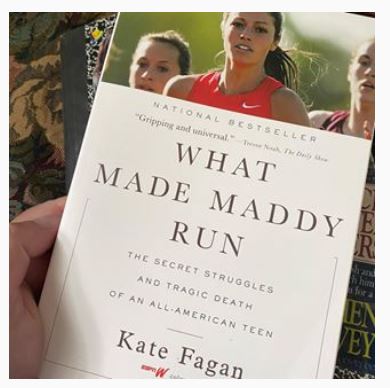
“…denying its existence isn’t helping anybody.” A review of “What Made Maddy Run: The Secret Struggles and Tragic Death of an All-American Teen”

One of the best things I did for myself this year was sign up for the Book Love Summer Book Club to benefit the Book Love Foundation. I enjoyed each of the texts selected for us this year, but the one I just finished – Kate Fagan’s What Made Maddy Run: The Secret Stuggles and Tragic Death of an All-American Teen – is perhaps the one that I enjoyed the most.

But how can one enjoy a book about the suicide of a young person? Well, no… it is not the subject matter that was enjoyable. Not at all. The subject itself is heartbreaking.

It’s Fagan’s manner in telling Maddy’s story that was most profound to me.

In the book’s Foreword, ESPN The Magazine Editor in Chief Alison Overholt wrote, “Great narrative journalism has long been about helping us to understand universal truths of the world by grounding big ideas in the stories of real people.”

The depression that had a stranglehold on college Freshman Maddy Holleran, the stranglehold that eventually led her tragic death, is a subject of universal truth that clearly needs to be addressed quite a bit more.

I reveal no spoilers when I tell you that Maddy Holleran ended her life in 2014 by taking a running leap from the top of a parking structure in downtown Philadelphia.

This event is not the focal point of the story. Instead, Fagan endeavored to examine what could have caused Maddy to make this choice. This final, irreversible choice.

I am not a mental health professional, but I know enough about suicide to understand that it doesn’t exist in a vacuum. The problem is that nobody wants to talk about suicide, and nobody wants to talk about suicide in the presence of kids. It’s almost as if mentioning the word or bringing up the topic in class dissolves some invisible protective barrier surrounding young adults that keeps them safe from suicidal ideations.

So in not discussing suicide, we often too ignore what leads to it: unrelenting personal pressure, anxiety, depression. While all of us battle these demons to one extent or another, there are so many people out there, kids out there, that succumb to the demons.

I must acknowledge my own discomfort in speaking frankly about suicide with students, and I would be hesitant to make What Made Maddy Run available to students without some kind of trigger warning or disclaimer, despite the fact that I loathe the idea of both, because I cannot guarantee that a particular student wouldn’t read a book about suicide and romanticize it.

That was not Fagan’s intention, and she says to herself. I think her approach was meant to give thoughtful readers a wide berth into examination of our own thoughts on anxiety, depression, happiness, and hopelessness. We get a window into Fagan’s thoughts through occasional deviations from Maddy’s story to present first-person narrative from her own experience. These are relevant inclusions and written from a place of empathy given Fagan’s background as a college athlete who also suffered bouts of anxiety and depression.

In fact, the complete story is an interweaving of Fagan’s access to primary source documents from the Holleran family, her own personal narrative, and various third-party interviews. Fagan interviewed those who knew and loved Maddy as well as others who, from their own experience, could offer either anecdotal or expert insight to illuminate Maddy’s mindset. This approach gives the reader a panoramic view of the tragedy through multiple perspectives. We are able to read Maddy’s text conversations with friends, narratives for school assignments, and personal letters to her track coach. We are able to get perspectives on Maddy from her parents, her friends, her friends’ parents, and her coaches. We get Fagan’s perspective, and we get perspectives from Fagan’s carefully-selected interviewees.

The phrase posted in the title of this entry comes later in the book, in a chapter titled, “The Rules of Suicide.” Here Fagan interviews Dese’Rae Stage, suicide survivor-turned-activist whose work aims to humanize survivors and bring light to the need for thoughtful and frank conversation on the topic of suicide. It was she that said, “…denying its existence isn’t helping anybody,” pointing out that we need to be able to talk about suicide in a safe way.

Stage adds, “I would like to imagine that the silence, or the inability to talk about it in healthy ways, directly relates to more suicides. “

One of the more interesting discussions in our Book Club chats centers with bringing Maddy’s story to the classroom. Can we do it? Should we do it? That’s tricky.

I recall a school psychologist I worked with, since retired, who had no problem projecting her frustration upon me when topics such as date rape, assault and suicide came up in English class. She said that such discussions drove fragile students into a state of panic, overflowing her office with urgency.

“You need to stop teaching Speak,” She would often say, adding that I had no idea how traumatizing the story was to kids who were themselves victims of sexual assault.

I see the point. I see it clearly. As a caring educator, the last thing in the world I would ever want to do is bring pain to a student.

But a teaching colleague also made a good point; “Isn’t that what discussion of these texts is supposed to do? Help us find the kids who need help so we can get them that help?”

So what do we do in the best interest of kids? I don’t have an answer, but I know this: Reading and discussing Speak in class is not going to bring an end to sexual assault, but neither is not reading and discussing Speak. Some students, whose own life experience is painful, will be reminded of that fact. Other students may develop an awareness of how sexual assault does long-term harm to a victim. Hopefully this awareness leads to empathy. Hopefully that empathy leads to a lifetime of “doing the right thing.”

How to introduce this text to students is a question I would like to explore with my colleagues: school psychologists, social workers, administrators, teachers, and coaches.

In the meantime, I do think the following people should read What Made Maddy Run:

  1. Secondary educators, especially those who are coaches. In another post, I plan to delve more deeply into the book as read from my own background as a student athlete, a coach, and now an official. Doing that here would have made this post long and unbearable.
  • Parents of teenagers or pre-teens, especially those who are parents of student athletes. I will argue that Maddy’s parents did everything they could to support their daughter and get her the help she needed. Though I’m sure they live with the regret and guilt that naturally comes with losing a child to suicide, they didn’t do anything wrong. The pressure Maddy faced was self-imposed. They recognized that, and they did the best they could to help her.
  • Those who lost someone they love to suicide. I lost a good friend from college, who took her own life at the age of 28. This came as a shock to all who loved her, as she always exuded (what seemed to be) pure happiness and contentment with the world.  I, too, felt a whole ton of guilt after it happened, trying to go backwards and search for any signs I might have missed that she was in trouble, any cries for help. Reading Maddy’s story helped me to understand that sometimes there are no signs, and we need to make peace with that. Before Kate Fagan came along to write this book, Madison Holleran was the author of her own life story. She published it on social media for the world to read. She sent it with her text messages. Everything that was plaguing her so deeply was internal, with only those closest to her knowing that she had some challenges, and with nobody knowing how extensive those challenges really were.

Can a book make you uncomfortable and still be enjoyable at the same time? Yes. It was wholly because of Kate Fagan’s thoughtful, respectful and skillful execution.

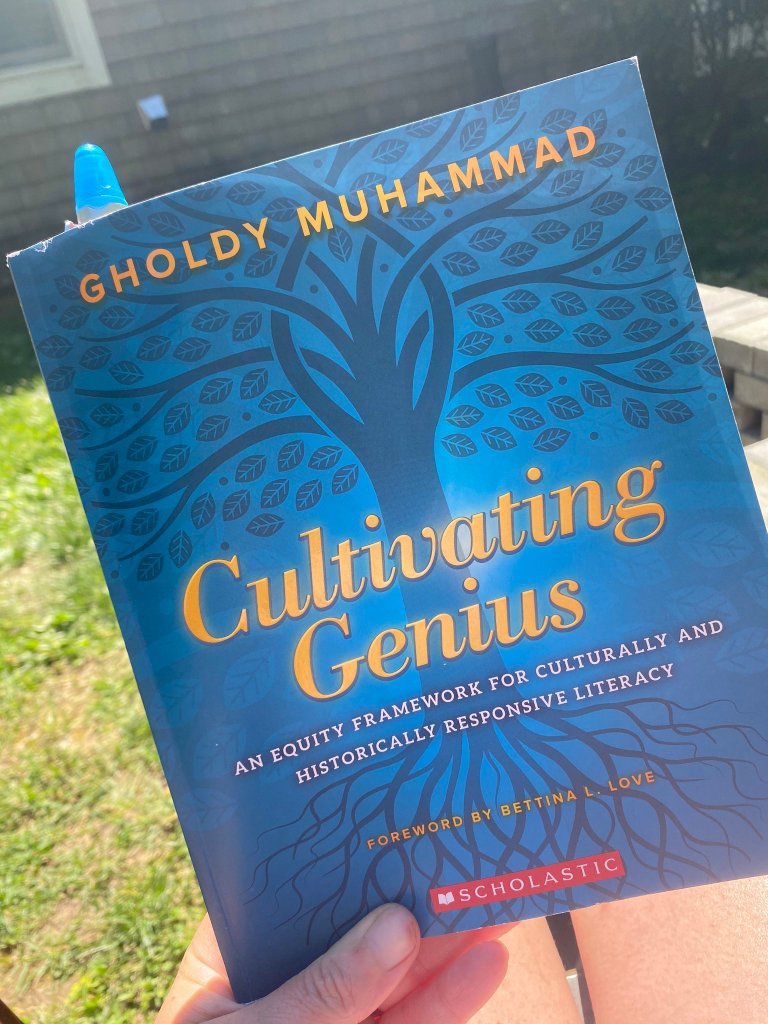
Summer Book Club: Cultivating Genius

Reflections from Chapter 1: Drawing from History to Reimagine Literacy Education

I joined the Book Love Foundation’s Summer Book Club this year. Selections for middle school and high school include this professional text: Cultivating Genius: An equity framework for culturally and historically responsive literacy by Gholdy Muhammad, a Georgia State education professor who founded Atlanta-based Black Girls Write! Perhaps because of its’ soaring popularity among educators after being featured in the Book Club, or perhaps because its subject matter is ever more timely due to current events, the book is presently sold out on Scholastic’s website.

About halfway through the first chapter, I realized how far out of my element I was. Here I am, a white educator who has worked in predominately white settings, reading a chapter in a professional text about Black Excellence. I was ignorant to this phrase prior to reading the book, and I imagine that’s not uncommon among my peers. I imagine that part of Dr. Muhammad’s purpose in writing the text is to educate the educators about what we’re misunderstanding about that buzzworthy phrase – “culturally-responsive pedagogy” – commonly referenced in educhatter and on job interviews.

There’s a tone-deafnessness there that we can’t always help. Case in point… the stay-at-home orders in New York State have given me some more time to go down that Twitter rabbit hole. A few days ago, I noticed that a former colleague had entered into a BLM/education argument by expressing the need to continue teaching To Kill a Mockingbird to 9th graders because the book provides opportunities to discuss the grim realities of racism.

I did not engage in this discussion. Instead, I took a trip back in time to the Tyrolia Literacy Institute that I was super-fortunate to attend last summer. There, as I read, wrote and thought among a truly diverse group of educators, I had that great opportunity to step out of my Long Island upper-middle class and predominantly white “bubble” and discourse with educators from all parts of the country. I helped me to understand things from different perspectives.

One night we had a spirited, but respectful debate about the merits of teaching TKAM over dinner and drinks. I think it was then that I finally began to understand the argument for letting it go.

I won’t go into details, as there are others making the argument much more eloquently than I.

But here’s the thing…

White educators, despite the best of our intentions, will never have a chance to understand a black teenager’s lived experience because we cannot, as Atticus Finch said, “climb into his skin and walk around in it.” But if we can break down the barriers of what we think we know and have known for years, we can begin to imagine what it must be like for a black student to continually read texts in English class where black children and adults are called words that we don’t utter in civilized company. Those characters are slaves, or freed slaves, or bound by the restrictions of Jim Crow. They are criminal or they are poor. They are disrespected and set up for a lifetime of poverty and heartache. We see it in To Kill a Mockingbird and Huck Finn and Of Mice and Men and The Help and Native Son. I can go on… By continually holding onto these texts because we think they teach important lessons about racism, we neglect the reality that there are kids in this world who already know lots about racism because they live within it every single day of their lives.

I met Chad Everett at Tyrolia. I’ve come to respect him and his work tremendously. I felt challenged by him, in a good way. It was he who pointed out that it’s time for me to “get uncomfortable” and “do the work.” A few months later I had an opportunity to meet and chat with Brendan Kiely at the NYSEC Annual Conference in Albany. He explained what it meant for a white educator to be actively antiracist. I am beginning to understand what that means now, and it is through the lens of the best kind of discomfort that I will read and attempt to learn from Dr. Muhammad’s book this summer. Hopefully this is a small piece of the “work” that needs to be done.

Because I think that’s what white upper-middle class educators like me need to do. We need to accept the fact that what we think we know and have known for years is not good enough anymore.

I’m going to keep much of my reflections on this book in a writers’ notebook – as there are some passages that I want to write beside and not necessarily for an audience. But I need to say that, even before getting through the first quarter of the book, I think it’s a worthwhile read for educators. English teachers? Yes. School leaders? Yes. Those who think they know what “culturally-relevant pedagogy” is?

YES.