In Retrospect, Cheerleading Taught Me Quite a Bit About Leadership Theories

I came home from school one day in fifth grade and begged my mother to sign me up for our town’s youth league cheerleading program. At this point, I had participated in a number of extracurriculars: softball, ballet, and baton twirling, each for no more than a year. I imagine my mother assumed that cheerleading would be short-lived as well. In fairness to her, the primary reason I wanted to join cheerleading was not because I had any clue what a cheerleader was or did, but because my best friend Brooke was on the team, and Brooke’s 3x weekly cheer practices conflicted with our frequent playdates. In all honesty, I just wanted to do what Brooke was doing (which was what explained my interest in softball, which I wasn’t very good at anyway…)

So at 11 years old, I became a cheerleader for the blue and white. The difference this time, however, was that something about cheerleading ignited me. Not only did I stay with the town team through the end of middle school, I went on to cheer in high school, and I eventually enjoyed a long coaching career in all levels of cheer: youth, JV and Varsity.
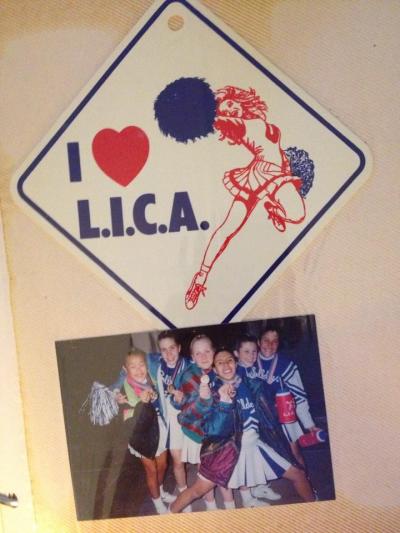
lica1993
A page from my 8th grade scrapbook – enjoying our team’s victorious performance at LICA Champs in 1993. 

To build context for this post, I want to go back and examine the leadership style of a woman who was deeply influential to me in this process. I first met the commissioner of our community’s youth cheerleading program at 10 years old. I remember her as a strict, all-business woman who took a tremendous amount of pride in the award-winning program she had helped to build. We were good… we were REALLY good! In my “senior” year on the 13-year-old team, the Bulldogs took first place in every competition we attended, including the SUPER awesome LICA (Long Island Cheerleading Association) competition that was held annually at Nassau Community College.

Her daughter, a year older than I, attended my high school. When it was time for me to try out for the varsity team, her mom had stepped in to serve as assistant coach.

To say that Coach helped to take our cheer program to the proverbial “next level” was an understatement. She coached with the same all-business discipline that set the standard at North Babylon. Though cheer was typically a fall/winter activity, we practiced year-round. Oftentimes practice included grueling conditioning exercises intended to build strength and endurance. We spent our “off season” attending stunt clinics and camps, and our Varsity team, in 1995, was the first from our high school granted permission to attend a national competition in Nashville, TN.
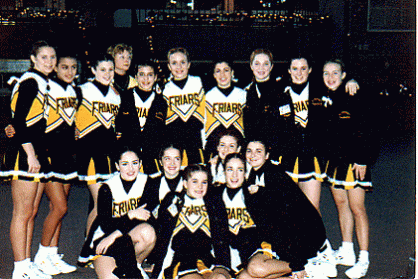
friarettes
The 1995-1996 St. Anthony’s Friarettes at Nationals at the Opryland Hotel in Nashville. I’m pictured 3rd from left in the back, and Coach is behind me.

Though I grew up with Coach, to an extent, she was not my “buddy” at practice. She was not warm, nor did she ever entertain any excuses as to why my individual (or collective team’s) performance was not to her expectation. I went to every single practice ready to work, even as I was battling a significant Crohn’s Disease flare and sometimes had to excuse myself to the locker room to throw up. The minute I came back into the gym, I went right back to my stunt group and kept working.

If at any time we stepped out of line, either as youth cheerleaders or as high school cheerleaders, Coach’s shouting would send icicles through our veins and snap us back to attention. Sometimes we were disciplined with extra conditioning: additional push ups, crunches, or jumps drills… one or two laps around the track. Late practices. Additional practices. And if we dared “fight back” (not that it was even a conceivable option), Coach had no problem benching us. Nobody on that team was irreplaceable, in her eyes. Knowing that kept us working our hardest.

I loved and respected her, but I probably also feared her. Regardless, I always thought she was an effective coach because I always knew that my teams were good. I felt lucky and honored to be a part of two very successful programs. I credited both to her.

Flash forward to 2002:

I begin my first year teaching English at a public high school, and I immediately expressed interest in working with the cheerleading program. I had been coaching a youth team since my senior year in high school, and I was ready for something more. As chance would have it, the existing varsity coach at Smithtown High School was expecting her first child. She welcomed my attendance at practice as a “helper,” and I imagined that someday I would be her official assistant coach, or maybe even head coach myself.

But I received an unexpected phone call on a cold December morning. The varsity coach had gone into early labor, and the team had a competition that day. Could I meet them on the bus and take them to the competition in her place?

That’s the day I became head coach of Smithtown Varsity Cheerleading.

I finished out the year with the team, who were sad to have lost their beloved coach to motherhood, but were also optimistic about a future with me. While I ran the remaining practices, I had nothing to do with existing choreography or stunt groups. I didn’t make too many changes. This was her team still, not mine…

My colleague never came back to school, so not only was I set to coach moving forward, I could operate on a clean slate without “ghosts” from the past (or so I thought). I was beyond elated at the idea and immediately got to work, spending lots of time thinking about the most effective ways to run practice, about stunts and choreography, about new uniforms.  Basically everything I had learned about running a competitive cheer program came from my own experiences with a coach, Robyn Woisin. I knew her approach worked, so I planned to do what I believed she would have done.

What I didn’t do was stop to think about the kids.

The members of the 2003-2004 varsity team were talented and capable, but they were not used to the level of hard work that I wanted from them. For me, cheer was life, and everything else was secondary. For them, cheerleading was something fun they did after school and on weekends, but it was not going to conflict with other important things they had going on.

Perhaps I was too immature at the time or simply couldn’t fathom “cheerleading” in any other way, but my approach with that team was tremendously unsuccessful. I butt heads with the kids, the parents, and even the athletic director… over what I thought were non-negotiable keys to success for a winning program. I came in there with my own mental model (as Peter Senge, author of The Fifth Discipline would say) or my own preconceived notion of what “should be” based on my own experience as a cheerleader with a demanding coach. My implicit bias stymied communication within the organization I was attempting to lead, and I failed.

Actually, I think most of the kids on that team ended up hating me. And I don’t blame them.

I was demoted to JV the following year, replaced by someone from another program who had far more coaching experience than I did, and she had come with a completely different style and approach. While I was upset at the time, I later came to understand why the demotion was the best thing for me. While my pride took a hit, I was able to take a hard look at what I had done wrong: I completely ignored the culture.  I had come in with an ego-driven agenda, and I assumed that everyone was going to be on board. I assumed that MY vision was also THEIR vision.  Not once did I ask if they were “all in” with me. Not once did I seek to understand before I could be understood. I didn’t “listen” to them (or interpret their thinking through action, or inaction). I thought, on my own, I could take an already-talented team and make them superstars. I thought that’s what they wanted.

I realized that I tried to break into an already-established culture and make sweeping changes with my wrecking-ball. It was incredibly naive of me to think like this because I never had buy-in. Not from them.

But luckily that next year coaching the Smithtown “JV Blue” team was different. In fact, it was undoubtedly my most successful year as a coach. Without knowing it then, I, with my team and their parents, had engaged in a form of presencing that Otto Scharmer describes as connecting deeply to our identity and our purpose to  “allow the future to emerge from the whole rather than from a smaller part…” That smaller part would have been my own ego that tripped me up the previous year.

I opened up to this group of 9th and 10th graders about my vision for the team, but I also endeavored to lean more about them and what THEY wanted from me, their coach. I began to see the “team” as a whole made up of parts: me the coach, the kids, their parents, our athletic director, the school. In the fall season, the team began to crystallize by committing ourselves to learning, growing, and working as hard as we could. The goals we set for ourselves were incredibly energizing and motivating. Unlike my varsity team the year before, this group of kids was accepting of my “tough love” approach. At the same time, I was learning and growing myself, and I quickly learned how far “tough love” would get me with different individuals, as some kids responded to softer, more patient approaches. We continued to work with my established cadre of cheer-industry professionals for tumbling instruction and choreography, who were also energized by this team’s confidence and grit. Similarly to my own experience in 1993, the JV Blue team ended up having an undefeated competition season, and they easily won Long Island JV Finals. I was even able to take them to Nationals. To date, no other Smithtown JV team has been permitted to attend a national competition. We were very lucky.
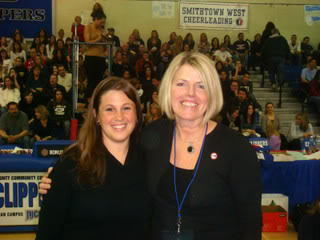
SmallVarsityFinals08036
Shortly after being honored at my last competition in 2009 with my “5 year” coaching pin, pictured with current NYSCJA Vice President Nancy VanHouten 

After that one year with JV Blue, Smithtown High School split into East and West campuses. I was appointed Varsity coach at West, which is where I coached until I eventually “retired” in 2009 to focus on finishing my administrative degree. In that remaining time, I worked with first-place teams and last-place teams, good kids and troublesome kids. Some of the girls I’ve coached have grown up to become colleagues and lifelong friends. But  – as many teams as I coached throughout the years, none was quite like the JV Blue team from 2004-2005. In my opinion, that was the year I finally learned how to coach.

Cheerleading is still a big part of my life today.  My involvement with the Section VIII and Section XI officials associations, CHSAA and the New York State Cheerleading Judges Association connects with that love of cheer that I developed at 11 years old. It wasn’t until reading Chapter 1 of Futures-Based Change Leadership by Dr. Richard Bernato, one of my professors at St. John’s University, that I made a connection to the leadership theories of Peter Senge and Otto Scharmer to coaching cheerleading. In the middle of writing this blog post, I connected to one of the earliest texts I read on leadership (and one of my favorites), Principle-Centered Leadership by Stephen Covey. To an extent, I think a lot of these theories are intuitive. Today, with the benefit of continual learning, I can articulate how the mistakes I made and the changes that followed connect to leadership theories. It’s an “a-ha” moment that arrived a little late…but at least it arrived.
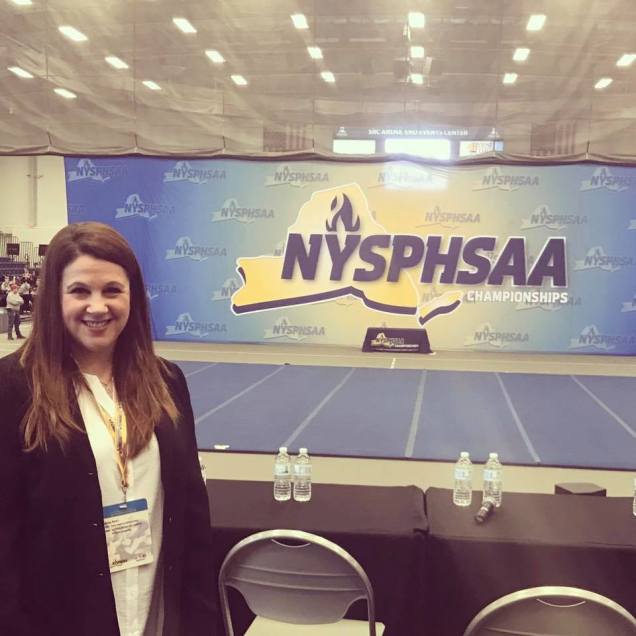
headjudge
Here I am in March 2017 before serving as “head judge” at the NYSPHSAA Cheerleading State Championships in Syracuse – approximately 20 years after I started coaching.

“Hybrid” Reading Strategies (because Johnny 5 Needs Input & There’s Never Enough Time)

Do you remember this movie from the 1980s? I loved it!

https://youtu.be/Pj-qBUWOYfE

This scene, actually, sums up how I feel in my dual role as an English chairperson and a graduate student. There’s so much “input” that I want and need; if only I could process everything as quickly as Johnny 5! Instead, my own reading is a slow process. Sometimes the only time I have to sit down and read is when I’m winding down for bedtime, and there’s a small window of “input” opportunity before my eyes begin closing, my vision blurs, and I’m snoozing before I get to the end of a page.

I have so many goals for reading this year. In no particular order, they are to:

  1. discover high quality young teen books that might be popular with the middle school students I work with
  2. catch up on the contemporary YA reads that the high school kids are buzzing about
  3. read some of the canonical classics that I missed in high school in college (I guess to continue flexing the part of my brain that formerly taught AP Literature and Composition)
  4. read the assigned texts for both of my cohort classes
  5. read the buzzworthy professional texts related to best practice in English and literacy education
  6. read the buzzworthy texts on leadership that are useful for the professional growth of any school administrator
  7. read the books I want to read!

All of this is a pretty tall order, and there’s simply not enough time in the day to read as much as I want to… which reminds me of another pop culture reference:

So – I can’t be Johnny 5, and there will never be “time enough at last” to get all of this reading done, so I came up with what I think is a pretty good solution which I’m calling hybrid reading.

I was tasked with reading Thank You for Being Late: An Optimist’s Guide to Thriving in the Age of Accelerations by New York Times columnist Thomas L. Friedman for one of my classes. While the premise of the book was intriguing to me, the length (500+ pages) was downright intimidating. As well, I’m not well-versed enough in concepts of globalization to fully “get it,” so it took a while to “get into it.”

There was no way I was getting through 500+ pages of dense text in 5 minute-before-sleep increments, but I did find a way to increase my available reading time… during my commute to work.

That’s right – it takes me approximately 35 minutes to drive to work each way (sometimes a little shorter if I manage to avoid rush-hour traffic home), but I typically spend that time listening to the radio in the car. Why not put that 1 hour a day to better use?

I downloaded the Overdrive app to my iPhone, and using my public library account, I was able to download an audio version of the book. On long drives, I would pick up a section of the book where I left off in my reading. When I got home and could use the physical book, I was able to skip ahead several pages to pick up where the audiobook left me.

Now this wasn’t always a perfect idea. As happens to many of us as we’re driving, my mind tends to wander. My drive in to work is particularly a difficult time to focus, as my mind is running the mental “to-do” list for the day ahead. When I found that I was too distracted, I would turn the audio off, turn on some music on, and let myself go.

This system works for me, though. It allows me to maximize the time I typically use during my commute to gain some time for “input.” Furthermore, having access to audiobooks allows me to “read” when I’m doing other things that don’t demand a whole lot of mental energy… enjoying a walk, folding laundry, cleaning the kitchen.

Sometimes I’ll come across a particularly engaging portion of a book on audio that I want to go back and examine more deeply in the text. It’s easy enough for me to “bookmark” the location by taking a screenshot of the chapter and location, then go back into the physical text and find the passage I’m looking for to highlight or annotate.

I definitely recommend this strategy for anyone who has an awful lot of reading to ingest and not a lot of time to do it. It’s amazing to me how much more I learn on long car rides and how many more books I can get through in less time!

Snow Days

This has been a winter of discontent. As I sit here and write this, I’ve already received the call from my district that we won’t be open tomorrow. A fourth nor’easter is forecasted to drop anywhere from 4-15 inches of snow on Long Island tomorrow. No joke, that’s what I read on an news alert shortly after I woke up this morning! The last two storms that came through were slightly misforecast in regards to snowfall, so I suspect the weather forecasters are playing it safe with this one. Give a big range and hope for accuracy.

I don’t mind having the unexpected day off. Honestly, it’s an opportunity for me to do some deep work on my class assignments, which (for the most part) I’ve been completing a little at a time on weeknights when I come home from work. That’s not really the optimal time for me to do anything that requires such focus, as I’m usually pretty shot from the day.

Days off, for snow or otherwise, were in short supply this fall and winter. Most Saturdays included back-to-back classes running from 8am until around 4:30pm, and many of my Sundays were devoted to judging cheerleading competitions here on Long Island. With cheer season ending in mid-February, I’ve been trying to get used to having a weekend day off again, and the ironic “abundance” of free time was a little weird for me. While I so badly wanted to use the days to load around my house in sweatpants and binge-watch Netflix all day, I felt almost guilted into doing “productive” things – laundy, grocery shopping, house cleaning, and the occasional social event. Rarely were chunks of time on those days allotted for the kind of deep work needed for reading chapters of complex doctoral texts filled with the vocabulary of the dissertation process.

But a snow day is a blessed “bonus” day. Since I used this past Sunday for errands, I can devote plenty of time (presumably with plenty of night-before sleep) for deep work.

And that’s what I’ll do. I’ll give myself a few hours in the morning to get some obligatory things done. Hopefully I’ll even get to the gym. After that… deep work.

Did you notice that this blog post is basically a pep talk for myself. Well, yeah… that’s what it is. Because no matter how I much effort I make into making plans for using my time tomorrow, who knows if I’ll succumb to the pressure of enjoying a snow day for what it should be: sweatpants and binge-watching Netflix.

5…4…3…2…1…

“Remember that you are in a launch window right now. You need to focus on the launch.” — C. Issacoff, Ph.D.

In the Fall of 2017, in the midst of navigating my first few years as a school district administrator and as new homeowner, I decided to go back to school one more time. Balancing the demands of my doctoral program with my personal, family and career obligations has been pretty demanding at times. Someone who I respect immensely equates my present situation to a launch window, a term used to describe a time period in which a particular mission must be carefully managed in order to be successful.

I started this blog to journal my experience about everything and anything related to the launch.

My most recent post is below this one. Thanks for visiting!

Backdated Post: Autoethnography 

One of the assignments I wrote for a class in the Fall 2017 semester was an autoethnography, which was explained as an essay that presents one’s development as a leader-researcher, including a personal history of what led up to pursuing a Doctor of Education degree. 

I didn’t love the assignment. In fact, the first thing that came to mind was the infamous first line from Salinger’s The Catcher In The Rye (1951): “If you really want to hear about it, the first thing you’ll probably want to know is where I was born, and what my lousy childhood was like, and how my parents were occupied and all before they had me, and all that David Copperfield kind of crap, but I don’t feel like going into it, if you want to know the truth.”

I wanted to do something a little different than write some boring autobiography of “myself as a learner,” so I tried to get a little creative. I chose a word – “hustle” – and wrote about myself through the lens of its various meanings. 

Now some of this did get a little personal, as it was supposed to. I am leaving some of the personal family history stuff off of the Internet, but here are some excerpts safe for public consumption:


HUSTLER \ˈhə-slər\ noun

  1. A person adept at aggressive selling or illicit dealing (Oxford)

  2. A prostitute (Oxford)

I’ve never had a problem writing that first paragraph of my cover letter… the one where I market myself by sharing insights about the qualities that make me an ideal employee for such-and-such school district.

The one key detail that I wanted prospective employers to know about me is that I am a hustler.

You’re probably thinking that’s  poor word choice on my part, and I’m not surprised. The word “hustler” has negative connotations, despite the fact that not all noun forms “hustle” are negative. Your initial gut reaction to my use of the word connects directly to the background knowledge that activated as you read it. If you felt that I’ve made a poor choice of words to market myself, it’s because your personal context of the word is negative.

The definition of hustler provided above is from the OED, which I consider an authority when it comes to defining words for academic purposes. A definition from Cambridge is similar: “someone who tries to get something, usually money, by deceiving others.” Rest assured I am neither of these, but both dictionaries offer definitions of the word with negative connotations, which are noted to be connected with informal or colloquial speech in North America.

Simple Internet searches allowed me to examine the etymology of the word, tracing is back to its roots in Middle Dutch. Hutselen, used in the late 17th century, is an intransitive verb meaning “to shake or toss.” in 2010, Pennsylvania historian and vocabulary enthusiast Douglas Harper offers additional uses of the word in his Online Etymology Dictionary, defining “hustle” as a  “pushing activity” or an “activity in the interest of success,” which was a common use of the word in the late 1800s. Today, most people associate the word “hustler” with a “swindler” or a “crook.”

I’ll be honest, I do not write “I’m a hustler” in any cover letter or description of myself anywhere in any capacity. Instead, I will use the term only when speaking and will do so only if I sense that I’ve managed to build a new context of the term for my audience. If, by the end of the interview, I’ve convinced the recruitment team that I am a highly-motivated, driven individual who is willing to “roll up my sleeves and get to work” to further the mission and vision of the school district, then I have presented myself as intended.

HUSTLE (n.) a popular dance often connected with the disco-music era of the mid-to-late 1970s.

When I received a flyer from my building principal announcing that St. John’s University planned to offer a doctoral cohort within the district I was (and still am) in an awkward state of flux. Within the last three years, I have been “dancing” through a number of significant life changes. My parents decided to enjoy their retirement in Florida. As they sold their home in New York, I hired a realtor to list my small condominium knowing that I would need a home large enough to accomodate out-of-town guests. Before these decisions were made, I had already sent out resumes for administrative positions. Within the period of three months, I had a buyer on the condo, I had an offer from an outstanding new district, and I fell in love with a home just slightly out of my price range. In this instance, I ignored logic and moved purely on emotion, promising myself that I would “hustle” to make it happen. The thought of going back to school to get a Doctor of Education degree had intrigued me for years, but concerns about time commitment and financial investment at a time when time and money are particularly scarce prevented me from looking into the matter further. That is, until I showed up at the meeting advertised on the flyer and learned of the articulation agreement between Stony Brook University and St. John’s. Being able to start this program in media res made the big concerns much more manageable. In addition, kind colleagues who believe in me have graciously offered me their St. John’s University College Advantage Program credits to help me along in this journey.

The struggle now is managing my time so I can be an effective administrator and a successful student. But, similarly to how The Hustle is a choreographed sequence of events that loops until the song ends, as long as I am employed as an educator, literally or figuratively, I will also always be a learner. I believe I have selected a dissertation topic that not only taps into a personal area of interest, but also will help me to become more effective in my role as District English Chairperson.